|
(Easter Sermon at Shantz Mennonite Church, preached March 31, 2024) While Christmas may be the most popular holiday within the Christian tradition, the celebrations of Good Friday and Easter are seen as the essence of Christianity. However, many Christians, like myself, have struggled with how to develop a theology that integrates the suffering of Good Friday with the resurrection of Easter. In this blog, I plan to share my story of how I have come to see the suffering of Christ as the essence of the Resurrection experience, but not in the way that most evangelical or Catholic churches believe. Some churches stress how Jesus had to suffer for the sins of humanity, and if we personalize this by believing that Jesus died for our sins due to some form of moral requirement from God, we will experience God resurrecting us from the guilt and shame of our sins. In this view, Jesus' crucifixion is seen as the essence of Easter. However, some theologians have noted that when you believe this framework of Good Friday/Easter, that Jesus had to pay the spiritual debt caused by human sinfulness, the historical event of Easter is no longer needed. All the conditions necessary for the salvation or healing of humanity are found in the historical crucifixion of Jesus. In contrast, other churches highlight what happened on Easter morning, the tomb being found empty, and women and men followers seeing the resurrected Christ. This resurrection event is seen as the key to Easter. For these churches, the suffering of Jesus shown through his crucifixion is a reality that should never have happened, and thus the suffering of Jesus for our sins is not needed for the resurrection event to have happened. 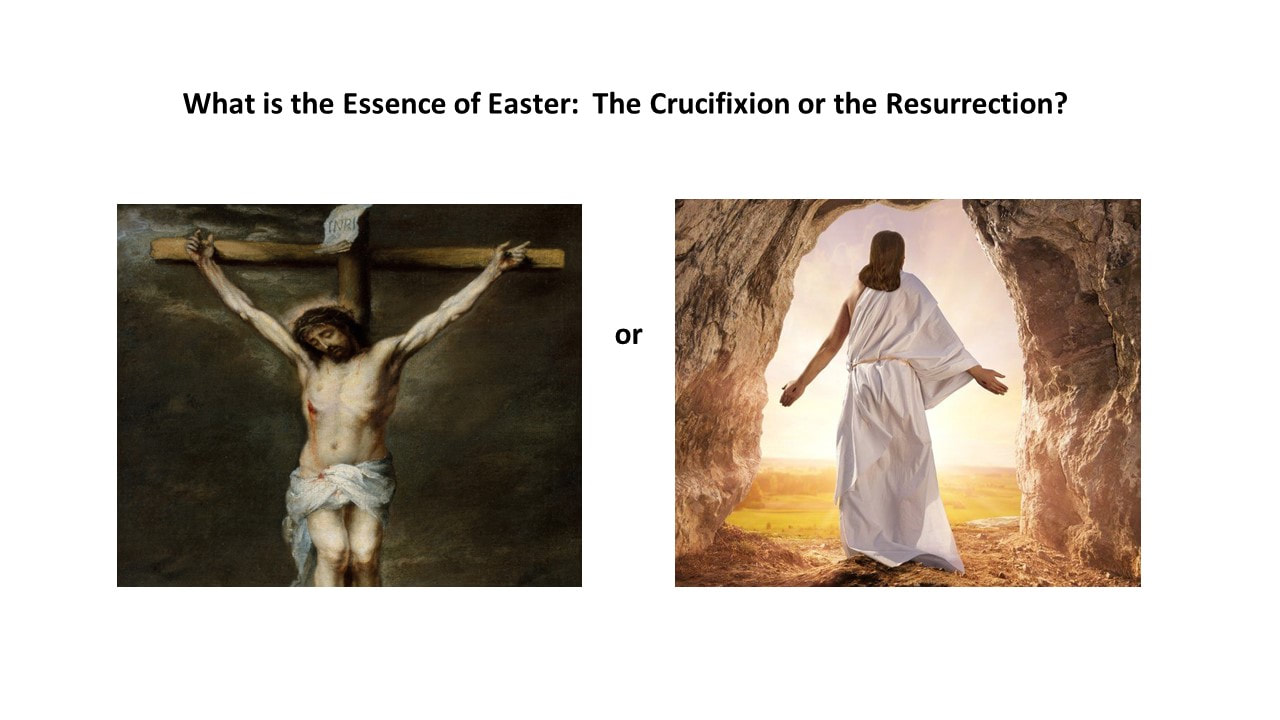 But is this true? I have found both personally and in my ministry that there is something about the suffering of Jesus on the cross that speaks to people. What follows is my attempt to capture that mystery and how the suffering experience of Jesus's crucifixion is essential to people encountering the resurrection/salvation experience in their lives. Throughout my lifetime, I have celebrated Good Friday and Easter in different ways. As a child raised in the United Church, I have no memory of attending a Good Friday service. The focus was Easter Sunday with the emphasis on the resurrection of Jesus. I suspect efforts were made to include aspects of the crucifixion of Jesus in the Easter service or in the Palm Sunday Service, the Sunday before. But the focus was on how God raised Jesus from the dead, and God’s resurrection power, and that there was life after death. When I entered Grade 13, my parents allowed me to start attending a small Mennonite church that had a MYF youth group full of many of my friends. Here I discovered that Mennonite Christians celebrate Good Friday, and often this service involved the reliving of Jesus’ last 24 hours on earth: the last supper in which Jesus celebrated the Passover Feast with his disciples, Jesus washing his disciples’ feet, Jesus praying in the Garden of Gethsemane asking God to take away his cup of suffering, the betrayal of Jesus by Judas, the arrest of Jesus, the denial of Jesus by Peter, the trial of Jesus, the nailing of Jesus to the cross, Jesus final words on the cross, “My God, My God, why have you forsaken me”, and then his final breath. In reliving this tragic day during the Good Friday service, I really experienced the suffering of Jesus and saw the weakness and sinfulness of people and how evil can cloud the minds and hearts of humans, even to the point of killing an innocent man like Jesus. 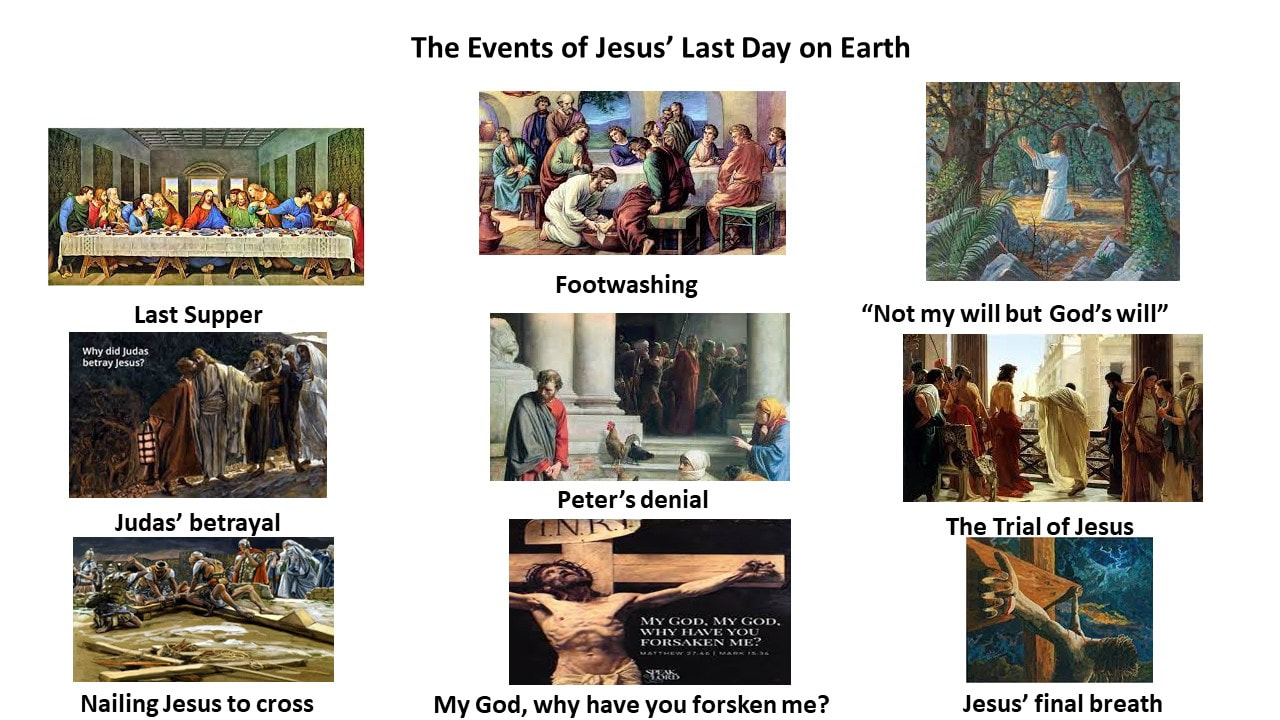 When I experienced the celebration of Good Friday for first time, I was captivated. This service touched all the senses of my body and soul…the washing of my feet (footwashing is practiced in many Mennonite churches), the drinking and eating of communion, and the sorrow of my heart. I still remember celebrating Good Friday services when I heard the hammering of the nails symbolizing the hammering of nails into Jesus hands. All that was missing was the moaning of Jesus dying on the cross…and the crying of the crowds who watched at a distance…but I could easily imagine these. The Good Friday service was far more than a lesson on theology about why Jesus had to die on the cross. Good Friday is a day when we recognize all the pain and suffering that happened on Good Friday. Personally, I have struggled in calling the day Jesus was crucified as Good Friday. For me, there is nothing about Good Friday that is good. It is day full of suffering and pain. Yes, I am aware of the Crucifixion theology that is common in many Christian churches, and it appears in some of our favourite hymns that we sing on Good Friday and Easter. Even my favourite Easter song, “When peace like a river” has this crucifixion theology. This theology stresses that Jesus suffered on our behalf, that Jesus had to die to pay the spiritual penalty of human sin on the cross so that humans could be free from the power of sin in our lives. This is seen as the goodness behind the day of Good Friday. But I struggle with this crucifixion theology for it does not fit with how I have experienced the healing that comes out of the Good Friday-Easter story, both within my life and my counselling practice. I have struggled with any Crucifixion theology that has tried to dismiss the evil and wrongness of what happened on this day by claiming that it was part of God’s will, a common theological belief in both the Evangelical and Catholic churches, although they possess different understandings of how Jesus' suffering is part of God's will. It makes little sense to me. When my two brothers died from HIV-AIDs in the 1990s, I could not, and still don’t believe that their suffering and death was part of God’s will and plan for their lives. I hold the same belief around Jesus’ death. Jesus’ tragic death should never have happened. It was caused by the dynamics of Evil and sin at work within human beings. It had nothing to do with God’s will. But as we all know, Good Friday is not the final act of the Good Friday/Easter story. It is the first act of the story, a story of much pain and suffering, but the story is not complete. Furthermore, it seems that the suffering experience of Good Friday does prepare the way for the resurrection power of Easter to come. To help you understand what I mean, let me tell you my crucifixion story, the time when I found myself uttering similar words to what Jesus uttered on the cross, “My God, My God, why have you forsaken me?” It was back in Aug, 1992 when I watched my brother Jamie (picture of him below) die from HIV/AIDS in Victoria Hospital in London, Ontario. I was in the midst of my training to be a Mennonite pastor, just completing my third year before heading to seminary at AMBS in Elkhart Indiana to finish my final year of training. 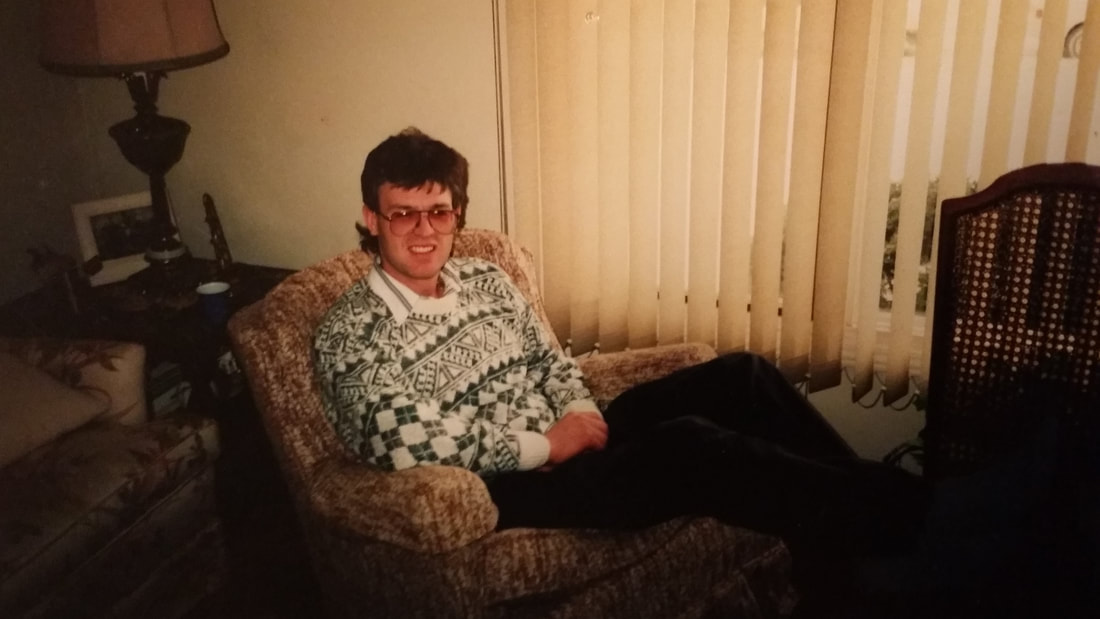 My family had known that both of my brothers, Kevin and Jamie, were HIV positive in 1985 when they were finally able to test for the presence of the HIV virus. My brothers had both got the HIV virus through the blood products they took for their blood condition, hemophilia. While Kevin was still asymptomatic, Jamie had been fighting different issues related to HIV/AIDS for at least 3 years by 1992. I had prayed often for God to heal Jamie from his disease and to cure him. A month before he died, I remember preaching a sermon at First Mennonite Church in Kitchener as part of my pastoral internship where I shared my struggle with my Christian faith, and how I was angry at God at his lack of involvement in helping my brother stay well or get better. I remember my Father asking me to lead a final prayer time with my family and my brother Jamie, barely conscious, was able to participate as part of this prayer. We prayed for healing but we also prayed for strength and comfort if healing didn't happen. A couple days later when Jamie breathed his last breath, I went totally numb. My faith was in shambles. I had no sense of God’s presence. “My God, My God, why have you forsaken me.” My Dad chose to have 4 visitations, much to my chagrin. I had no desire to be around people in this state of forsakenness, but I endured it. Throughout those visitations, my heart felt numb and dead, no sense of life. The day of the funeral came at Lucknow United Church. The church was packed with over 200 people. The service began with my family walking into the front of the sanctuary from the side door. As I walked in, I could see the many faces of the people in the pews…and they were all filled with tears. Up to now, I saw God as a distance observer, just watching me in pain. But as I saw all those people weeping over the loss of my brother, a deep realization washed over me. I suddenly realized that God was crying with me, that God was in as much pain as I was as was evident in all the people crying that day. As that realization soak in, it is like my heart split open, and I began to sob deeply: tears of pain but also tears of joy bubbled up inside of me,. God had not abandoned me after all…and I was so grateful. God was faithful after all, not in the sense of healing my brother, but in the sense of God's spirit being with me and my family and this faith community as we suffered in grief and pain together. The funeral service, that I had dreaded going to, became for me, after that profound realization, an Easter service. Everything shared took on a very different light. Rather than being a day of just pain and sadness, it became also a day of much celebration of who Jamie was. But for me to encounter that Easter experience, I had to discover God in the midst of my suffering. I had go through the suffering of Good Friday to discover the new life that God provides on the other side of the cross. Normally, during Easter Sunday worship, we hear one of the 4 resurrection stories found in the 4 gospels, but I want to begin our Easter reflections from a different place. I want to start with Apostle Paul's reflections on the resurrection. Many church attenders don’t realize that the authentic letters of Apostle Paul were all written before any of the gospels were written…at least a decade before the earliest Gospel of Mark which most scholars speculate was written in the late 60’s CE. In the image below, we see Apostle Paul's written words from his first letter to the Jesus believers of Corinth. 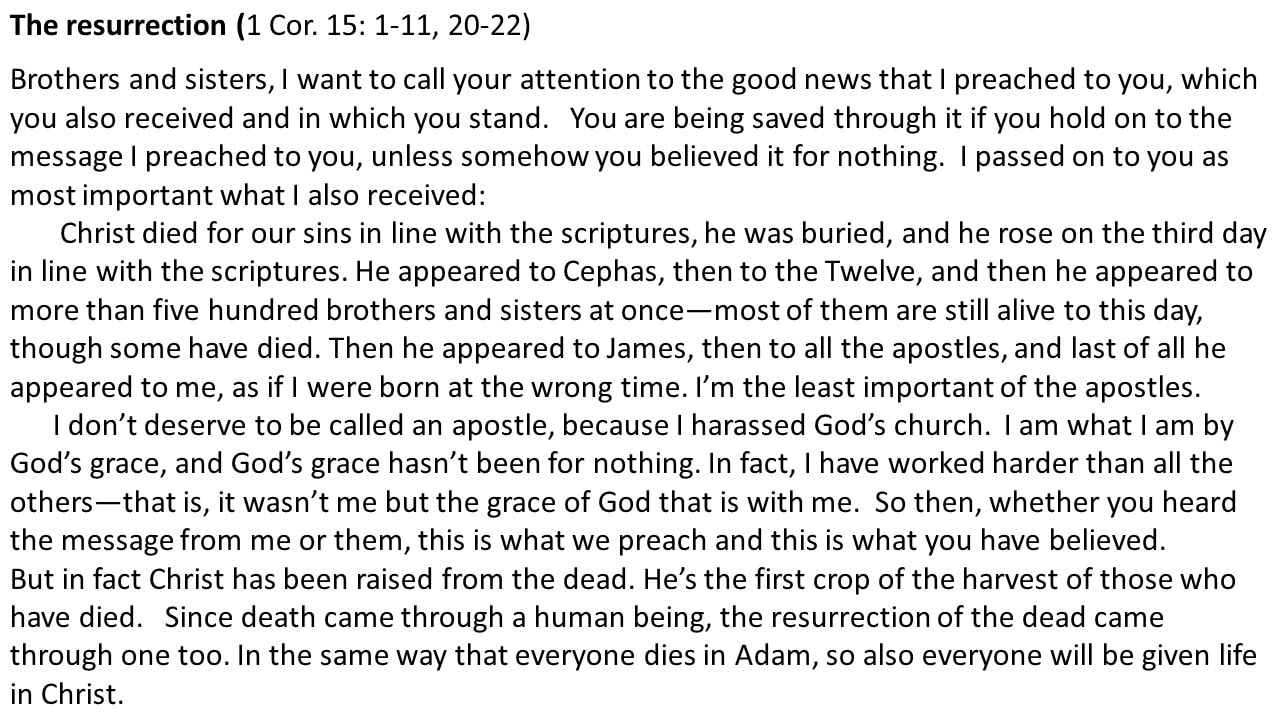 What I want you to notice in this reading of Apostle Paul is that there is no mention of the name Jesus, the name associated with the human man Jesus. The focus is on Christ, the resurrected Christ…the Spirt of Christ that lived within the human Jesus. This Christ died for our sins, was buried, and arose on the Third day, then he appeared to Peter, called Cephas in this text, then the 12 disciples, then to more than 500 brothers and sisters at once, then he appeared to James, brother to the human Jesus, then to all the apostles, and then finally to Paul. Apostle Paul writes that he is the least important of the apostles. He writes, “I don’t deserve to be called an apostle, because I harassed God’s church. I am what I am by God’s grace.” For Apostle Paul, the experience of the risen Christ has no sense of the human Jesus. There is no mention anywhere in Paul’s writings of anything about Jesus’ earthly life, his virgin birth, his healings, his teachings, his miracles, etc. It seems that Paul knew nothing about the earthly Jesus. Instead, Paul’s relationship with the Risen Christ began on the road to the Damascus when a bright light blinded him, and the voice of the Risen Christ spoke to him from this light. It is here that Apostle Paul encountered the Risen Christ for the first time, and as he developed a relationship with this Christ, he soon discovered that this spirit of Christ actually lived within him. 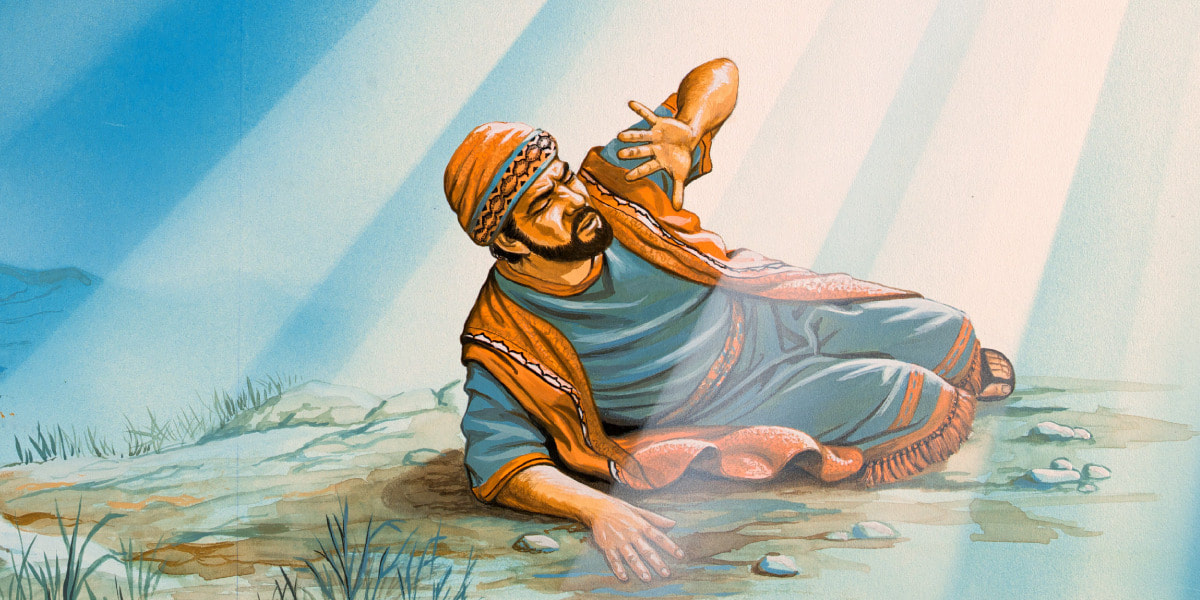 In one of his earliest letters, his letter to the Galatians, Apostle Paul writes, “I have been crucified with Christ and I no longer live, but Christ lives in me. And the life that I now live in my body, I live by faith, indeed, by the faithfulness of God’s Son, who loved me and gave himself for me.” (Gal 2: 20). For Apostle Paul, the Risen Christ was no longer a spirit out there in the world, like a ghostly spirit separated from him. Rather, the Risen Christ had become an indwelling Spirit of Christ that lived within him. This is why Apostle Paul talks about being "in Christ" or "in Christ Jesus" so much in his writings...over 60 times in his letters. He is not talking about his belief in Christ, like many Christians do today. Rather his Christian faith arose from him noticing the spirit of Christ arising in different ways within him, within his mind, heart, body, and soul. In many other places in his writings, Apostle Paul describes the different expressions of the indwelling Christ within him as the workings of God’s Holy Spirit. Those words of Apostle Paul where he describes "being crucified with Christ" capture for me how we experience Easter through the sufferings of Good Friday. I have revisited many times my resurrection experience around my brother’s Jamie’s funeral. In doing so, I realized that this was my crucifixion experience…when I was crucified with Christ…when I discover the spirit of Christ suffering with me in my anger, pain, and grief of losing my brother Jamie. When I realized this, that Christ or God was in as much pain as I was, the walls of numbness between Christ and me came tumbling down, and I found the spirit of Christ living within my body and soul and life after all. I also found a profound compassion and grace flowing toward my emotional, mental and spiritual pain, and profound relief and gratitude arising within me. One could see those walls of numbness as curtains that separated me and thus made it impossible for me to experience the gracious presence of Christ in my life. Those curtains needed to be split in two. At the centre of the Jewish Temple in Jesus' time, there was a room called the Holy of Holies where the Ark of Covenant resided. It was believed then by the Jewish people that God's spirit resided with this sacred place. This room was totally curtained off and only the high priest could enter this holy space on the Day of Atonement, once each year. All four gospels highlight the fact that when Jesus died, this curtain in the Temple was torn into two, a sign that the presence of God was no longer meant to be hidden away from humanity behind this curtain. God was no longer meant to be seen as separate and indifferent to human suffering, if that was ever true. Rather, this torn curtain symbolized the truth that God experiences all the sufferings that we, humans go through....and in response, we sense Christ or God's Holy Spirit responding to our pain.  When we realize that Christ is suffering within us in our pain, our anger, guilt, despair, anxiety, grief, or doubt, this curtain of numbness within our soul or inner sanctuary is ripped in two, and we discover that Christ is both experiencing deeply our pain, but also responding to it through the spirit of compassion, grace, insight/truth, etc. As this healing response emerges, we sense some form of resurrection happening to us, within us, and beyond. My Easter experience has caused me to realize that the Spirit of Christ lives within every person, within each of you…even within a person like Paul who was persecuting Christians for he saw them practicing a false and dangerous faith. But when he experienced blindness and suffering, and found Christ in the midst of his crucifixion experience, Easter happened for Paul, and he never looked back. He became a new creation, a new human. This realization that the Spirit of Christ lives within the soul of each human being is profound. The gospel of John describes this connection between Christ and human beings in this way. God is seen the vinegrower, Christ is the vine and each human is a branch on this vine. The gospel writer has Christ Jesus teach, "If you abide in me and I abide in you, you will produce much fruit. Without me, you can do nothing." (John 15: 5). This image of Christ being the vine and we, humans, the branches, suggests that Christ experiences everything we experience. If we are in pain, Christ the vine will feel this pain, and thus will respond to this pain with the hope of healing this branch.  During a Lenten worship service this year, our Children's Time leader shared a demonstration that vividly illustrated for me what happens to us when we become aware that Christ lives within us. He had two jars that were full of water and appeared identical. In one jar, he placed an egg, and it floated to the bottom: the water could not support the egg. But when he placed the egg in the second jar of water, the egg floated. (The children didn't know this but there was salt in the water of the jar where the egg floated. ) When I saw those two jars, I realized that the Children's Time leader shared the perfect picture of what happens when the numbing pain walls within our soul come down and we discover the spirit of Christ abiding within us. For me, the jar with salty water represents the soul of each person. For many people, they are totally the oblivious to the movement of Christ’s spirit within them and thus it remains dormant. Or people are totally resistant to any idea of God being active in the world, let alone God’s spirit living within them. The have an internal curtain or wall ...like I had when my soul was numb due to my anger at God for not healing my brother. As a result, these people experience life like that egg that floats to the bottom of the jar. We experience little to no spiritual support in this world or in our lives from God. We are not open to God’s Spirit moving within us. We believe the Indwelling Christ does not exist within us. As a result, we have to create all of our support...from our striving and efforting or if we are able to reach out, from the support of others in our lives who show care for us. 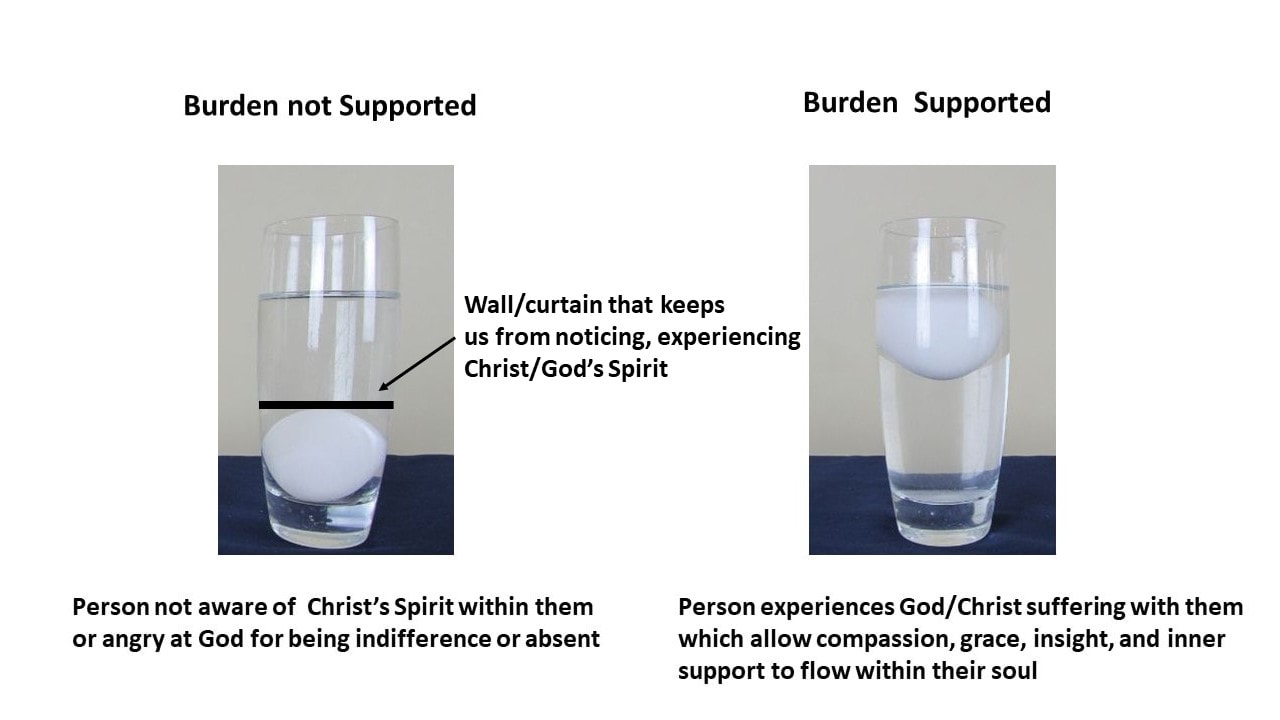 However, when people discovered that Christ’s spirit lives within them, then suddenly they notice the dynamics of God’s spirit working within them and beyond them in the world around them. So how do we discover or notice this Christ Spirit at work within our lives? My brother Jamie died in August. I still remember the phone call I got from my parents in January five months later when Valerie and I were at seminary. They were phoning down asking me to give them permission to adopt a young boy. I knew that they were trying to replace my brother Jamie through this adopted boy, to somehow relieve the pain they were feeling inside. I also knew that I had to say no for it would not be fair to any boy they adopted to live with the emotional burden that my parents would be placing on them. But then I got this inspiration, and it came out of nowhere. I said to my Mother…”Mom, you always wanted a daughter. Why don’t you become a Big Sister within the Big Sister program to a young girl who does not have a mother….and Dad, why don’t you become a Big Brother within the Big Brother program to a boy who has lost their father.” My parents took my advice to heart. My Mother became a Big Sister to a young girl and my Father became a Big Brother to a young boy. It was a very healing relationship for both of them at that time, a helpful place to direct their attention and energy…although it became also challenging at times, especially years later. But God had further surprises to my family. The little boy that was matched with my Dad lost his father to the reality of HIV/AIDS. My Dad was the perfect Big Brother for him. This truth that Christ lives within all of us, that we are all connected to the vine of Christ, now flows into my counselling ministry. When I see people suffering in their lives, I know that Christ is suffering with them for we humans are connected to the vine of Christ. If any of one of us are suffering, Christ is feeling this suffering too. For me, this is a given, undisputable for I believe that if I can feel the pain of my client in the counselling room, then Christ must also be able to sense this same pain. This suffering may be anger at life, others, even God. This suffering maybe depression or despair, maybe anxiety or fear, maybe abandonment by God or others, maybe guilt or profound shame. Whatever we are experiencing, Christ is experiencing with us. This is our experience of the Cross, of Good Friday. The challenge in my work is how to help people realize that Christ is suffering with them. If they can’t realize this truth, then they will experience life like that egg that floated to the bottom of the jar. They will often feel totally unsupported, alone, abandoned, angry, resentful, etc. They will frequently become stuck in the suffering of Good Friday. However, if I can help my clients realize that God is suffering with them, that Christ understands and feels their crucifixion experience, that is when the curtain in their heart rips open...and a new conversation opens up exploring how God or Christ is with them in their suffering. These conversations are often quite rich. Sometimes, my clients can't make this leap of faith and so I focus on helping my client realized that they are not alone, that I deeply feel and appreciate what they are suffering with. I do this with the hope that by me standing in for Christ, in the future I can eventually help them realize that the Spirit of Christ lives within them as well as me. When that occurs, the client's experience of God being within them in their crucifixion opens up the doorway to their resurrection. Clients are often quite surprised when I suggest to them that God is just as angry as they are at what has happened to them or their loved one. If they are feeling in despair or abandoned by God, I suggest that Christ understands what that might feel like for Jesus went through a similar abandonment experience. If they are feeling guilty, ashamed, anxious or grief, I suggest that Christ is able to appreciate these intense feelings too for Jesus felt it with Peter when Peter denied him or Jesus sensed it with Judas when Judas betrayed him, or Jesus was deeply moved by Mary Magdalene on Easter morning when she was so bereaved. There is no feeling that God/Christ has not experienced first hand and does not understand. Once clients realize that God/Christ feels their suffering deeply, that is, they sense Christ entering and responding to their human cross experience, this opens the door for clients to live into their Easter healing experience.  When we see the Good Friday/Easter event in this way, it becomes quite evident how the suffering of Good Friday opens the door to the new life found in the resurrection of Easter. Thanks be to God.
Gord Alton MDiv RP CASC Supervisor-Educator
0 Comments
What does it mean to listen and hear God’s voice? This was the question my pastor pondered over this morning (Jan 14, 2024) in his sermon as he explored the story of little boy Samuel hearing the voice of God for the first time. Hearing his sermon caused me to consider what is happening within our psyche when we pray. I wondered why is it so hard for us to pray, for us to experience the dynamics of God’s spirit in our life. I ask this question for most people I have met don’t have these divine encounters. They struggle more with the question, “where is God, or does God even exist?” I also wondered, “when we do have these types of divine meetings, what is happening within our human soul?" Finally, I wondered, “how do we know that what we hearing or sensing or experiencing is coming from the Spirit of God within our soul, and not from one of the fallen parts that are often clamoring for our attention?” In this blog, I plan to explore these questions, drawing upon teachings from the Bible but also insights from the Diamond Approach and Internal Family Systems, both modern day psychospiritual psychologies that I use regularly in my counselling and teaching. In doing so, I will be playing with the Christian mystic idea of the "inner room."  Why is the Word of the Lord Rare Today? This notion that God speaks to humans is a common teaching within the Bible. We have stories of God speaking many times to Moses, like the time when God spoke to Moses through a burning bush. We learn about how God began speaking to Samuel as a young boy, and then later in history when God spoke through the Hebrew prophets. In the life of Jesus, the scriptures allow us to see how Jesus had a close and intimate relationship with God through many alone times of prayer but also as he experienced God's spirit through interacting with people with teachings and healings. As we move into the years of the emerging Christian Church in the Bible involving Jesus’s first disciples and Apostle Paul, we see God speaking to many people through what became known as the God’s Holy Spirit. From these stories, it seems that God wants to speak to people, and that in the days of the early church, God spoke often and that many Christian people heard these insights. During the early church times, it is almost like a spiritual awakening happened with many early Jesus followers. Yet, I have found in my spiritual care work that most people don’t consciously pray often, and if they do pray, they would claim that they rarely experience God speaking to them. When I heard my pastor highlight the words that began Samuel’s story, “the word of the Lord was rare in those days”, (1 Sam 3), I said to myself, “this is also true now. The word of the Lord is rare today too.” Why is that? To answer that question, I want to turn to some words that Jesus taught in his famous Sermon on the Mount. He taught, “The eye is the lamp of the body. If your eye is healthy, your whole body will be full of light, but if your eye is unhealthy, your whole body will be full of darkness. ” (Matt 6:22-23). The common interpretation of the eye in these verses is the human eye, our biological eye that gives us vision to see the outside world. But this is not how Christian mystics understood this eye. Rather, Christian mystics understood this eye as our internal eye, or inner witness/observer, that part of our soul that makes it possible for us to be self aware and see the dynamics happening within our soul. Our biological eyes allow us to see in the outside world. Our psychic eye allows us to have inner vision, to see what is happening within our mind, heart, gut, and body, to see within our soul. 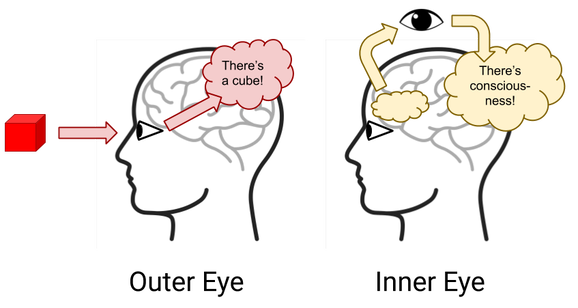 When our inner eye is healthy, this allows us to be self aware. When this happens, there is internal space between our internal observer and what we are perceiving. There is interior space between our sense of “I” and our feelings and sensations in body. There is space between our sense of “I” and our beliefs and thoughts. There is space between our sense of “I” and that part of us that acts with compulsive behaviors. When our inner eye is healthy, there is a spaciousness that makes it possible for us to perceive our thoughts, our emotions, our behaviors, our longings and motivations, our compulsions and impulsions, to perceive all the inner dynamics within our soul. When this spaciousness is present, our internal eye helps us notice how people’s words and behaviors affect us. If people’s words are kind, we will notice our soul and body relaxing and responding in kind ways. We will have kind thoughts, feelings, and utter good things to people. If people’s words are angry or dismissive, we will notice our soul and body becoming unsettled and agitated, even contracted, a sign of us becoming triggered and wanting to respond in angry or anxious ways and seek to protect ourselves. However, if our eye is healthy, we will see or sense this triggering process within us and possibly chose a response that will help us disengage from it and respond in a more helpful way. This experience echoes of what Jesus taught, “if our eye is healthy, our body/soul will be full of light.” To be full of light in our body/soul is to be fully self aware. You may not be familiar with this Diamond Approach term “inner spaciousness” that comes with having an inner observer. You may be more familiar with the experience of inner freedom that comes with that inner spaciousness. When we are able to be self aware and perceive these dynamics within our soul and body, we also have more freedom to choose whether or not we join with these dynamics. We now have more choice around how we engage our thoughts, feelings, and behavior, and often people find that quite freeing. When that happens, we are experiencing inner freedom. This is the gift of a healthy eye, a healthy internal observer. When we have a healthy eye, we now have the interior awareness to notice any dynamics that may have their roots in God. It is now possible for us to be prayerful. A clear and open inner eye allows us to notice the dynamics of God’s spirit arising within our soul. 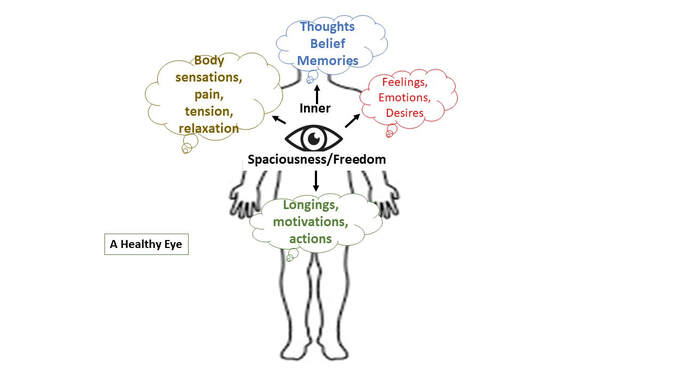 However, Jesus teaches, when our eye is unhealthy, our whole body/soul will be full of darkness. What does this mean? Our Christian mystic tradition has not done a good job of explaining this darkness except to teach that internal darkness means that we have little to no self-awareness, and that this darkness is caused by sin. But sin is often a loaded term full of much judgement. Furthermore, sin does not explain how an unhealthy eye causes our body/soul to lose self awareness and become filled with internal darkness. Here, I have found the Internal Family System teaching of blending so helpful. When we are triggered by someone's behavior, words, or appearance, our internal eye becomes blended or merged with a part within us that is being triggered. Lets say someone says critical words to us. When we hear those judgemental words, certain parts within us become triggered, depending upon what coping mechanism we have developed from our past. Some of us will become defensive and angry at that person. When our inner witness merges with that angry part, we become a different person, not the calm person we were a minute ago. All inner spaciousness and inner freedom disappears. We become an angry person full of angry thoughts and feelings toward that person, and that causes us to think, say, or do mean things to that person. When that merge happens, our inner eye becomes filled with darkness. We often lose all sense of self awareness for we are often oblivious to what we are feeling or saying until afterwards. 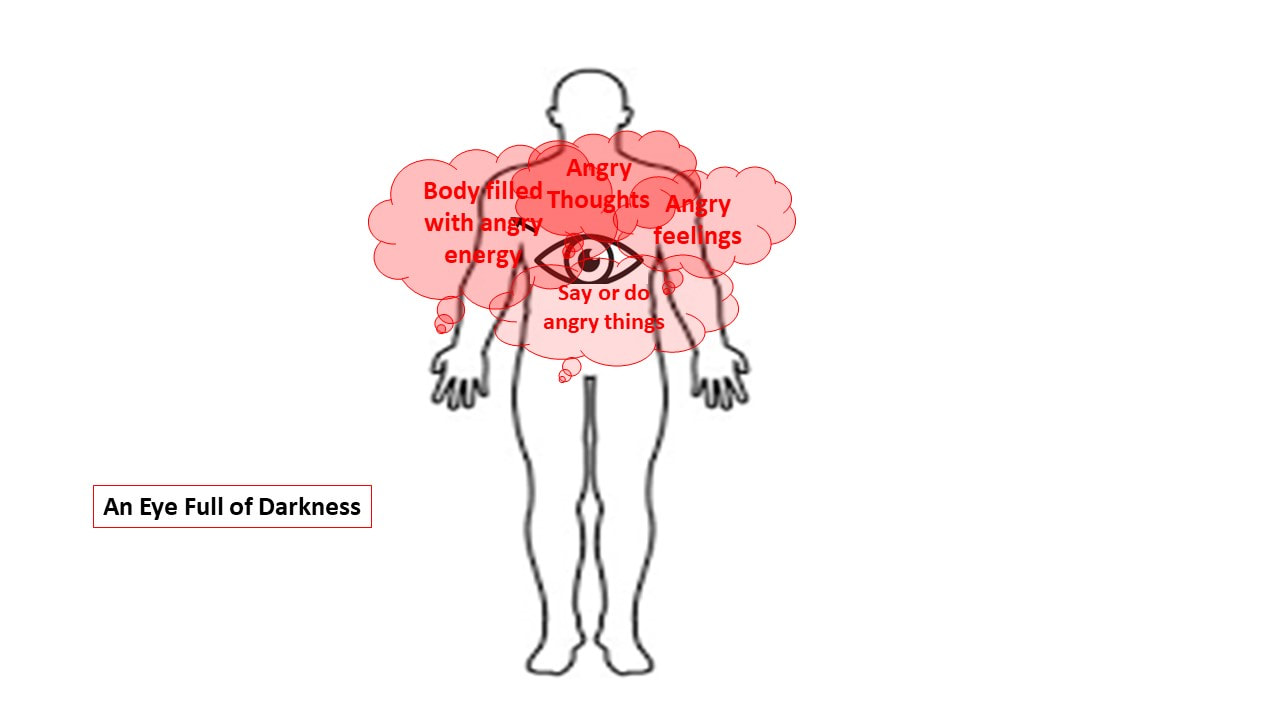 Instead of anger, some of us become very anxious when we hear angry words. When our inner observer merges with that anxious part, we also become a very different person, not the relaxed person we were a minute ago. We become a very anxious person full of scary thoughts, feelings of panic, and we seek to find ways to escape this difficult experience through emotional numbing, soothing our anxiety through eating or drinking, or simply leaving the situation with the goal of possibly never returning. This person or place is no longer a safe place. When we are in a triggered state, like I have just described, all self-awareness disappears. It is like when we put on a pair of dark sunglasses that make it impossible for us to see.  Our body/soul is full of darkness. We are often oblivious to our thinking processes, emotions, or behaviors in the moment and only become aware of them after the fact, when we are no longer in that triggered state. During our current times, it seems that many people are triggered most of the time due to the stressful dynamics within our world, our work settings, and our home and family life. This is especially evident in the polarizations we see around us in our world right now. When we are triggered by these polarizations, our sense of “I” has merged with a part within us that takes away our ability to see the goodness in the people of the other side. We tend to divide people into good or bad categories. We are good and they are bad. All we see is their darkness and we are often totally blind to the darkness present within us that is evident in our thoughts, feelings and words we say about the other side. Other people see and experience our darkness but we don't. When our inner observer is full of darkness and not able to be self aware, it is not possible for us to notice or hear the “word of God”. It is not possible to pray, to enter into a state of prayerfulness. If most people in our current culture struggle with interior darkness, it makes sense that the “word of the Lord” would be seldom heard today. Let us turn to my second questions, what are we noticing when we hear God’s voice or experience God’s Spirit? Perceiving God’s Voice and God’s Spirit To answer this question, I want to turn to another teaching of Jesus in the Sermon of the Mount. Here, Jesus stresses that prayer is less about what we do externally through spoken words and behaviors, and more about what happens to us internally. Jesus taught the following: “Whenever you pray, do not be like the hypocrites, for they love to stand and pray in the synagogues and at the street corners, so that they may be seen by others. Truly I tell you, they have received their reward. But whenever you pray, go into your private room and shut the door and pray to your God who is in secret, and your God who sees in secret will reward you “ (Matt 6: 5-6). The common way this scripture is interpreted is that we are to withdraw from the outside world and go to a private place, and in that private place, we pray with God. Prayer is often seen as disconnecting from the external world through retreats, or attending church worship on the Sabbath, or by going to a private place to pray, like Jesus did when he went to the mountain or wilderness to pray.  However, some Bible versions translate the Greek word behind “private room” as “inner room.” I think this “inner room” translation actually captures better what actually happens when we experience God interacting with our prayers. There is no doubt that the silence and disengagement that go with being in a private space help to facilitate prayer. However, when we realize that there is an inner room within our soul that we can create and nurture, that helps us begin to understand what prayer looks like. Part of the process of creating this inner room involves what we have already talked about. When our inner eye is blended with a structured part in our soul like anger, anxiety, or a compulsive behavior, there is no inner room present within our soul. There is no place to go internally to spend time with God in secret for there is no internal spaciousness. However, as we learn how to unblend from our triggered parts, this inner room opens up. An inner spaciousness opens up and we become aware of the inner dynamics that are happening within us…thoughts in our mind, feelings in our heart, urges and motivations in our gut, and other sensations in our bodies. 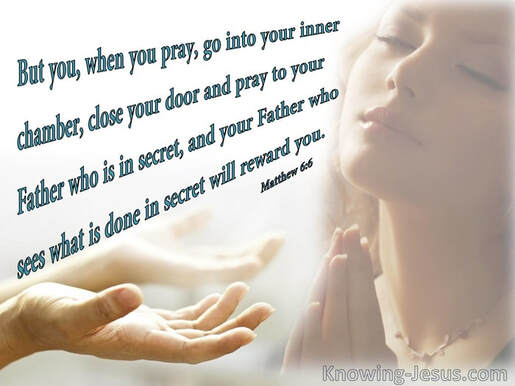 When this inner room emerges, we find ourselves often relaxing and settling into this calmer and spacious place within our body. It is here in this inner room within our soul that we discover, to our surprise at first, that God’s spirit actually lives here within us. This inner room is not just located in our heads, which is often where we sense our internal observer. Rather, it is situated more in our heart and gut areas of our body. And when we learn to spend more and more time in our inner room, we discovered that we can share with God in secret our most intimate longings of our heart. One scripture that describes this inner room is the text in John 15 where the gospel writer describes God as the vinegrower, Christ as the vine, and we are the branches. This text teaches that when we are aware of being connected to the spiritual vine of Christ, we will notice that Christ abides in us, and we abide with Christ. This experience of Christ abiding with us and we with Christ occurs in this inner room. This inner room is where we discover that Christ’s spirit lives within us. 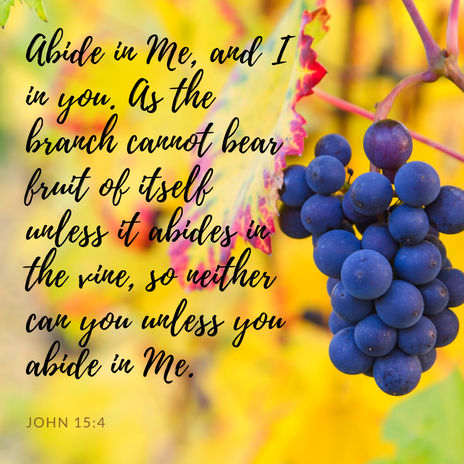 Sometimes, these personal prayers are more feelings then thoughts shared in silence with God. As we sit in silence with these prayers, we often notice that a response emerges to our prayers within this inner room. Sometimes these responses are words or thoughts that come to us….”you are not alone. I am with you” or “you are my beloved child.” Sometimes this response is the experience of Divine Compassion arises in us that causes us to say caring words to people struggling with pain or negative experiences. If we are personally wrestling with a burden, we may experience a sadness or compassion that actually arises and soothes our own pain. Sometimes, this response is one of an anger-like strength that emerges in response to wrongs we see happening in the world or to times when people dismiss a truth that we are trying to share. As we spend more and more time in our inner room, we eventually discover that all the gifts and fruits of God’s spirit flow through our inner room into our mind, heart, body, soul and life. These spiritual fruits include the ones that Apostle Paul writes about like “love, joy, peace, patience, kindness, generosity, faithfulness, gentleness, and self-control” (Gal. 5: 22-23). And there are many more. 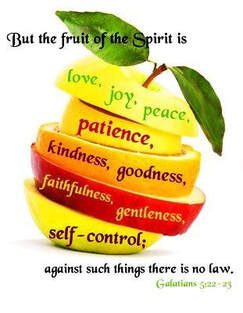 Discernment of Spirits: Which Ones come from God? Let me now turn to the final question: how do we know that what we are experiencing is coming from God and not from other fallen parts within our soul that are begging for our attention? This is a very good question. One of my key learnings from both the Diamond Approach and Internal Family System about this inner room is that God’s voice is always gracious and loving. There is no judgmental attitude or feeling within God’s voice. I have discovered that some Christians confused God’s voice with their inner critic voice, a voice that many people have that compares them often to an ideal standard and critiques them every time they fail or might possibly fail to meet this standard. Often, within our Christian songs, Jesus is portrayed as the Gentle Shepherd. When we become aware of this Christ voice in our inner room, it does have a gentle caring gracious tone to it that wants the best for us and sees the best within us. 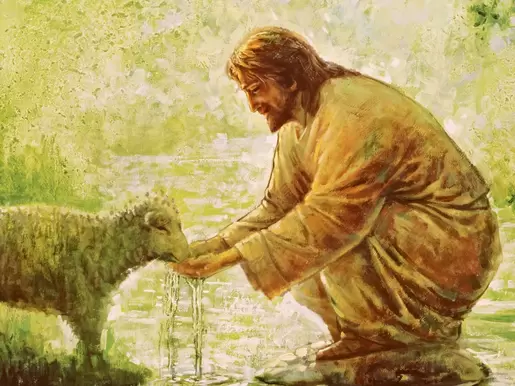 Any thought or internal voice that is judgmental or critical is not a God-voice. Rather, this critical voice points to a part within us that was formed from trauma and attachment wounds from our past. Within my Internal Family Systems training, an evidence-based psychological counselling model, it has been interesting to learn how it separates out our internal experiences into two categories. One category are the experiences of our parts in our soul that I have described already, those parts that blend with our inner eye and cause our soul to become dark filled with many unhelpful thoughts, feelings, and behaviors of these parts. These unhelpful parts are often quite structured, persistent, compulsive, often very judgmental, and cause us to lose our self-awareness. It is important to realize that these parts at one time in life were necessary for our survival, and maybe still are. In fact, I have come to realize that when these parts formed in our psyche, they were the best survival strategy available at the time, regardless of how bad or demonic they may appear now. One could say that these survival strategies were God's way of caring for and protecting the person as they were going through original painful experience. It maybe unhelpful at times now, but in the beginning, it was created with a life-surviving intent. This is why Internal Family Systems teaches that there is no such thing as a bad part. The second category of experience are what Internal Family System (IFS) calls the experiences of the Self…what we Christians call the experiences of God’s Spirit or Christ’s spirit. Included in these experiences of Self are what IFS call the 8 C’s and the 5 P’s. The 8 C’s include compassion, curiosity, courage, creativity, connectiveness, clarity, calmness, and confidence. The 5 P’s include playfulness, patience, presence, perspective, and persistence. And this list is not exhaustive. There are many other experiences of Self. I believe that all of these experiences of Self arise from our Inner Room. 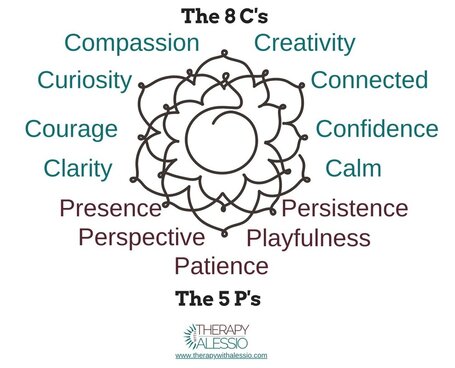 Now, these experiences of God’s spirit are different than the experiences of our parts. They have a very different type of character to them. This difference in character helps us in discerning whether a dynamic is coming from God through our inner room or if it is coming from outside our inner room through a structured part within our soul. Instead of being structured and often fixed, the Spirit is always open, vulnerable and sensitive. Instead of being judgmental, the Spirit is gracious and loving, seeing us always as one of God’s beloved children. Instead of being concerned with right or wrong, the Spirit is focused on what brings us life, on what brings freedom to our soul. As the Scriptures teach, the truth of God always sets us free (John 8:31). Truth set us free; judgements of right and wrong do not (Rom 8: 3ff). Instead of being reactive to our painful experience, the Spirit is always unfolding, responding in the best way possible to what we are experiencing now. Instead of us just reliving history, the spirit helps us live in the Present Moment. If painful memories from our past emerges in the Present Moment, if we are open to God's spirit, we will notice dynamics interacting with these painful memories with the hope of healing them. 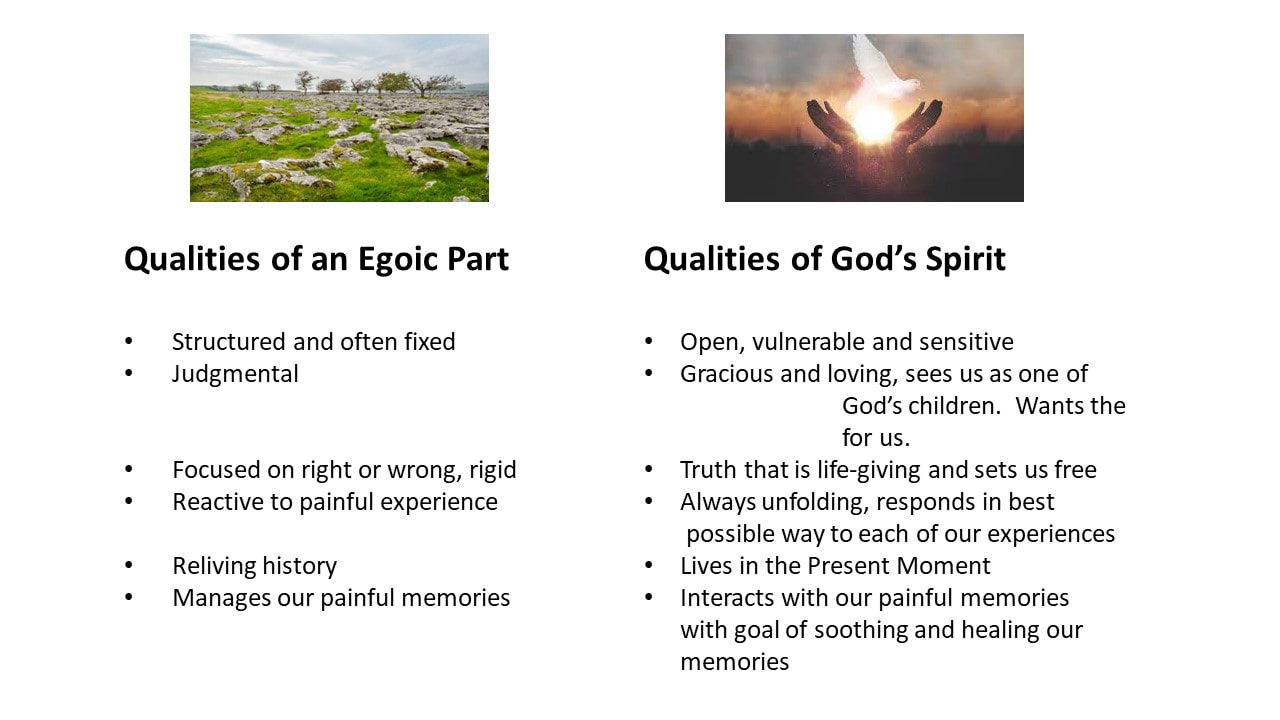 These differences between what is Spirit-guided and what is a structured egoic part in our soul help us in discerning which experiences are from God.
Throughout this blog, I have explored different questions around the dynamics of prayer, and in doing so, a key concept has been the inner room. This inner room is key to our experience of prayer. I invite you to see if you can discover your inner room for yourself, and notice how it interacts with your life, both the good times but also difficult times. Don't take my word on it. Discover for yourself whether what I say is true. Gord Alton MDiv RP CASC Supervisor-Educator There is a teaching within Christianity that the “truth will set us free.” I find this teaching profound for it suggests that a key characteristic of God’s truth is freedom. If a truth does not lead a person to freedom, then clearly this truth is not a truth from God. Rather, this truth is fake news, false good news. In this blog, I want to explore what Divine Truth is and how feeding on this truth leads us to greater freedom and more abundant living.  This teaching “the truth will set us free” comes from the Gospel of John in the Bible. This gospel, written at least 2 decades later than the other three gospels, describes a very different view of Jesus. Instead of encouraging people to follow Jesus or believe in Jesus, John’s gospel stresses the importance of developing an intimate relationship with the mystical Jesus. For example, John’s gospel’s Jesus teaches, “I am the vine; you are the branches. Those who abide in me and I in them bear much fruit, because apart from me you can do nothing” (John 15: 5). Jesus’ words “the truth will see you free” come from a similar context. John has Jesus teaching his followers, “If you abide in my word, you are truly my disciples, and you will know the truth, and the truth will set you free” ( John 8:31-32). But what is this Divine Truth that sets us free? Divine Truth and Knowledge One common understanding of this freeing truth is that it is knowledge. As we learn this knowledge and put it into practice, we believe this knowledge can set us free. Within the Christian Church, this knowledge is often seen as knowledge about God, Jesus, and God’s Holy Spirit. This is why, being raised in the United Church, I memorized Bible verses and many small books of catechism. By people gaining this basic Christian knowledge, the church believed that this knowledge provided the basis to discovering a life of freedom. In the more conservative Christian tradition, this life-giving knowledge is often seen as believing that Jesus was crucified on the cross for our sins. If we believe in Jesus dying for our sins, this tradition believes that this will lead us to experiencing freedom from the guilt of our sin. Within the Old Testament and the Jewish tradition, this knowledge is tied to the Jewish law often connected to the Ten Commandments. By people becoming knowledgeable about the Jewish law and following it, this led people to greater freedom. It turns out that within the counselling profession, where I spend most of my professional time, knowledge is often seen as key. By helping our clients gain key insights about their presenting problem, we often believe that this knowledge is the truth that our clients need to be set free of their issues.  But there is a problem to seeing this Divine Truth as knowledge. Rarely does this knowledge alone lead people to a life of greater freedom. It is interesting to note that the Bible actually describes this problem with knowledge. The Bible describes how knowledge and the law can teach us about what is good and what is sinful, but it cannot save or heal us (Rom 3:20; Rom 7:7). And this is very true in the counselling office. As counsellors become more knowledgeable about the counselling process through training and experience, we see more and more clearly the issues our clients are wrestling with. It is tempting to share this knowledge with our clients, and I have been guilty of doing this too, but that knowledge often only helps our clients see more clearly the issues they are living with. That knowledge reveals the problems within our client’s lives, just as religious law and theology exposes sinful behavior and thoughts, but that knowledge rarely alone leads to significant healing. What happens instead is, that with this knowledge, a part of us tries to make changes in our life to fix the problem. But as Apostle Paul describes perfectly (Rom 7: 14-23), when we attempt to make these corrective moves, we find another law at work within our soul. While there is a part within us that seeks to work at transformation, there is another part within us that resists this change and is often stronger. The end result is that we find ourselves in a stuck position unable to change. We echo the words of Apostle Paul, “what a wretched person I am.” 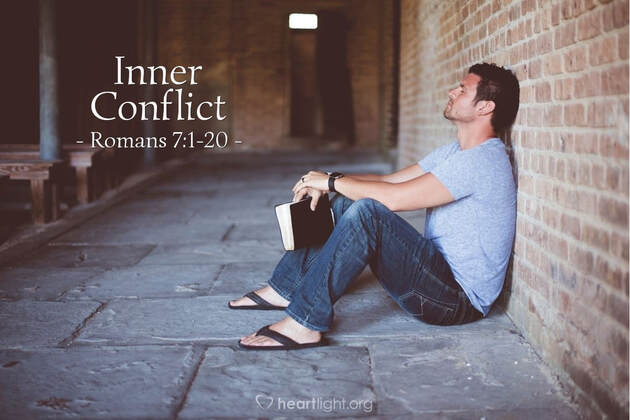 The inner conflict that Apostle Paul describes so clearly is understood as a polarization within Internal Family System, a psychospiritual framework that I used in my counselling practice and teaching. There is a protector part within us, often an Ideal Self Protector, whose goal is to change our behaviors, thoughts, and feelings so they align more perfectly with what we believe they should be, the image of our ideal self. However, as soon as the Ideal Self Protector tries to manage our behaviors, thoughts, and feelings, we become aware of another protector part, a Fallen Self Protector, that part of us that wants to do the fallen behavior that we are trying to stop. This part is called a protector within IFS because this Fallen Self Protector is often a necessary coping pattern to keep us from feeling the anxiety, fear, anger, pain, or other negative emotions from past trauma or attachment wounds within our soul. Seen in this way, the Fallen Protector Protector is no longer seen as the problem for it is providing an important survival role to the client's internal system. Instead, the problem is the polarization caused by both parts, the Ideal Self Protector and Fallen Self Protector, being in total conflict, one resisting the other, and yet both are doing important protective functions within our soul/life. No wonder, we often feel stuck and in despair. 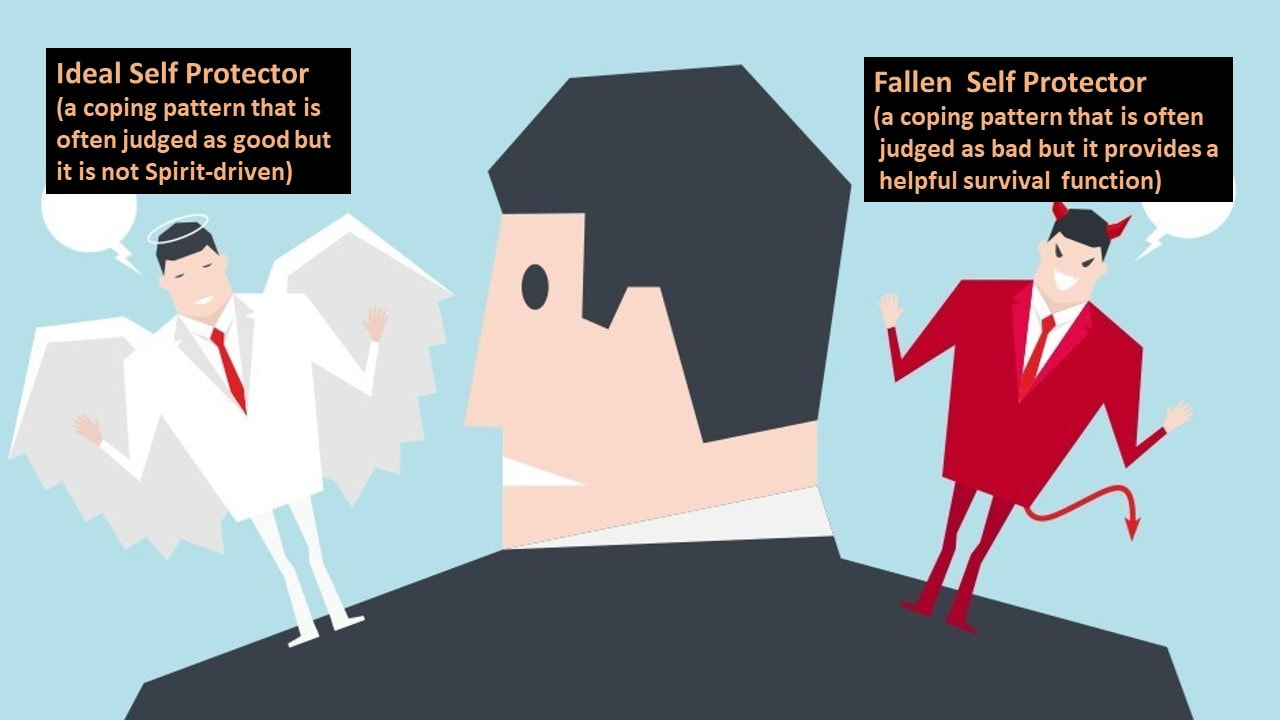 From this discussion, It is apparent that knowledge is important but it is not the Divine Truth that sets people freed. This Divine Truth refers to something else. Divine Truth and Heart/Soul One way of working at this difference between law/knowledge and Divine Truth is noticing the connection between law and love found within the Bible. Jesus taught that the two greatest commandments are the love commandments, to love God with all your mind, heart, strength, and soul, and to love others as you love yourself. And then we read, “when you love in this way, you fulfill the law” (Matt 22:36-40). Apostle Paul comes to a similar conclusion (Rom 13: 8-10). He writes, ‘Owe no one anything, except to love one another, for the one who loves another has fulfilled the law. The commandments, “You shall not commit adultery; you shall not murder; you shall not steal; you shall not covet,” and any other commandment, are summed up in this word, “You shall love your neighbor as yourself.” Love does no wrong to a neighbor; therefore, love is the fulfilling of the law.’ I find it interesting how law/knowledge and love are brought together in Christianity. Law/knowledge is held within the mind, the head centre of the human soul. The mind is where we do our thinking and holds all the knowledge we have learned throughout our life. The mind is the home of our mental truth, which is what knowledge is. Knowledge always arises when our mind thinks about an issue with a goal of trying to fix it or change it or understand it. Our mind draws upon knowledge it has learned through education, TV, research on the internet, and past experience. In contrast, Jesus notes that not only can we love with all our mind but we can also love with all our heart, strength or gut, with our whole soul. How often have you considered truth arising from your heart or other aspects of your soul like your gut or body rather than only your mind? While our mind is home of mental truth, our heart, body, and soul are home to the deeper dynamics of truth, what I am calling Divine Truth. When our mind is engaging with Divine Truth, our mind is not thinking about an issue or problem or topic. Rather, our mind notices, in the present moment, the experience in our heart or body and finds language to capture the dynamics and insights it is noticing within our experience. This is Divine Truth arising.  I remember my Diamond Approach teacher making a comment about Israel/Palestine that caught me and most of my fellow students off guard. He shared something like “we don’t need any law to tell us that what is happening in Israel/Palestine is wrong. Our hearts already know it is wrong.” My teacher’s insight helped me realize that laws are only needed if people are not in touch with their hearts that tells them what is true, what feels right or feels wrong. Laws are necessary when, we, as people, lose touch with the subtle dynamics of our hearts due to emotional numbing, avoidance, addictions, conflicting desires, and other emotional Protector parts, and live primarily from the thoughts of our heads. When this occurs, we need the outside world, through laws and knowledge, to tell us what is good and evil, what is right or wrong. We need laws/knowledge in our secular world to tells us what is wrong, just like religious law/theology informs us what is sinful, when we don’t have access to the dynamics of our heart and soul. However, when we do develop sensitivity to the subtle movements of our soul, including the dynamics of our mind, heart, gut, body and soul, we become aware of the manifestations of the Spirit of Truth. Divine Truth and the Spirit of Truth So far, we have seen that Divine Truth does not arise through the mental process of us thinking about an issue, question, or problem. Mental knowledge can be helpful in understanding the reasons why our problem or issue exists, but in most cases, it does not provide the doorway to freedom. In contrast, we have learned that Divine Truth emerges from a place of awareness, when our mind is watching, noticing, and describing our experience that is unfolding in our heart, body and soul. It is important to realize that once we receive Divine Truth and the healing shifts that arise from that truth, this insight eventually becomes past experience. Divine Truth eventually becomes mental knowledge, knowledge gained from past experience. This is a key teaching from the Diamond Approach. This transformation from Divine truth to mental knowledge explains why clients get excited at first by how IFS helps them understand the polarizations between their Protector parts in their inner world. At first, as I work with clients with IFS, my clients understand for the first time the inner conflict between their Ideal Self Protector and their Fallen Self Protector. This insight arises due the dynamics of Divine Truth and causes them to experience much grace toward themselves and their struggle. However, as soon as this Divine Truth becomes mental knowledge, knowledge we think about rather than truth that emerges in the present moment, Divine Grace disappears. They soon start believing that since this problem is so understandable now that it can be easily fixed. In believing this, my client often falls back into the inner conflict and soon becomes disillusioned. This tells us that there is another dimension to Divine Truth that we need to understand that finally brings about the freedom we are looking for. Let me return to the bible verse that teaches that Divine Truth will sent us free: “If you abide in my word, you are truly my disciples, and you will know the truth, and the truth will set you free” ( John 8:31-32). What does it means to “abide in my word”? John’s gospel actually provides the answer to this question. Later in the gospel, John has Jesus teach, “When the Spirit of truth comes, he will guide you into all the truth, for he will not speak on his own but will speak whatever he hears, and he will declare to you the things that are to come” (John 16:12-13). I want to suggest that this Spirit of Truth is what Jesus is talking about when he instructs his followers to “abide in my word.” When we abide in this spiritual place of Divine Truth, we will sense truth being revealed to us, and this truth will set us free. 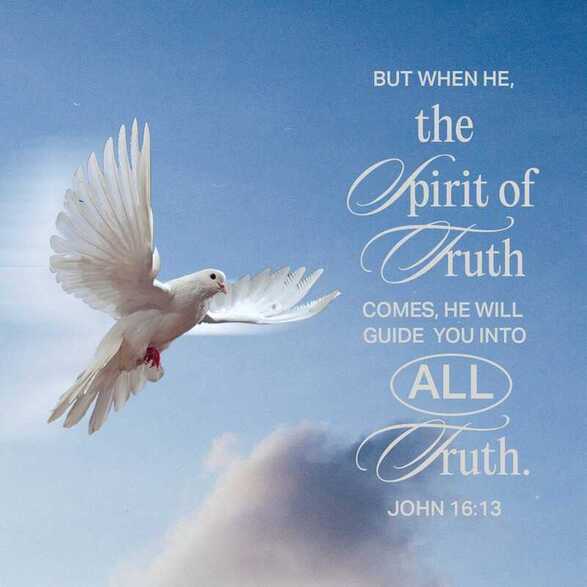 This Divine Truth or Spirit of Truth is not just something described in the gospel of John. It turns out that the psychospiritual frameworks of the Diamond Approach and the Internal Family System both have found this Divine dynamic within their exploration of human experience. Within the Diamond Approach, it teaches that “we can know what is true and what is not true in our experience—because inherent in our soul is a quality that is just Truth. Not a particular truth, but the presence of consciousness that is experienced as the presence of Truth” (Spacecruiser Inquiry, pg. 351). When we experience this Divine Truth, the Diamond Approach highlights that this is the actual presence of spirit, which is our true being (Diamond Heart Book Five, pg. 31). The Diamond Approach also stresses that “it’s important that we don’t conceptualize what the truth is; we don’t determine what this reality is that we are devoted to. That’s why we simply say it’s the truth and then let the truth reveal itself, whatever it happens to be, instead of saying from the beginning, “It’s God,” or “It’s Brahman,” or whatever religious concept you might choose. We can just leave it as the sacred, as divinity, as purity, as reality, and still be devoted to it in a personal way” (Nondual Love: Awakening to the Loving Nature of Reality, pg. 150). Through a Diamond Approach lens, when we learn to abide more and more in this place of Being, Spirit, and Truth, we are abiding in the Spirit of Truth as described in the gospel of John. In terms of Internal Family System, the experience of Self that clients discover, beyond their various Protector parts and Exile parts, echo of the Spirit of Truth described by the Gospel of John. Normally, when clients come into counselling sessions, their sense of Self is blended with their Protector parts. 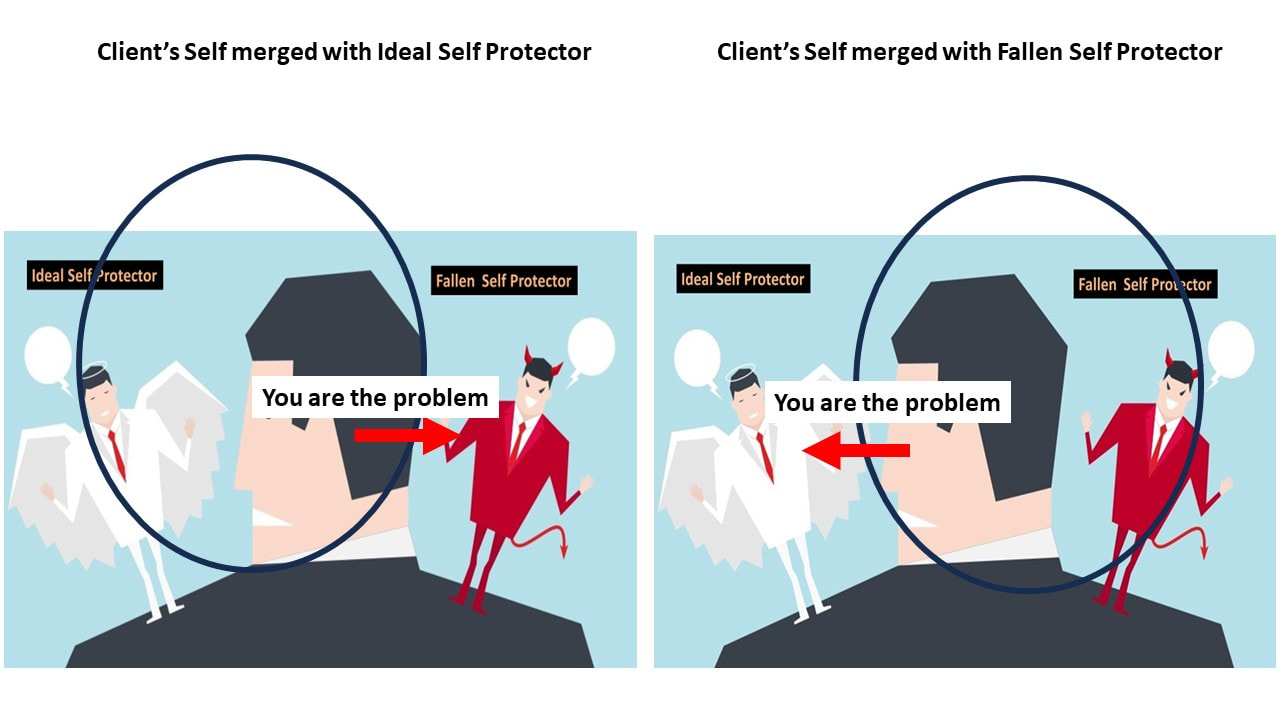 They are either merged with their Ideal Self Protector which causes them to strive to manage their behaviors, feelings and thoughts so they align with their ideal image of self. Or they are merged with their Fallen Self Protector, who resists being managed, and causes the client to do, or feel, or think thoughts that the clients believe are sinful and wrong. However, when clients are able to see these two Protector parts and understand how they function to protect them, they begin to unblend from these parts. When this happens, they become aware of another aspect of themselves, an experience of Self that is neither their Ideal Self Protector or their Fallen Self Protector. IFS simply calls this dynamic at the ground of our soul as Self which is experienced similarly to how Divine Truth is experienced…as the actual presence of spirit and true being within the Diamond Approach. 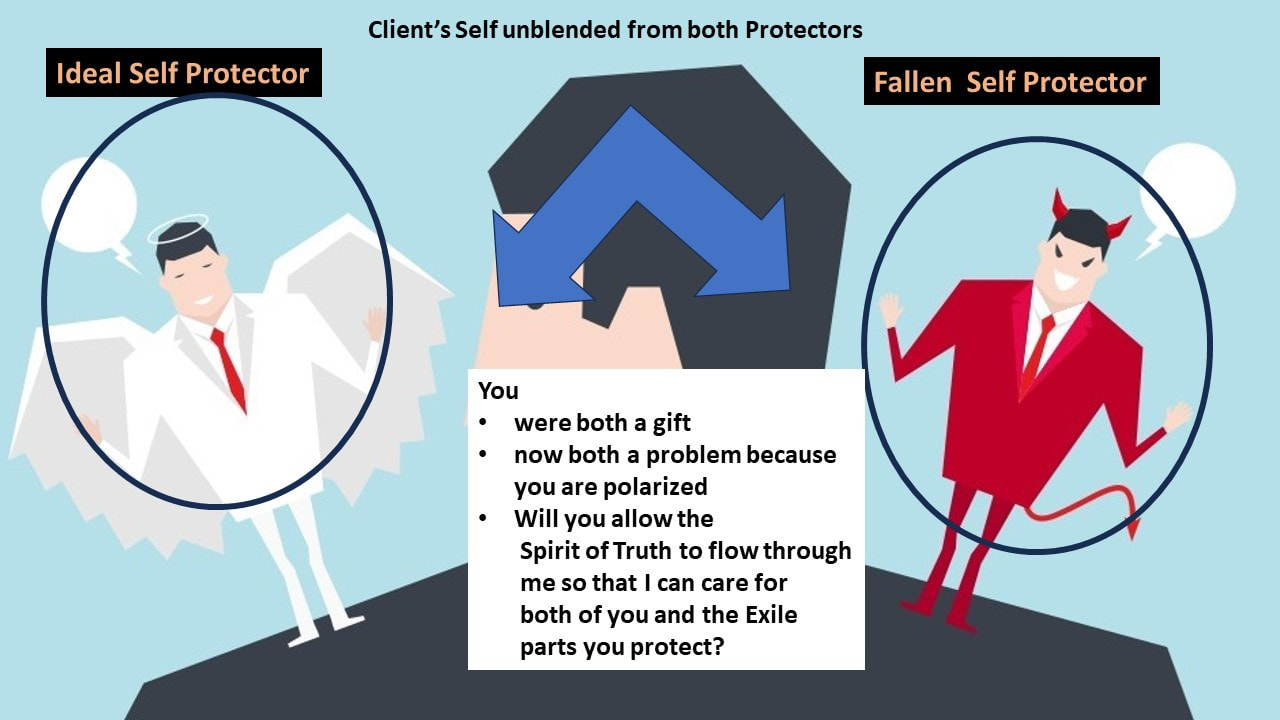 As clients learn to abide in this Self or Spirit of Truth dynamic, they discover that this Self can provide everything that their soul needs to heal from the trauma and attachment wounds of their past. This Self provides compassion to the parts of our soul that carries pain. This Self provides truth to the parts of our soul that believe unhelpful lies. This Self provides strength to the parts of our soul that struggles with weakness. This Self is the doorway to access whatever spiritual dynamic is needed to bring healing to the struggles of our soul. When we learn to abide with our presence of Self, unblended from all our Protector and Exile parts, we “will know the truth, and the truth will set us free.” When we see Divine Truth through the lens of IFS and the Diamond Approach, it brings new meaning to words of Apostle Paul found in Romans 7. Apostle Paul writes, “ I find when I want to do what is good, evil lies close at hand. For I delight in the law of God in my inmost self, but I see in my members another law at war with the law of my mind, making me captive to the law of sin that dwells in my members. Wretched person that I am! Who will rescue me from this body of death?” Apostle Paul’s answers this question by proclaiming, “Thanks be to God through Jesus Christ our Lord.” But what does that mean? How does this truth of “Jesus Christ” become a truth that brings freedom to people trapped by this profound and powerful inner conflict that everyone experiences in life?  If you read Romans 8, you will discover that Apostle Paul is not talking about believing in the human Jesus Christ that lived on earth 2000 years ago. He instead is describing the dynamic of Christ, what is sometimes called the indwelling Christ, a dynamic that I believe is found at the ground of every human soul. I believe this Christ dynamic is identical to the dynamic of Self that IFS uses to help people experience healing from their psychological struggles.
When we learn to abide in the Christ/Truth, using Apostle Paul’s and Apostle John’s language, or to abide in Self, using the IFS’s framework, we will know the truth, and the truth will set us free. Thanks be to God. Gord Alton MDiv RP CASC Supervisor-Educator During the four weeks leading up to Christmas, the Christian Church celebrates the season of Advent, a time of waiting and anticipating the coming of the Christ child. Often during these weeks, we focus on the different aspects of waiting on God to act. However, this year, as I reflect on this waiting, I am wondering if we got the waiting all wrong. Something is not quite right about this understanding of waiting, waiting on God to act. Maybe it is the other way around, that God is waiting on us, waiting on us to become vulnerable so that God’s spirit can enter our lives and bring transformation to us and our world. However, as I worked on this blog, I came to realize that both types of waiting are true: we are waiting on God AND God is waiting on us. How can these both be true?  Within Christian Scriptures, we read many verses about those who are waiting for God to act. Here is one such example found from the Old Testament in the book of Isaiah. “It will be said on that day, ‘See, this is our God; we have waited for him, so that he might save us. This is the Lord for whom we have waited; let us be glad and rejoice in his salvation’” (Is. 25:9). This notion of waiting on God to act is very pervasive in the Bible and is a common belief among Christians and religious people. This understanding of waiting on God is often behind the Advent season. During each Sunday of Advent, Christian congregations are waiting in anticipation of God sending the Christ celebrated each year imaginatively and mythically with the birth of the Christ child of Jesus. In this Christmas celebration, we are both celebrating the birth of the historical Jesus who was born 2000 years ago but also the birth of the Christ child within each of us. As we realize the birth of the Christ child within us, we realize that God’s spirit lives within each of us, that we are one of God’s beloved children, and that God is inviting us to join the people of light seeking to positive change to our world of darkness.  I see this type of waiting on God in many aspects of my life. Some of my clients are waiting wondering when God is going to heal their cancer. As we watch the traumatic tragedy unfolding in Israel and Palestine, many wonder when God will intervened. When will God confront the rich to help those who are poor or homelessness as is evident in the rising rate of homelessness in Waterloo Region? When will God address the mental health crisis happening among teens and young adults in our country? I could go on for the number of issues in our world are endless. There are lots of people who are in need of God acting, who are waiting for God to establish Heaven on Earth. During our weekly Advent services at church, our churches are saying prayers that express this waiting on God to act. This was true at my church a couple of weeks ago when we prayed: Leader: Together we wait. People: How long must we wait? Leader: No one knows when the time will come. So, go! Keep alert, strengthened by God’s faithfulness to you As this prayer says, “how long must we wait”…on God to hear our prayers and act? But is the theological assumption behind this prayer true? Is the reason these issues are not being addressed in our world because of God, because we are waiting on God to act? I actually jumped ahead and peaked at the worship resources for my church on the Sunday after Christmas…to see what we would saying on that day. Here is what I found. Leader: Together we rejoice! People: Our waiting is over! Leader: We’ve seen the One, the light to all peoples, who grew in strength and is filled with wisdom. The favor of God is upon him! Go! Rejoice! God is here!  As these words express, we imagine in this Christmas reading that our waiting on God is over. However, we know that this is not totally true. In most cases, the waiting goes on. This suggest that we are not just waiting on God during the Advent season. There is another form of waiting occurring. I want to suggest that instead of people only waiting on God to act, God is also waiting. God is waiting on faithful people, like Mary and Joseph, the parents of Jesus, people who are willing to become vulnerable enough so that God’s spirit can enter and transform their lives. God is looking for people who are open to the Christ child to be born within them, that is, risk allowing God’s spirit to enter their soul so that healing and empowerment can happen. In doing so, they will discover that God truly loves them, that they are one of God’s beloved children, and that God is inviting them to become part of a growing people of light addressing the issues of darkness within our world. True, we are waiting on God to act. This is evident in our longing. But, God is also waiting on us to become vulnerable so that God can respond to our longings and respond to our prayers.  This dual waiting is very evident within psychospiritual counselling. Clients come to their first counselling session often after a long time waiting on God to act and bring positive change to their lives. Eventually, their longing for healing becomes so great that they realize that maybe God is waiting on them and so they come to counselling with the hope that maybe we, as psychospiritual therapists, can help them work on their healing. However, the reason God is doing the waiting is because most people find it very hard to be vulnerable to anyone, let alone be vulnerable to God’s spirit. This is very evident in the first sessions with a client. People often come into counselling very guarded and resistant to becoming vulnerable even though a part of them longs to be seen by someone who truly understands their pain. I have found the Internal Family System (IFS) of counselling very helpful in understanding this confusing interplay that happens within clients between their longings for help and their resistance to letting help in. IFS perceives this resistance as a Protector part within our personality that keeps us from settling into this place of vulnerability. A Protector functions like a sub-personality. When our sense of “I” merges with a Protector, all our thoughts, feelings, body sensations, and behaviors are shaped fully by the painful memories and associations connected to this Protector. We can be happy and free one minute but when a Protector gets triggered and we discover ourselves merging with it, that happiness and freedom disappears and we find ourselves under the trance of the Protector, very anxious or angry or numb or stoic. It is important to realize that these Protector parts are doing a protective role, and a big part of this role is to avoid vulnerability. Some of these Protectors are mental protectors that are designed to keep us in our heads and avoid us feeling too deeply emotions in our hearts. Other Protectors are behavior protectors designed to keep us busy or keep us from doing things or meeting people that make us nervous. Other Protectors are feeling protectors who prevent us from feeling our tender emotions through expressions of rage, acts of physical numbing or denying our feelings. or doing behaviors that soothe our anxieties like drinking, smoking, shopping, medications, etc. These Protectors, which all people have, perform a very important protective function. They protect us from feeling the pain and negative emotions connected to younger parts within our souls who carry the wounds and traumas from our younger years. These childhood parts are called Exile parts by IFS for they are often hidden away in our psyche, out of sight, out of mind, by our Protectors. However, our Exile parts long to be seen, heard, and healed by God’s loving gracious spirit. Many of our deep spiritual longings come from our Exile parts. One could say that our Exile parts are the parts of us that are waiting on God to free them. Our Exile parts are the parts of us who long for God to come, who long for the Christ to come and minister to their needs. These longings explain the traditional religious notion of waiting on God to act that happens in our church and in our Scriptures. Our Exile parts know, at a deep unconscious level, that God’s spirit is their salvation. 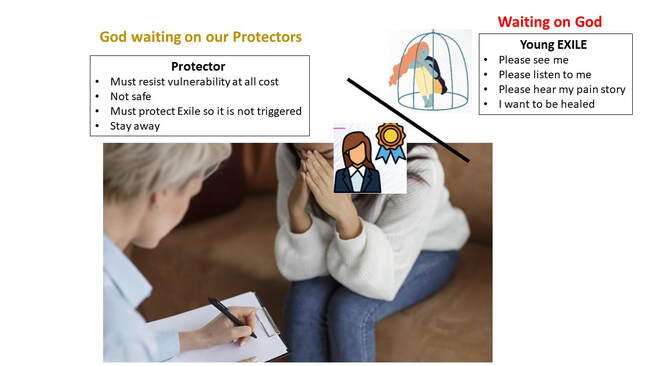 And yet, the reason God’s spirit cannot minister to these Exile parts within us is because of our Protectors. Our Protectors are very suspicious and distrusting of God, and this makes total sense. Remember, Protector structures formed in our soul because of attachment wounds and traumatic experiences that were too much for our souls to handle, times when God’s Spirit failed to protect us through our parents, other caregiving adults, etc. Being so young, our soul was too immature to manifest the spiritual resources needed to protect us from harm. Instead, mental and emotional mental structures, coping patterns, what IFS calls Protectors, formed to stabilize our soul so that we could survive. Due to this history, our Protectors keep us from this vulnerable place of being in the Present Moment due to the fear that the pain within our Exiles will be triggered again. Now you can understand why God is in a waiting stance too. God must wait for our Protectors to start trusting God’s spirit more so that our Exiles’ longing for God’s spirit can be realize. Seen in this way, you can begin to see the two sides of waiting. Our young Exile parts are waiting on God’s spirit to come and bring healing and salvation, to them. On the other hand, God is waiting for our Protectors to trust God enough to allow God’s spirit to minister to our soul. This aspect of God waiting on us is what I sense is missing in our churches today as we celebrate Advent in preparation for Christmas. How would churches celebrate Advent differently if we focused on what our Protectors needed so they could learn to trust God more? As I reflect on the individual stories of Mary and Joseph, the parents of baby Jesus, I can see hints of how they both wrestled with their Protector parts. I wish we had more details in our Bibles about their personal faith stories around Jesus’ birth. It would explain, how in the end, God’s spirit was able to heal and transform both their Exile and Protector parts so they could become willing actors in God’s plan. It would also help us today understand better how to help our Protector parts trust God more so that similar transformations could happen to each of us. Here, I have also found IFS helpful in understanding how to help our Protectors trust God’s spirit, what IFS calls the Self with a capital “S”. IFS has discovered that our Protectors also want to be seen, heard, validated, and eventually freed from their tiring and demanding role of protecting our Exiles. When our Protectors feel validated and understood by our deeper sense of Self, they slowly begin to trust God more which opens the door to deeper healing and salvation. Therefore, when we reach the end of Advent with the arrival of Christmas, instead of celebrating only the historic Christ child that was born 2000 years ago, we would also be celebrating the many ways God’s spirit has healed our Protectors and Exiles, and the fruits that come from this. With such healing, more of us would become like Mary and Joseph, people willing to take risks for God through becoming agents of God’s transforming love in the world.  As I reflect on the individual stories of Mary and Joseph, the parents of baby Jesus, I can see hints of how they both wrestled with their Protector parts. I wish we had more details in our Bibles about their personal faith stories around Jesus’ birth. It would explain, how in the end, God’s spirit was able to heal and transform both their Exile and Protector parts so they could become willing actors in God’s plan. It would also help us today understand better how to help our Protector parts trust God more so that similar transformations could happen to each of us.
Here, I have also found IFS helpful in understanding how to help our Protectors trust God’s spirit, what IFS calls the Self with a capital “S”. IFS has discovered that our Protectors also want to be seen, heard, validated, and eventually freed from their tiring and demanding role of protecting our Exiles. When our Protectors feel validated and understood by our deeper sense of Self, they slowly begin to trust God more which opens the door to deeper healing and salvation. Therefore, when we reach the end of Advent with the arrival of Christmas, instead of celebrating only the historic Christ child that was born 2000 years ago, we would also be celebrating the many ways God’s spirit had healed our Protectors and Exiles, and the fruits that came from it. With such healing, more of us would become like Mary and Joseph, people willing to take risks for God through becoming agents of God’s transforming love in the world. I hope by now that you are seeing waiting in a totally different way. Yes, there is a part of us that is waiting on the Lord, our Exile parts that desire to be seen, heard, validated, and healed by God. But our Exile parts will wait in vain unless we understand why God’s spirit is also waiting, unable to minister to our longing parts. It is not until our Protector parts are ministered to, not with words of judgement but with words of grace and understanding, that healing begins to happen, and the waiting ends. When that happens, we can celebrate Christmas with more honesty and authenticity as we proclaim the words: All: Together we rejoice! Our waiting is over! The favor of God is upon him and us! Go! Rejoice! God is here! Gord Alton MDiv RP CASC Supervisor-Educator Pathway of Peace: Working with Hatred I suspect everyone has been troubled by the war that is happening right now between Israel and Palestine. As the war indicates, the many years of international efforts to maintain peace within the volatile context of Israel-Palestine context has failed. Why? Some point to the many underlying issues of injustice that have not been addressed in Israel-Palestine. But I wonder if it goes deeper than. War and injustice both create trauma, and one of the powerful realities of trauma is the dynamic of hatred. People who are traumatized naturally hate those who have hurt them. However, hatred is something that many in our world see as sinful, wrong, even evil. It is true that if hatred is left unchecked it can and often does lead to major traumatic atrocities like we are seeing now in the Israel-Palestine. However, this hatred, if honoured and processed in healthy ways, opens up the door to the potential healing of this trauma. Until we learn how to work with this hatred in supportive ways, I think there is little hope of healing the trauma that is fueling this conflict in the Middle East. In this blog, I want to explore what it might mean to work with this hatred in helpful and transforming ways, ways that help people struggling with hatred to regain their power, agency and voice.  The Roots of Hatred I have found my Christian tradition to be very confusing in understanding the dynamic of wrath, which is the Biblical word for hatred. The Bible is very clear that humans should not express anger or any form of hatred/wrath. For example, in listing the different expressions of human fallen nature, the author of Galatians includes “enmities, strife, jealousy, anger, quarrels, dissensions, factions” (Gal. 5: 20), all different expression of anger or hatred. While it is wrong for humans to express hatred and wrath, the Bible does have many teachings about how God is “slow to anger” (ten different places in Old Testament) and that God does express wrath. “God’s wrath is always regarded in the Scripture as the just, proper, and natural expression of his holiness and righteousness which must always, under all circumstances, and at all costs be maintained” (www.biblestudy.tools) . For example, in Apostle Paul's writings, we see how he saw it wrong for humans to express wrath but acceptable for God. Here is an example of this teaching. Apostle Paul writes, “Bless those who persecute you; bless and do not curse . . . Do not repay anyone evil for evil…. If it is possible, as far as it depends on you, live at peace with everyone. Do not take revenge, my dear friends, but leave room for God’s wrath, for it is written: “It is mine to avenge; I will repay,” says the Lord” (Romans 12:14, 17-19).  This seems like a major contradiction. God can express anger and wrath in our world while humans can’t. But how does God, as Spirit, express wrath in our earthly world? The only way I know for this Divine wrath to manifest is through acts of incarnations in our world…and humans are the predominant way in which this incarnation happens with God’s spirit. Can human expressions of hatred be seen as manifestations of God’s wrath? I suspect there are both Jewish and Palestinian people who believe deeply that they are instruments of God’s wrath in the world. However, I, and many religious people would agree with me, must say no to this belief that we, as humans, can be instruments of God’s wrath in our earthly world. If I am correct, then I am not sure how God’s wrath can take on form in our earthly world. This means that we have to rethink our theology around God’s wrath, and all the verses in the Bible that talk about God’s wrath. Maybe the experience of God’s wrath is a heavenly dynamic, one that we sense mentally, emotionally and spiritually within our soul that is connected to God, but a dynamic that is never meant to be manifested physically within our earthly world. I think all of us can relate to the experience of hatred in this way. When someone hurts us or our loved ones deeply or threatens our survival or our loved one's survival due to acts that we judge as immoral or evil, we naturally are filled with feelings, thoughts and desires of hatred toward those people. We want vengeance. One could say that we are connected to God's wrath toward those people And yet we know, deep within us, that it is dangerous for us to act out from this place of wrath, just as the Christian scriptures teach. Instead, we are to leave these experiences of hatred/wrath in God's hands, that is, keep them in our mental/emotional/spiritual world where God's spirit can interact with these painful experiences, and not allow them to become expressed in our earthly world. This way of reframing hatred/wrath would be one way of holding both truths as true, that God experiences wrath/hatred, which we experience within our soul, but the human incarnation of this Divine wrath is not part of God’s will within our earthly world. I suspect some of my readers would question this framework I am proposing but as I will show in this blog, the two major psychospiritual frameworks I use in my counselling both work with hatred in this way. To help me understand better the dynamics of hatred tied to God’s wrath, I have turned to two different modalities . I plan to draw upon the Diamond Approach, a spiritual psychology that seeks to integrate the teachings of psychology into spiritual formation, and Internal Family Systems, both psychological modalities that I am quite familiar with. I have been a student of the Diamond Approach now for 17 years and I have been working with the IFS framework extensively for 3 years now in my counselling practice which has many overlapping concepts with the Diamond Approach.  The Diamond Approach Understanding of Power and Hatred Within the Diamond Approach, hatred is directly connected to the experience of powerlessness. The Diamond Approach has discovered that hatred naturally “arises when you feel powerless, for it is an attempt to eliminate the frustration by annihilating it. You want to annihilate whatever problem you have, whatever is in your way, whether it is an inner or outer frustration. You want to make it disappear.” (Almaas, Spacecruiser Inquiry p. 328). Hatred is a survival strategy. Every time our sense of self/being is threatened, hatred will arise to protect us from those who are threatening our existence. Seen in this way, we see how hatred is a reaction, and when that reaction of hatred happens frequently in our life, often reactive structures within our soul begin to form that cause us to move to hatred very quickly anytime we sense, even a little, that our survival is threatened. Now the opposite to powerlessness is power. Our religious traditions, including Christianity, often see God as possessing this quality, the quality of Divine Power. This Divine Power is often characterized as almighty power. The common understanding of this almighty power is based on how we see power being expressed in our earthly physical world, a power that can dominate and overpower any physical expression of power. One could say that this notion of power is how our human ego understands and seeks to express power. Ego-based power has a lot of hatred associated with it. In fact, hatred is often the driving force of this power, a power to destroy our enemies who threaten our survival. When we see power in this way, we realize that Divine Power must be something very different. It is here that I find the Diamond Approach's understanding of Power helpful. Divine Power is “simply the power to be who you are, without domination or control, the power of True Nature that brings a love and a freedom in simply being yourself” (Almaas, Unfolding Now, pg. 111).  This Divine Power that arises as we allow ourselves to be true to what we are experiencing in the moment is not a selfish or ego-driven power. Far from it. When we are in touch with this Divine Power, we are in a place of vulnerability, a place our ego avoids like a plague. In this place of Being, where we are vulnerable, we reveal our truth, what we are feeling and thinking, our own unique story, as Michelle Obama says it, though it may be different than others around us. That is true Divine Power in action. You will notice that there is no reactionary quality to this experience of power unlike hatred, which is why the Diamond Approach sees hatred as “false power” or “fallen power.” We will also observe that this Power quality of Being is always present or available within our experience of life, if we are in this vulnerable place of Being. We will also discover what when are in this place of Being with Divine Power, the Divine qualities of Love, Compassion, Strength, Joy, Will and other essential qualities (the Diamond Approach term for “fruits of the Spirit”) are also present or accessible. That is, these qualities of Being can co-exist. I see this interplay in my spiritual care practice when I see a palliative client shift from experiencing sadness/compassion at the prospect of dying and saying goodbye to their loved ones, to anger/strength at the unfairness of life that they have to die, to gratitude for having enjoyed many years with their loved ones…all within a few minutes. I have come to see this intermingling of experiences as a sacred moment, a sign that my client is connected to their sense of Being or Divine Nature. In contrast, hatred is a reactionary force that only arises when our ego believes our sense of survival is threatened. The same is true of anger and despair and lust, and other ego-based qualities; they are all reactionary dynamics. When these ego-based dynamics arise, people's sense of I often merged with these powerful negative experiences, and they no longer have access to any of the qualities of Being or spiritual fruits. When we are centred in our experience of Divine Power, the Diamond Approach has noticed that a sense of stillness and peace settles within our soul, and all mental activity comes to a place of rest. In this mental place of stillness, there is a deep peacefulness and that is why , within the Diamond Approach, Divine Power and Divine Peace are seen as two sides of the same coin. They co-exist. When we experience Divine Power in its fullness, we realize that Divine Power is a mental/emotional/spiritual dynamic that we, as humans, experience within our soul before it manifests within our earthly realm. And when Divine Power does manifest itself through human actions and words, its goal is not to destroy the enemy but rather to nurture a movement toward reconciliation and restoring a sense of peace to our earthly life and world. However, any time this Divine Power within a person or nation is oppressed or obstructed or distorted, and they are no longer able to express their power of being themselves, then they begin to feel powerless and fear for their survival. When that happens, the egoic dynamic of hatred and wrath naturally arise instead within us. When we see power and hatred in this way, we begin to see that there is no hope of peace in Israel-Palestine, or anywhere where there is racial/religious/cultural violence. That is until the governments of our world embraces and practices a different form of power, one shaped by Divine Power emerging from Spirit rather than Egoic Power triggered by hatred.  The Dynamic of Trauma and Hatred Both the Diamond Approach and Internal Family System see a split in the soul as the source of this hatred. This soul split is due to trauma. The experience of trauma happens when an experience in life is too overwhelming for our human soul. This is especially true in our childhood years when our soul’s capacity to hold trauma was quite limited. However, we are discovering that adults can also be traumatized through distressing experiences in their life that are just too much to hold like we witness in war, car accidents, intense violence and abuse, etc. When our soul reaches this point of overwhelmness or too much, it splits as act of human survival. The Diamond Approach and Internal Family Systems (IFS) understand this split in two different ways, but I think they are simply two different ways of describing the same split. Within the Diamond Approach, this psychic split leads to a split in how we experience the reality of Being and life. No longer able to hold authentically all our experiences of life within ourselves, a split forms within our experience of self. All that is seen as bad is projected outside…as all occurring in the world, in the other. Everything that is seen as good is perceived as only occurring within one’s self or within one’s people. Furthermore, this split leads us to experiencing the evil outsiders as powerful and our experience of our good self as very powerless. The end result of this psychic split is that “this all-good, innocent, and powerless sense of self is experienced as confronting a world that is all-bad, hateful, and powerful” (Almaas, Pearl Beyond Price, pg. 450). When we reflect upon what is happening in Israel-Palestine right now, we see evidence of this psychic split on both sides. Both sides see themselves as powerless, innocent, and good and see the other side as evil and powerful. 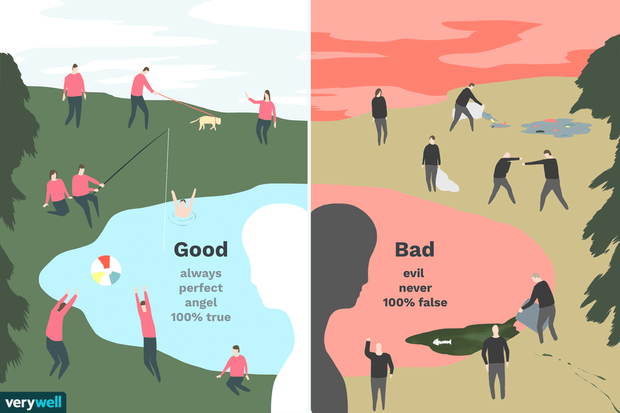 Within Internal Family Systems, this psychic split is understood differently. When the human soul becomes overwhelmed by trauma, our soul or sense of self splits into two types of parts, a Protector part often full of hatred or rage and an Exile part that contains all the pain from that trauma. The deeper the pain contained within the Exile, often a younger part, the stronger the hatred found within the Protector. The goal of the Hatred Protector is to make sure the person does not enter any situations that will trigger the traumatic pain found within the Exile. As soon as this Hatred Protector senses any risk of danger that echoes of the pain in the Exile, this Protector causes the person to feel hatred and take actions to ensure nothing happens that will retraumatize the person. (Click here: Here is a simple but helpful description of IFS and trauma) When you apply this IFS model to the Israel/Palestine context, you quickly see that the Hatred Protectors of both groups are very active, both protectors seeking to protect their people from the other side so that the deep pain of their traumatic past is not touched. Healing of Trauma and Hatred When you understand the conflict of Israel/Palestine through these lenses, you soon realize that the only way to peace is through healing the painful traumatic split that has occurred within both the Jewish and Palestinian people. I find it interesting that both the Diamond Approach and IFS see the pathway to healing as working with the emotional/spiritual dynamic of hatred. Within IFS, the dynamic of hatred toward who we perceive as the enemy is seen as a Protector structure within our soul. For healing to happen for a client, a counsellor spends a lot time with the client exploring this Hatred Protector with the goal of helping the client understand and appreciate its protective role. Just because Hatred Protectors are spewing out hateful words toward their perceived enemy does not mean these parts are intrinsically bad. Instead, these extreme expressions of hatred reflect the intensity of the traumatic pain carried by their Exile parts that these protectors are trying to shield. Before these traumatic events happened, IFS teaches that this protector part didn’t exist in this form: it was simply a part of a healthy dynamic soul. However, due to the overwhelming pain of the trauma, the best available survival strategy was a psychic split, where a Hatred Protector part developed to protect the Exile part, carrying the traumatic wound, from ever being triggered. These Hatred Protectors are doing everything possible to keep these past traumatic memories from being triggered. IFS counsellors spend a lot of time with clients helping them see the positive protective nature of their Hatred Protectors with the goal that eventually the client's sense of Self will begin to validate and appreciate these protective parts. This exploring process involves helping the client notice how this Hatred Protector affects their thoughts, feelings, and sensations in their body. This inquiry also includes helping the client discover when this Hatred Protector first appeared in their lives, and all the memories and narratives connected to it. This investigation also means noticing how this Hatred Protector dictates their behaviors and impacts their relationships, both those they see as friends and those they distrust and treat more as enemies. Through all of these inquiries, the client begins to understand how this Hatred Protector protects them and is working so hard to do so. But they also see something else. The begin to understand how this Hatred Protector has a very limited view and understanding of life and the world, and the harm that arises and has occurred due its thinking and actions. This exploration process requires a lot of patience, grace, and time for clients are often very anxious of their Hatred Protectors (a sign of an Anxious Protector) and often judged themselves as evil (a sign of a Judgmental Protector) because of these Hatred Protectors . However, as the client works through these other Protectors and begins to validate and befriend their Hatred Protector, they begin to appreciate why their Hatred Protector is so active. This Hatred Protector has a huge fear that if it stops doing its job, "making the client hate people they perceive as dangerous", the client will re-experience that painful trauma again. It is important for the counselor and client's sense of Self to see and validate this profound fear. In doing so, the Hatred Protector slowly softens and begins to trust the client’s sense of Self. Eventually, when enough trust develops between the Hatred Protector and the client’s Self and their counsellor, the Hatred Protector will allow the client and their counsellor to begin to spend time with the Exile part. This opens the door to healing the traumatic pain held by the Exile part. Once the client's Self begins to care for and protect the Exile part that carries the traumatic pain, the Hatred Protector no longer has to be so active to doing its protective role. If we were to apply this IFS approach to the Israel-Palestine war, we would realize that our ultimate goal is not peacekeeping, trying to manage the hatred on both sides so that war does not happen. Rather, our goal would be to have two groups of trauma-trained counsellors, one group for each side of the conflict, to work at helping the nations of Israel and Palestine heal the different traumas driving their conflict. The counsellors' purpose would be to hear and validate the trauma that they are hearing from the ethnic group they are supporting, both current trauma and historical trauma. We know from the counselling office that we cannot move quickly to healing the trauma pain of the Exile parts of each ethnic nation. Instead, these trauma-based counsellors would have to work with the Hatred Protectors of each nation for a long time and express a lot of understanding, patience, and grace. Eventually enough trust with the Hatred Protectors would develop allowing for a deeper healing process to occur that would address the traumatic pain driving the violent conflict both Israel and Palestine. 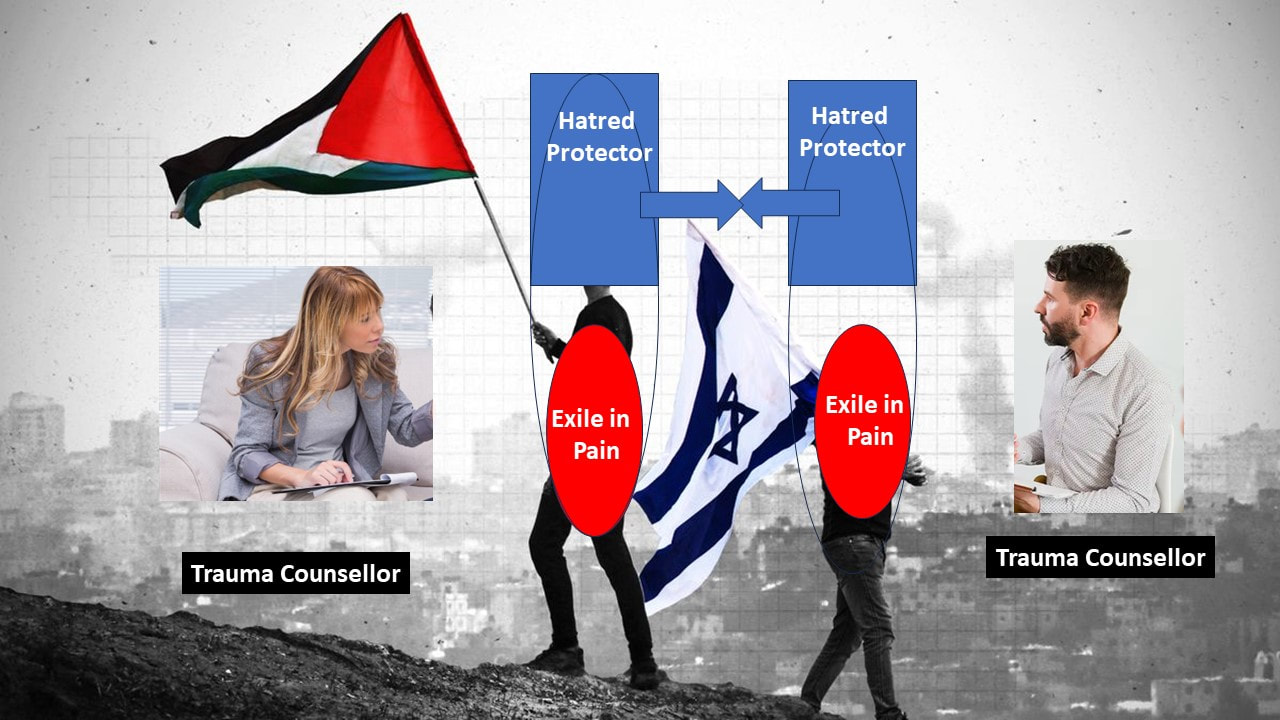 While IFS provides a structure of how to work with the trauma-based hatred driving the conflict between Israel and Palestine, the Diamond Approach provides insights to help counsellors support people and nations working with their Hatred Protectors. This involves understanding the psychic split at the root of the hatred object relationship between Israel and Palestine. Almaas, the developer of the Diamond Approach, states it this way: "To understand this object relation involves recognizing the defense mechanism of splitting, and therefore coming into contact with one’s split-off hatred and destructiveness. When one finally recognizes that it is one’s projected hatred that one is afraid of, and deals with the fear and the splitting, one then begins to feel the hatred directly" (The Inner Journey Home, pg. 205). As we allow ourselves to experience directly the hatred that we project onto our enemy, it is important we feel the hatred but not act on it. Almaas writes, "learn to hold your hatred, be with it, feel it as much as possible from the inside and from the outside. Seek to know hatred, to feel the energy of it, to feel the power of it, and recognize all the associations that come up in relation to it. See into the history that created it and understand that, too. Continue in your inquiry until you are finally able to feel that hatred completely, in its full energy and power. If you do not obstruct it through judgment or rejection, the hatred will—just like anything else that arises in your experience—naturally reveal its own nature. It will dissolve, leaving what is true. And that truth turns out to be essential power—it is the power of truth and peace and stillness. This is the immense and silent power to be—to be undisturbed and unruffled by the ignorance and reactivity of the familiar self. It is simply the power to be who you are, without domination or control, the power of True Nature that brings a love and a freedom in simply being yourself" (The Unfolding Now, pg. 111). I know this may sound airy-fairy to some of my readers, but this description fits very closely my experience when I transformed a hatred-based relationship in my life, with the help of my Diamond Approach teacher. As I allowed myself to experience this hatred directly and fully, in the Present Moment, and not project it, I felt like I was full of evil, almost Satanic in nature. It felt so wrong, which scared me, but as I stayed with and explored this mysterious experience, it was totally different than I at first thought. The feeling of hatred changed…and it transformed into a Power that I had never felt before. This Power had a sense of almighty to it, that this Power could conquer and destroy anything it confronted. However, this Power also had the ability to not act, to simply be with what is without needing to intervene or change anything. It had an aspect of self control connected to it, which as a Christian I perceived as the spiritual gift of self control (Galatians 5: 23). I realized that if I stayed fully present to this experience of Power, there was no danger of me ever abusing this Power. And as I thought about the person I hated, the hate had dissipated. I realize that I had no need to do any harm to this person, that doing harm would be counter-productive and would only lead to more pain, not healing. Instead, now in touch with my own sense of Power, this person was no longer powerful or scary to me. In allowing myself to experience my hatred and discover my Power, that process somehow severed the emotional link with the person I hated. The psychic split had been healed, transformed. They no longer had power over me. Now, to my surprise, I started to feel tender feelings toward this person which totally surprised me. I shared my personal journey with transforming one of my hatred-based object relationships to help you begin to dream of what this could look like in the Israel-Palestine context. This past week, CBC reported an amazing story that is happening in my backyard of Kitchener-Waterloo that illustrates a beginning step toward what I am encouraging in this blog around the Israel-Palestine conflict. The news article shared how the "Interfaith Grand River (IGR) held a sharing circle last week where community members of various faiths — including those from the Jewish and Muslim communities — explained how they feel about the Israel-Hamas war, but made a point of leaving politics out of it" (See article).  Jay Moore, President of Interfaith Grand River said that "it was very high-powered, meaningful, enlightening, and we want to carry that spirit of opening up, bringing down barriers, and we have to start with ourselves." Such vulnerable conversations allow Muslims and Jews, as well as others, to own the mixed feelings the conflict in Israel-Palestine brings up for them including their feelings of distrust, fear, dislike, and even hatred. Such conversations allow us to practice our vulnerability where we can own our feelings of hatred and fear with one another without having to act out on them. In doing so, it allows all those involved in the conversation to begin to understand the dynamics of hatred and why they exist. Only then when we learn to hold this hatred, without discharging the feelings through actions or speeches of hate, can we begin to heal the psychic split at the root of hatred.
It is my hope that what was modelled at Interfaith Grand River can become a model for others in the world. We need to find new ways to hold and process our feelings of hatred so that the painful traumas behind the Israel-Palestine conflict can be healed leading to a deeper possibility of peace. Gord Alton MDiv RP CASC Supervisor-Educator This past spring I read a fascinating book, “Death Interrupted”, written by Dr. Blair Bigham. Within the book, Bigham shares his journey of trying to make sense of what he calls the “death dilemma” that happens for doctors, patients, and their families as they wrestle with the question of when is it the right time to allow death to happen. Bigham shares interesting stories of medical history but also many personal stories from his own medical experience as a paramedic and then an Intensive Care Unit (ICU) doctor as well as stories from his research for this book that makes his book very compelling and enjoyable to read. I resonated quite deeply with many of the issues he raised in this book for they are very present in my palliative care ministry. In this blog, I plan to provide a detail summary of his book, sharing his key insights into what has created this death dilemma along with his conclusion to resolving it.  The History of Medical Intervention In his early job as a paramedic, Bigham followed what was called Death Policy 4.4 which described the “obvious dead” as people who were pulseless, breathless, and lifeless and had a certain dead person look (11). When he encountered such dead people as a paramedic, he knew that there was nothing to do. Yet, sometimes it was not so clear for the death look had not appeared yet and so the race was on to pull the person back from the cliff of death through cardiopulmonary resuscitation (CPR) and other medical interventions like defibrillation (12). When he became an Emergency Room (ER) doctor, the obviously dead never came to the ER and so he never encountered a patient who met the clear criteria of Policy 4.4 (17). Now, the decision to declare death was his. And here is where he experienced head on the death dilemma. Now he “encounter almost daily situations where the life I’m entrusted with can’t be saved, but where death is anything but black and white” (23). The death dilemma is a recent phenomenon. Going back a hundred years, doctors were not typically present when a person died. Furthermore, Bigham notes, death was a common experience with global life expectancy being around 30 years in the 1800’s, while in 2000 this global life expectancy was 70 with some countries having life expectancies over 80 (35). Furthermore, death happened in people’s home so it was part of people’s everyday experience, not hidden away in hospitals or other health institutions. Between 1850 and 1950, Bigham concludes, life expectancy doubled due to vaccines, antibiotics, and public health measures like clean water and simple hygiene (36). I (Gord), personally, was surprised how doctors, by simply washing their hands before helping a mother give birth, led to a dramatic drop in babies and mother dying soon after childhood (36-37).  Since 1950, we have seen huge changes in medical technology that has raised the death dilemma into the forefront. In 1952, during a polio epidemic in Denmark, Bigham learned, they discovered that ventilators dropped the fatality rate of polio from 80% to 40% (45). Soon after, ventilators popped up around the world. At first these ventilators were hand-driven but soon they were mechanized and “devices were eventually sequestered together forming the first intensive care units” (45). (see picture above; polio patients in Boston ER room, 1955) Soon after, in 1960, Guy Knickerbocker published findings in 1960 about cardiopulmonary resuscitation (CPR) and CPR quickly became the medical standard for patients whose hearts had stopped (48). At the about same time, Bigham discovered, Knickerbocker developed the defibrillator. “As defibrillators became smaller [and thus portable] and CPR was taught to medical students around the world and as ventilators became common place, doctors became appreciating the life-saving implications of applying invasive therapies to people at the brink of death” (49). “By the end of the 1960’s, the word resuscitation was mainstream, and intensive care units had been established in most hospitals for diseases other than just polio” (49). Now, Bigham notes, we have medical technologies to do the work of many of our organs: lungs (ventilator), kidney (kidney dialysis), feeding tubes (stomach), urostomy (bladder) , colostomy (bowels), heart machine, etc. (61-62). Now, “I can take nearly every aspect of your physiology” and address the problem with medical technology. “Most times, I win this battle with death …but there are times I lose. A slow decompensation, one organ at a time, into oblivion...The problem is this: there comes a point where I know I will lose, but I don’t know exactly when. There won’t be a return to life, but the line of death hasn’t been crossed. It is no-man’s land, where no person ever wants to be” (62). Furthermore, Bigham highlights that “all this technology makes it quite hard to actually die, but none of it gives assurances that you will recover” (70). In fact, “the treatment for one failed organ often makes another worst” (70). What makes it even more complicated is that each machine is owned by a different specialist in the hospital but no one except the internist holds the full picture who often is forced to make trade-offs between the different specialists to ensure each organ has a fighting chance (71). This begs the question, how do we avoid this situation that places us right in the centre of the death dilemma? In some sense, Bigham concludes that “the death dilemma is a result of our often indiscriminate application of technology to prevent in the short-term a death that will ultimately come anyway” (68). What does it mean to die? To explore this grey zone further, Bigham turns to the question, “how do we know death has occurred?” Before this death dilemma appeared, death was primarily determined through checking if the heart had stopped beating and had no hope of being restarted. However, with the invention of ventilators, brain dead people no longer died quickly (71). To determine if a person was brain dead, the ventilator had to be shut off, but this raised another concern due to the emergence of organ transplants. Organs often became damaged waiting for death to happen so that these organs could be transplanted. This led, Bigham asserts, to “the urgency to precisely determine death while on ventilator: solid organ transplant was quickly becoming available, and fresh organs were in high demand” (72). The criteria for brain dead needed to be defined.  The first human heart transplant happened in South Africa in 1967, but there was no established brain dead criteria (74). The second heart transplant was done in Japan months later, but the transplant doctor was charged for manslaughter. These charges were later dropped but repeated criminal accusations plagued Japanese doctors (76). This legal controversy, Bigham notes, was occurring around the world. Most of the heart transplants were unsuccessful so few places were doing heart transplants until the arrival of anti-rejection medications made heart transplants viable again (77). The brain dead controversy eventually led to the Uniform Determination of Death Act (81) which stressed both the personhood and the physical brain of person. “When the brain dies, it is when the soul departed: what is left are ‘mortal remains’” (81). However, this Death Act didn’t resolve the controversy for many religious people saw the soul based in the heart, not the brain. This difference, Bigham claims, led to conflict between families who couldn’t make a decision and the transplant medical people who needed that organ right away (84). Bigham then researches why families have a hard time with the reality of death. One of his sources, Steve Berry, death historian, states that death is no longer a common experience of most people, but instead has “been exotified and denied to such an extreme that the idea of discontinuity of the self is so harrowing to people” (87) Furthermore, Berry claims that when people are treated as special and deserving of life, death seems unacceptable (85). He argues further that we are having an epistemic crisis, where due to our smartphones, we think we can access the facts ourselves, and so we have lost public confidence in all forms of authority, government, medicine, technology, etc. (86). Seeing these factors, no wonder people in our culture fight death to the end causing us to "spend ¼ of all health care dollars in the last six months of life” (89). Bigham discovered that there are “over one hundred thousand technology-dependent patients in long-term facilities in the United States, pushed out of hospitals no longer willing to deal with the consequences of their treatments” (92). “Chronic critical illness in the U.S. is a twenty-five billion industry” (93). Bigham believes that ”while aging population is no doubt a large part of it, therapeutic advances that decrease ICU death rates without getting people back to health are major contributing factors” (93). The costs caused by this death dilemma are very clear, and they are both emotional and economic (93).  Eventually, brain death became defined as the death of the brain stem and the irreversible loss of [the capacity of] consciousness” (98) or personhood (99). “When neurological death is proven to have occurred, personhood has ended” (100). In 2006, three guidelines were formulated to diagnose brain death, and to be verified by two physicians. One, ”you must have a reason to be brain dead” (100). Two “you must not have any confounding factors that could be mimicking brain death”(101). Lastly, ”a detailed exam of the cranial nerves must be performed” (101). While this provides a scientific definition of death, Bigham, through his research, discovered that there can be clash between families and medical staff. Families need time to transition from hope to despair, and that is something, Bigham observes, that doctors are not good at (108). Candi Cann, Professor of Religion and death researcher, sees “a void in the system that religious leaders can fill, offering guidance at end of life that can help normalize the dying process while doctors are trying to overcome it” (127). The Root of the Death Dilemma It is at this point in the book that Bigham begins to summarize what he thinks creates the death dilemma. He sees it being caused by technology, resuscitation glorification and death denialism. (145). Bigham describes "’resuscitation glorification’ as a societal belief that death is never near, if it comes at all, and that survival is always better than death, a position many in the know would dispute” (144). The end result of these factors is false hope, which Bigham sees at the centre of the death dilemma. This false hope, Bigham argues, "sets aside one of the most important tools in medicine, palliative care, until the window for effective palliative measures has mostly closed and it is too late to undo extraordinarily suffering” (145). From here, Bigham begins to unpack the culture found within the ICU. While families wrestle with the fear of death, doctor wrestle with the fear of failure (146). A fear of failure requires a humility within a doctor to admit that they cannot help a patient (148). Bigham highlights that “doctors are trained to look at things they can fix, establishing a self-esteem system based on making things better” (151). Therefore, for most doctors, the fear of failure is tied to their fear of death for death is seen as the “only bad outcome one can experience from surgery” (149) ..."when in delaying death, we may only cause more pain, more suffering, more despair” (149). 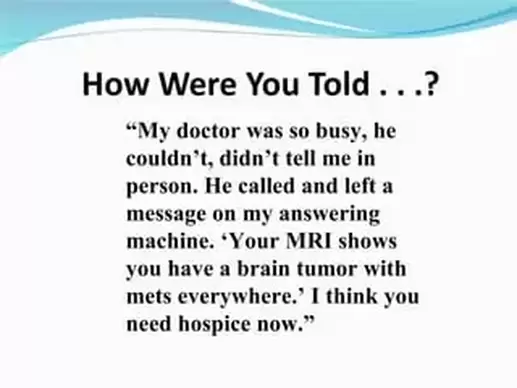 Because of these fears, Bigham notes that “for many specialties, the palliative care conversation is a non-starter”(157). “Many surgeons consider a move to involve palliative care experts as 'giving up’ and in many ways it is. But it isn’t giving up on the patient; it is giving up on a curative intent and on fighting a reality that can’t be avoided” (157). Bigham highlights that emergency doctors have a process called “flipping the plan” which describes “conversations they have with families of patients who aren’t suitable for full resuscitation efforts” (164). These doctors realize that there is some point where “you have to turn off the curative tap and turn on the palliative tap” (165). With cancer, this changepoint is more obvious: when chemotherapy treatments stop, you then move to palliative (166). However, this natural process of slow death that happens openly in palliative care is foreign to many people who expect sudden death. For example, “with heart failure, they get a pacemaker, and then they get an LVAD (left ventricular assist device), so they were dying the whole time, but it’s so medicalized that when these technologies fail, death than comes quickly. It’s not that you’re here one minute and then you’re gone“ (165). One of the interesting findings from Bigham’s research is that families based their decisions around death on the spiritual realm. While doctors flood them with more data and science when they are in this indecisive place, families are often looking for some sign that death is meant to happen (167). A Good Death Since there is such reluctance to talk about dying and death within the medical system, Bigham explores what a good death might look like. Interestingly, Bigham discovered that “only 25% of people have taken steps to ensure their wishes are known and 7 percent had spoken to their doctor” (180). When you lose capacity and are no longer able to share your wishes, it is the role of your Power of Attorney around Personal Care or close family members to share your wishes. These wishes around dying are called Advanced Directives, a conversation that I (Gord) am often privy to or encouraging in my palliative care ministry as a spiritual care provider.  It is pretty hard to have a good death when no knows what you consider a good death for you to be. Bigham has observed that “time and time again, families in the ICU are able to clearly articulate that 'Mom would never want this' yet can’t bring themselves to let go, to let those wishes be acted upon by the medical team” (187). In describing a good death means that a “bad death” is also a reality. One of Bigham’s research sources compared the ICU to a water treatment plant. Just as water issues upstream are eventually discovered downstream in a water treatment plant, everything that goes wrong in the health care system eventually gets to the ICU (193). As a result, the ICU source said, “I am a big believer that there is a negative quality of life” (193) which means in this context, a life that is no longer worth living and thus leads to a bad death. Bigham concludes that death happens in four ways when we are caught in this death dilemma. The ICU staff will work “full throttle until your heart gives out despite all the drugs, shocks, and chest compressions” (197). Second, “your brain can swell until blood can’t get it, and you’ll be pronounced brain dead” (197). Third, you can choose to assign people in your life, and arm them with documentation (Advance Care Directives), to make sure you never end up on unhelpful technology to begin with and move to palliative care (197). Or fourth, “you (or more likely someone acting on your behalf) can flip the plan at which point we’ll keep you comfortable (and probably comatose) while the machines are peeled off and you die naturally” (199). This option is often called palliative sedation. In recent years, Medical Assistance in Dying (MAiD) or euthanasia has entered the equation. For many, Bigham notes, “euthanasia is a way to avoid the pains doctors today can extoll on people as they near the end of their lives. Afraid to wither away, they instead choose a controlled—if not early—death away from the institutions and machines that define modern medicine (211). Often, Bigham learned from a MAiD practitioner, “good palliative care means people don’t want MAiD right away. But there comes a times when they are suffering too much, despite all that palliative care can offer” (204).  The Technology Conundrum Knowing the reality of a “bad death” and “good death” only sharpens the death dilemma. It is clear decision-making needs to happen but it is “not always clear who will live and who will die when we make decisions about implementing medical technology” (235), especially when “doctors around the globe are pushing the limits of resuscitation, often with remarkable results” (236). Bigham stresses that “as technology gets better, there is even more hope, more optimism, that resuscitation can save a life. But what happens when we roll the dice and lose?” (236). Bigham has observed that “every ICU has its frequent flyers, its bounce-backs and chronic long-haulers , the patient who has been there for one hundred, two hundred, three hundred days” (238). Eventually death comes to chronic ICU residents for they can only linger so long for eventually you will end up suffering from complications (243). Seeing this death dilemma so sharply, Bigham wonders “how could we differentiate false hope from true hope?” (255). Unfortunately, the reality is, “that ability to prognosticate about survival and future quality of life are inherently limited and will always create a tension that needs to be addressed incorporating uncertainty” (255). Toward the end of his book, Bigham has a big “aha” moment. “In the ICU, the doctors knew the dismal prognosis and so did the family, but neither was willing to make the difficult call to lessen, not maximize, the use of technology that would, in all likelihood, only temporary postpone death” (257). Bigham wondered, “could I, [as their doctor], simply make the interpretation on behalf of my patients, based on what their families could tell me, and propose ending the use of technology?” (257). Wouldn’t that solve the death dilemma? He learned from a senior physician that “some family members want us to take responsibility for these decisions and – in the right circumstances –we should be willing to do that” (256). In the end, Bigham realizes, that to resolve this death dilemma, we need to first “move technology from its current power grabbing position and instead consider its use when ethical -- and by ethical, I mean not only to prevent immediate death but to reasonably promote a return to life” (271-272).  Preventing immediate death is not, by itself, a valid enough reason to apply life-saving technology (272). Once this happens, Bigham claims we see that there are three major players in the death dilemma…and none involve medical technology: the patient, the patient’s family, and the medical staff. Each of these players have the ability to end the death dilemma (271): the patient through having a clear plan of care around their health and dying, the family through not placing unreasonable demands on doctors due to grief and unrealistic hopes, and medical staff through not losing sight of the forest of the reality of life and death due to the trees of symptoms demanding their attention (271).
Bigham, Blaire. Death Interrupted: How modern medicine is complicating the way we die. Toronto: House of Anansi Press, 2022. Gord Alton MDiv RP CASC Supervisor-Educator During a worship service this summer, the guest speaker at my church brought together two prominent themes found in the Bible. One is that God is an unconditional lover, that “perfect love casts out fear” (1 John 4:18) And two, we are to “fear the Lord”, a phrase that appears many times in the Bible. I found the conflict in these verses very jarring and pondered it throughout the service, and many times since. How can this be? This blog is my response. 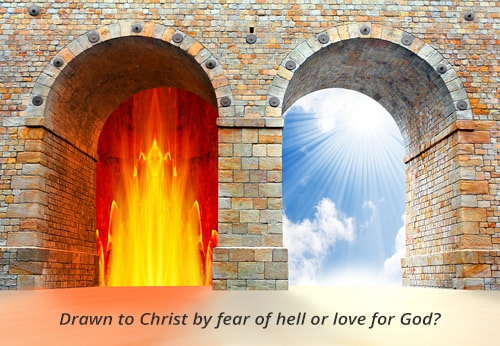 Why should anyone be afraid of a God that manifests its Presence through the experience of unconditional love? Many faith-based people believe both…that God is loving and that one needs to be fearful or careful of God. Personally, I have come to realize that this conflict should not exist for love cannot be experienced fully in the midst of fear: fear always shuts down love. This suggests that there must be another way to understand this fear of the Lord, a fear that opens the door to experiencing God's love rather than shutting it down. The Bible ties faithfulness to having fear in God in many places. Let me provide you a sampling:
 In all these verses, the fear of the Lord is seen as the root of being faithful or obedient to God. These teachings suggest that fear of God is the reason people resist sin or evil or seek wisdom and knowledge about God. People fear the consequences that will come from doing wrong…like being caught and judged by our wrongful actions by our community or the judicial system or other personal sufferings. Within these Bible verses, these negative consequences are ultimately tied to God. However, It is interesting to note that this relationship between God and fear is very weak in the New Testament, almost entirely missing in the four gospels. This should cause us as Christians to pause. Instead, there are many places in the Old Testament and New Testament which experiencing God’s love as a sign of knowing God. Here is a Jewish mantra that appears may times throughout the Old Testament: “The Lord is merciful and gracious, slow to anger and abounding in steadfast love“ (Ps. 103: 8) The notion of God’s steadfast love, which is another way of saying that God’s love is unconditional, appears 175 times in the Old Testament.  At the same time, the New Testament also teaches “that there is no fear in love, that perfect love casts out fear” which suggest that if we fear God, then we will not be able to feel God’s love very deeply, if at all.  As I sat with this conflict, I came to realize that I see this fear dynamic many times in my spiritual care work. As a spiritual care provider, I am seen as a person that helps people experience God in the midst of their palliative illness. For me to be effective at my work, my clients need to become vulnerable in my midst, to be open about their thoughts and feelings, about their struggles and pains, about the fears and hopes with me. Otherwise, there is little space for the Spirit of God, that flows within me through love, compassion, and insight, to flow into their lives. However, to be vulnerable like that is really scary for people. Can I trust that if I become vulnerable with Gord right now that l will not get hurt, that life will not hurt me. This is a profound fear that creates tons of resistance around becoming vulnerable. Many people do lean into this fear in my spiritual care ministry and as this happens, lots of healing and insight arises for my clients. But I have discovered that many other clients cannot lean into this fear, even with my support, and so they not able to discover the love that casts out their fear.  Within my church’s worship service, we have a time when people can share with our faith community about a blessing or concern they are carrying that day. To share openly in this sharing time means become vulnerable to my faith community and to God. Do I risk becoming vulnerable and share a concern or thanksgiving with God and my friends here at church? Or do I stay quiet, like I did couple months ago, and not shared my thankfulness for my wife being fully recovered from what doctors are now calling viral encephalitis? I chose to stay quiet…because of my subtle fear of becoming vulnerable. I want to suggest that this fear of becoming vulnerable maybe a better way of understanding what the phase “fear of the Lord” might actually mean. This type of fear is a fear that all of us have experienced. That fear of entering the space of vulnerability is what keeps us from entering a more personal intimate space with others including allowing ourselves to be ministered to by the Spirit of God found in the Present Moment. This fear is the fear that all of us must lean into if we are going to enter into the vulnerable space of opening ourselves up to others and God…so that we can experience God’s love and allow God’s spirit to minister to us. However, when we are able to lean into this fear of the Lord, something magical happens.  That fear is quickly transformed by a gracious love that bubbles up as we share of ourselves with another person or with God. As the Bible says, perfect love casts out fear, that is, a love that is responsive and sensitive and caring to the people who have risk sharing themselves with us and God. Love as I am describing in this blog is different that how many people understand love. When we are in touch with the dynamic of unconditional love, that allows others to be vulnerable with us without any risk of judgment from us about whatever they are experiencing...whether it be anxiety, anger, hatred, shame, guilt, and even beliefs that we disagree with. This past week I visited a person who shared beliefs and experiences that were very different than mine. She was a person who didn't believe in taking the COVID vaccine, that didn't trust doctors, that saw our health leaders as hiding information from us, who saw the freedom rally in Ottawa as more of a lovefest than violent perpetrators as was portrayed in the news, etc. What did it mean for me to practice loving her so that she could feel safe in my presence? It meant putting all of my beliefs and past experiences to the background so that I could create a safe place so that she could feel safe and become vulnerable with me. 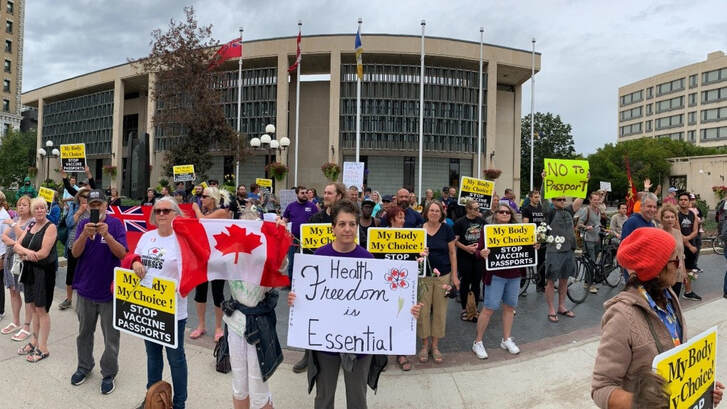 As I did so, I began to understand how she had come to distrust the world, the health care system, the media, and many others who often judged her as wrong and even evil. She has had many experiences that support her distrust of the health system and COVID vaccines, and yet it seems there have been few people in her life who have held and validated her painful experiences. Through loving in this way, I gain a deep appreciation for the pain, fear, rejection, and loneliness she experiences every day, so much so she wonders if life is even worth living some days. I also came away with the realization that life is far more complicated than I thought, that I need to be to far more discerning with how I listen to the news, and beliefs the people promote as the whole truth.
As you see from my example, it is difficult to be a perfect lover where people can feel safe to be their vulnerable selves with us. And that is also true for us too, when we are looking for perfect lovers to be vulnerable with. Most people are far from being perfect lovers, where they express a love that transforms our fears around vulnerability. This means that we need to be careful with who we become vulnerable with. However, God’s spirit is a perfect lover, and when that spirit is flowing freely within us as we care for others, we become perfect lovers to those who risk becoming vulnerable with us. Gord Alton MDiv RP CASC Supervisor-Educator Back in July (2023), I found myself sitting beside my wife Valerie in a hospital Emergency Room, doctors totally stumped with what was wrong with her. She was mentally confused and had an extreme high fever. After blood work and urine analysis ruled out sepsis, a systemic infection, a spinal tap pointed to a form of meningitis. The doctors quickly started heavy duty antibiotic and antivirals, but little change happened at first and so we feared the worst. However, forty eight hours later, a shift happened and Valerie’s health begin to improve quickly. Some of my people in my support network began using the word miracle, that God had answered their prayers. But I was troubled by connecting the word miracle to my wife’s healing. In this blog, I want to unpack this healing journey more for it has caused me to rethink what a miracle really is.  As a Christian, I am well aware of the many healing stories and other miraculous events in the Bible. As a pastor of twenty-seven years in the Mennonite Church, I have preached on these stories, trying to explain how and miracles happened. The answers I was given at seminary and church were straight forward. God was the source of all miracles. And the reason miracles happened here and not there was because of God’s will. Prayer was often seen as trying to influence God in causing a miracle to happen. But now thirty-years later, the simplicity of those answers no longer satisfy me. The connections between God’s will, miracles, and prayer began to break down early in my pastoral life. The reason for this is that I watched my two brothers die of HIV/AIDs. As I supported my twenty-four year old brother Jamie during his dying journey from HIV/AIDS in 1992, many people around him prayed for God to do a miracle but a miracle never happened, at least not a physical healing miracle. After that death experience, my understanding of miracles began to change. I remember doing a lot of research asking the why question and it led me to facilitating a community workshop on that topic. The whole point of the Why Workshop was to try and understand the dynamics of God’s will around sickness and death and miracles. In doing so, I began to see the gift of physical and emotional pain and how death is a necessary and essential aspect of human life so that emotional maturity and spiritual growth could happen. The book “Pain: The Gift Nobody Wants” was instrumental in that faith journey. I began to see miracles more through this lens, the healing that happens as one encounters the presence of God’s spirit interacting with one’s suffering that leads to spiritual healing and growth. When my brother Jamie died, I was quite angry at God and my heart was emotionally numb. But at the beginning of Jamie’s funeral, a miracle happened to me. As I entered the sanctuary with my family for the funeral, I saw many people in the pews weeping, and I realized in that moment that God was weeping with me through those relatives, neighbours, and friends. I realized that God was in as much pain as I was, that God saw my brother’s death as wrong as I did, something that should not have happened, but did. This realization led me to sobbing deeply then for I sensed God's presence again. God had not abandoned me like I thought. This same painful dynamic was evident when Jesus died on the cross with all the women, Jesus disciples, and crowds beating their chests in grief (Luke 23: 27, 48). These weeping people were expressing the pain that God was experiencing that day. God was in as much pain as they were watching Jesus be crucify by the religious people, leaders trying to be faithful to following God’s law, a faithfulness that was distorted by their false perceptions of life and God. This death should not have happened, but it did. 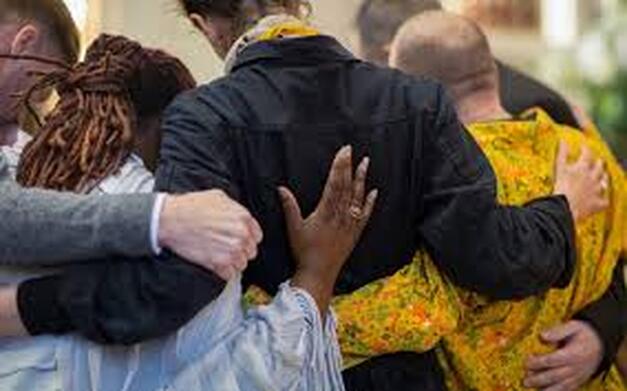 When my second brother Kevin died of HIV/AIDS five years later, I was no longer praying for a physical healing miracle. I no longer believed that was how most miracles expressed themselves. I was praying for a different kind of miracle, the one I experienced in the end around Jamie’s death five years before. And Kevin’s funeral was even more powerful than Jamie’s in the sense that the dynamic of gratitude was even more present in midst of our grief, gratitude for who Kevin was and how he left a profound mark on all our lives. Yes, we were very sad but we were also very grateful for the thirty-two years that he was in our lives. For me, the experience of Kevin’s funeral was a miracle. Many people left that funeral touched by God’s presence. Over the past 30 years, I have done a lot of thinking about miracles and how God’s spirit interacts with our earthly world, especially as I ministered twenty years ago to palliative care clients for the Community Care of York Region as pastoral counsellor (part-time from 1997 to 2006) and now as I do similar work as a spiritual care provider for Lisaard and Innisfree Hospice and the Home Community Care Support Services of Waterloo and Wellington Regions (2020-2023). This history shaped what I experienced as I sat with my wife Valerie in a Hospital Emergency wondering if she would live or die. Let me share some insights I have learned about miracles 1: The emphasis on physical healing miracles within our religions can lead to much pain. All of these palliative and church experiences has shown me how many people have been hurt by the church and religious people who espoused a faith in a miraculous God who heals physically those who are faithful. They struggle with questions like:
 I have found that trying to explain how God’s will is tied to why someone is sick or has died does not provide any comfort to anyone. Furthermore, I am now convinced that the reason some people get physically better while others die has little to do with God’s will. Physical miracles are rare. Instead, people are often angry at what is happening to them or their loved ones due to their illness and the reality of death. That is the common experience. To help people process their anger at the unfairness of life to God, I get people to lament and express their anger at God. I have found it important to help people howl, like a wounded wolf howls at night, around the pain they are experiencing. I have discovered the importance of using swear words, for swear words, even the “F” word, captures the experience of anger and pain better than other words. Ann Lamont wrote a book on prayer where she taught there are 3 essential prayers, the “wow” prayer, the “thank you” prayer and the “help me” prayer (Help, Thanks, Wow: The Three Essential Prayers, 2012). I still remember the day when I preached on her book, and I suggested to my congregation that she missed a key prayer, namely “the God damn this” prayer, a prayer that we utter when we are angry at life and need to complain and lament to God. We actually practiced this “God damned this” prayer in worship that Sunday and many people appreciated it.  The angry response to the lack of miracles struck me clearly that day as I visited a person from my palliative care ministry while Valerie was still in Hospital Emergency waiting for the antibiotics and antivirals to work. In one of those visits, a wife was furious about the unfairness of life that took her perfect husband away at the age of 60. I knew she had no mental space for hearing about my hope for a miracle around my wife’s physical health. She needed a different type of miracle, and I think it happened for her as I gave her permission to lambast life/God about how painful her life was with the death of her husband. I helped her realize that God was as angry as she was at the unfairness of her caring husband dying so young. God totally understood her rage. 2. Physical miracles don’t happen as often as we want due to our misunderstanding of God’s healing power. I have come to see how my past theology that believed God was almighty and all powerful, as many of our Church hymns preach, is not true, at least not true in the way I had commonly understand it. My understanding of God’s almighty powerful nature was that God’s power had no limits. But if that was true, then are we not seeing tons of divine miracles in the world? The common answer that I was told in seminary came down to God’s will. God, because of his/her unlimited power, could do miracles all the time, but due to God’s will, God chose, for various reasons, not to. Based on the lack of physical miracles in the world, it seems that God was choosing most of the time to withhold his healing power. During this time that my wife was in hospital, I learned later that Valerie's relative’s stepson was struck by lightning while golfing. For about two weeks he was in hospital struggling to live until he died. How does one reconcile a powerful God that could have save his life, but didn’t, while in my case, my wife surprisingly after a couple scary days, took a surprising turn to the better, and ended up leaving hospital a week after she was first admitted. I want to suggest that theologians are wrong in saying that God can choose to exercise unlimited power in this way. To do so would go against the very character of God, that of unconditional love, a love that has no limits which is at the core of Christian teachings about the character of God.  As I have worked at unpacking this tension between God being all powerful and God being an unconditional lover buried in the notion of miracles, I have come to realize that my notion of Divine Power was wrong. I had always conceived this Divine Power in terms of having power over other things or people or powers including illness. This is how power is understood within the earthly realm and why everyone seeks to get this power for this type of power is limited. Only one person can be all powerful and for this happen, all others can’t have this power. Seeing this truth around earthly power should make us suspicious of connecting this concept of power to God. Within the Diamond Approach, a sacred psychology based on the insights of religious mysticism and different psychologies, it sees Divine Power different. Instead of have unlimited power over everything including illness and people, Divine Power is seen as having the power or ability to be who you really are, in all of your fullness. This means that if God is an unconditional lover, then God’s almighty power is expressed through God’s ability to manifest his/her unconditional loving character in everything God does. However, Divine love never forces one’s will upon another nor can love change something that is beyond its control. When you see Divine power in this way, you realize that there are many forms of physical suffering that are beyond the influence of God’s Spirit stopping them like natural disasters and many types of illnesses. Furthermore, there are other forms of suffering that God’s loving spirit could transform, like the suffering of wars, human injustices, poverty and homelessness, even possibly illness, etc. but this Divine transformation can only happen through the process of human incarnation, which leads me to my final insight around miracles. 3. Miracles manifest in our earthly world through the process of Incarnation. There is a notion within parts of the Christian church that God created the universe from nothingness, like magic. This “God creates from nothing” theology causes us to see miracles as arising from nothingness, as God answering our prayer through entering our physical world and transforming illness immediately into health.  However, the Christian tradition teaches that God’s spirit manifests in our earthly through the process of the Incarnation. Our physical universe came into existence through the Incarnation. The Bible, through a creation myth, teaches that our universe began coming in being when the wind/spirit of God swept over the chaotic waters of the depths. As this spirit/chaos interaction happened, an evolving structuring process unfolded leading to day and night, land and waters, plants and animal, and eventually, male and female human beings made in the image of God. (Gen 1). We see a similar incarnation process around the birth of Jesus. Mary was told by an angel, “God’s spirit will come upon you, and power of Most Hight will overshadow you, and as a result, you will find yourself pregnant with a child” (Luke1). The father of Joseph, also, had a similar angelic encounter involving dreams. Here, we see God’s spirit interacting with the spirituality of Mary and Joseph leading them to be parents of Jesus, who would help raise him up to become what people would later call him as “the Son of God”. The Christian doctrine of Incarnation is not about God creating something from nothing but rather about God’s spirit interacting with the dynamics of physical/psychological/spiritual reality within the earthly plane. Through this interaction, the incarnation happens leading to what could be called miracles, miracles in the sense that without the presence and influence of God’s spirit, such healing dynamics would not arise. Back in my February, 2023 blog, I discussed the book "Cured" written by Jeffrey Rediger, a Harvard medical doctor who studied spontaneous remissions, the scientific term for healing miracles that cannot be explained my medical science. In his study, he discovered that there is a relationship between spontaneous remission and healing one's diet, one's immune system, one's response to stress due to past trauma, and one's experience of self. In that blog, I highlighted how these spontaneous healings were due to interactions between the Spirit of God and the physical/psychological/spiritual realms of our human being. This is how the process of the incarnation happens in our earthly world between heaven and earth.  However, the dynamics of Incarnation are limited by the openness of the subjects that God’s spirit is interacting with. Mary and Joseph could have easily refused to raised such a spirit-filled child. Even Jesus, through his own egoic resistances within his soul, could have resisted the influences of God’s spirit, and led a very different life. In fact, through the stories we do have of Jesus, there are times when he wrestled with the dynamics of his own egoic structures. When we notice the men and women who followed or interacted with Jesus, we see the incarnational aspect of God’s spirit at work through insights arising for people along with emotional and physical healing. However, we also see places where the incarnational dynamics of God’s spirit were thwarted due to too much internal resistance and lack of openness within people’s souls and institutional structures. In my psychospiritual therapy ministry in palliative care and through the ministry of my psychospiritual therapy interns to their mental health clients, I see these two conflicting dynamics at play. Everyone, at their core, has a deep, often unconscious, longing to connect with the loving, gracious and transforming nature of God’s spirit. As a spiritual care counsellor/supervisor, I am trying to help my clients or my interns to become open and trusting enough to surrender themselves to this Divine Spirit so that healing can happen through this incarnational activity between their soul and God’s spirit. When this intimate connection happens leading to healing of some form, one could say a miracle has occurred. Oftentimes, there are many egoic structures within people’s souls that resist being open and surrendering to the interactive care of this Divine spirit. This is why miracles don’t happen as often as we hope for. This reality is not about God’s loving and powerful character or will but about the human reluctance to trust in the incarnation healing process. With these understandings of miracles, let me briefly share my experience of my wife’s scary illness and healing. On the Sunday following my wife’s scary encounter with potential death, I sat in my church’s worship sanctuary. My pastor Kendall preached on these verses from Philippians 4. “Rejoice in the Lord always; again I will say, Rejoice. Do not be anxious about anything, but in everything by prayer and supplication with thanksgiving let your requests be made known to God. And the peace of God, which surpasses all understanding, will guard your hearts and your minds in Christ Jesus."  These words of scripture struck a chord with me except I would change the word “rejoice” to “gratitude”. For me, the experience of that week when Valerie was in hospital involved the dance between anxiousness, gratitude and peace. There was no doubt I was feeling at times anxiousness, but I was amazed at how much gratitude I kept experiencing throughout each day.
When Valerie left hospital one week to the day she went into Emergency, the doctors sat down with Valerie and her sister and told them that they really don’t know why Valerie got sick. All the cultures from the spinal tap came back negative…no bacteria and no virus. No explanation for why the white blood cells were there in the spinal fluid…but clearly the body’s immune system was fighting something. They downgraded the minor meningitis diagnosis to viral encephalitis. All antibiotics and antivirals were stopped and Valerie is now recovering well at home and planning to return to work as a part-time Care Coordinator in a few weeks. Clearly, Valerie was healed, and I am grateful for her returned health. Was her physical healing a miracle? I would say yes, but only in the sense I have described in this blog. This is not a case of God’s creating a miracle from nothing, a miracle that should not have occurred but mysteriously did. No, this miracle reveals how God’s spirit brings about healing of many different types, emotional, mentally, physically, spiritually, if we are open to God’s spirit interacting in our lives and bringing about transformation and healing. Gord Alton MDiv RP CASC Supervisor-Educator On the last Sunday of June, I was asked to facilitate a church worship service tied to Indigenous spirituality since it was National Indigenous Awareness Day on June 21 in Canada. I decided to work with a major teaching of Indigenous spirituality, namely to “only take what we need.” In this blog, I want to share my reflections from that day plus the insights my faith community shared with each other as we discussed in small groups in worship what this teaching might mean for us.  Indigenous Reflections: Taking Only What We Need I first became aware of this Indigenous teaching from Clarence Cachagee, an Indigenous Elder and founder of Crow Shield Lodge. I first got to know Clarence when I was pastor of Mannheim Mennonite Church (2013-2020). He reconnected with his foster mother who was a member of my church before she died. This reconnection caused our church to have Clarence shared about his Indigenous spiritual practices and teachings with us. Even though I am no longer pastor at Mannheim Mennonite Church, I continue to connect with Clarence. He is now helping Lisaard and Innisfree Hospice, where I currently work as a Spiritual Care Provider, work at become sensitive to the Indigenous beliefs and practices around dying. Throughout these different education opportunities, Clarence has often stressed the teaching, “only taking what you need.”  So what does it mean to only take what we need? I began my contemplation in the church’s worship service by sharing some thoughts from Robin Wall Kimmerer’s book titled “Braiding Sweetgrass”. I became aware of this book through reflections shared by Leah Bowman during a May worship service of the Burning Bush Forest Church, an alternative church founded by Wendy Janzen, a former pastor of Mennonite Church of Eastern Canada. In the book, Kimmerer writes about reciprocity; the idea that there should be a give and take between humans and non-humans. Bowman notes that "Kimmerer sometimes refers to this idea as the Honorable Harvest, where you only take what you need. For far too long, humans have been doing a whole lot of taking; too much taking; taking to the point of extinction; taking to the point of resource depletion; taking to the point, as some may say, of no return". ( https://www.burningbushforestchurch.ca/reflections--prayers) Here is a quote from her book: “all flourishing is mutual. We need the berries and the berries need us. Their gifts multiply by our care for them, and dwindle from our neglect. We are bound in a covenant of reciprocity, a pact of mutual responsibility to sustain those who sustain us.” (p 382) 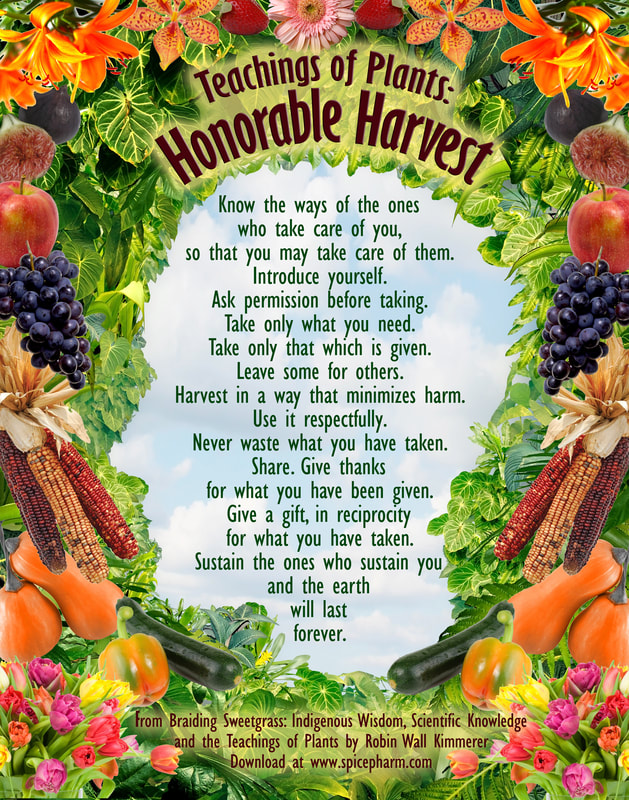 Through these Indigenous reflections, we begin to get a picture of what “only taking what we need” might look like. The Bible and "Taking Only What We Need" It is interesting to note that this Indigenous teaching is not very dominant within the Christian tradition, even though there are hints of it within the Bible. For example, the Lord’s Prayer is a common prayer spoken by many Christians, and many Christians know this prayer by memory. Have you ever considered that there is a phrase in this Lord’s Prayer that hints at this teaching? When I asked, during my meditation time in worship, what this phrase might be, there was a pause from the congregation but soon people responded, “give us this day our daily bread.” Does not this verse really mean, “God, give us this day what we really need, our daily bread?”  Hearing this phrase in the Lord Prayer in this way causes me to pause. What does it really mean for God to give us this day what we really need? In the Bible, there is also an Old Testament story that highlights the importance of the Hebrew people looking to God to provide for their daily needs. This Old Testament scripture captures the speech the Hebrew people heard before they entered the Promised Land. This speech begins by Moses reminding the Hebrew people how God had provided for them in the past. When they were starving in the wilderness, after having fled from slavery in Egypt, God provided them with a mysterious substance called manna that appeared like dew each morning. They were told to just gather enough manna for what they needed on that day; on Friday, they could gather enough manna for two days because of the Sabbath. If they gathered more manna, the manna would rot and become infested with worms. Taking more than what they needed led to real physical consequences for the Hebrew people. Through eating bad food, they would get sickness, even die. They had to learn to live one day at a time, trusting that God would always provide what they needed. They had to learn to take only what they needed, no more. Moses, after reminding them of God’s faithfulness. then looks into the future. It is interesting how Moses saw the dangers of being in the Promise Land where people were not longer required to live from hand to mouth. They now had bountiful harvest but with this bountiful harvest, Moses noted, came the risk of believing that we, humans, now controlled our destiny, that God was no longer needed or necessary. We would outgrow God. Little did they know back then that human’s unsatiable desire for bigger and bigger bountiful harvest could lead to damaging Mother Earth. However this text in Deuteronomy does hint that there are consequences… “If you do forget the Lord your God and follow other gods to serve and worship them, I solemnly warn you today that you shall surely perish” (Deut 8:19) 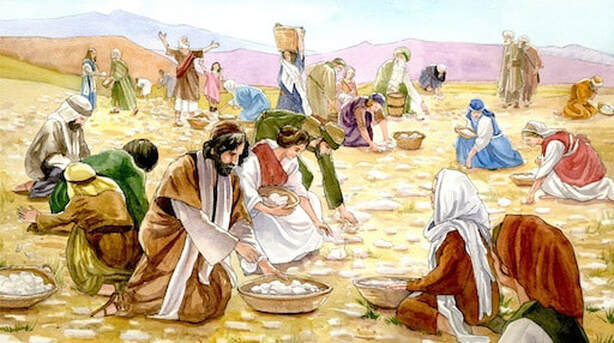 We are beginning to understand what this perishing might look like as we begin to see the impact of climate change and how we are taking more from Mother Earth then we need. We are also seeing the impact of us taking more than we need in terms of the human community around the world, where the rich get richer and poorer get poorer. These disparities are breeding conflict throughout the globe through political unrest, polarization, and distrust in governments, corporations, and human leadership. There is a third Bible text that can be tied to this practice of “only taking what we need.” It is often called the Golden Rule…where we are to treat others as we want to be treated. One version of this golden rule is found is Luke 6. “Do to others as you would have them do to you.” I used to think that the golden rule was the highest standard of love and human treatment one could practice. Until this past year… when I learned about the Platinum Rule. Has anyone heard of the platinum rule? Rather than “treat others as we like to be treated”, which is defining actions of love based on what we want, the platinum rule says this “we treat others in ways that is best for them.” Now, that is a totally unselfish understanding of love. If we were to practice the platinum rule, would we take as much as we wanted…or would we take only what we needed, or would we even go a step further, thinking about the needs of others first before we do any taking. We live in culture that sees our Creation, Mother Earth, as a resource that we can take and use as much as we want. We have had little sense of the Indigenous teaching where we take only what we need. It is only just in my recent lifetime are we seeing the consequences of such selfish thinking and the hurtful actions that come from such thinking. Children Story "The Octopus and the Shark" There is a children story that illustrates this point vividly. The story is called the Octopus and the Shark. The story comes from an excellent movie titled “ Short Term 12” (2013), a story based on the challenges for caring for young teens in a group home, that I watched a couple of months ago. Here is a link to a clip from this movie that contains the following story (https://thatnameasif.medium.com/short-term-12-shark-octopus-story-1fe16bfd1fe1). (In this movie, this octopus and shark story is used in the context of parental sexual abuse, not abuse of Mother Earth as I am using it here)  Once upon a time, somewhere miles and miles beneath the surface of the ocean, there lived a young octopus named Nina. Nina spent most of her time alone, making strange creations out of rocks and shells. And she was very happy. But then, on Monday, the Shark showed up. “What’s your name?” said the Shark. “Nina,” she replied. “Do you want to be my friend?” he asked. “Okay, what do I have to do?” Said Nina “Not much,” said the Shark, “Just let me eat one of your arms.” Nina had never had a friend before, so she wondered if this was what you had to do to get one. She looked down at her eight arms, and decided it wouldn’t be so bad to give up one. So she donated an arm to her wonderful new friend. Every day that week, Nina and the Shark would play together. They explored caves, built castles of sand, and swam really really fast. And every night, the Shark would be hungry, and Nina would give him another one of her arms to eat. On Sunday, after playing all day, the Shark told Nina that he was very hungry. “I don’t understand,” she said. “I’ve already given you six of my arms, and now you want one more?” The shark looked at her with a friendly smile and said, “I don’t want one. This time I want them all.” “But why?” Nina asked. And the shark replied, “Because that’s what friends are for.” When the shark finished his meal that night, he felt very sad and lonely. He missed having someone to explore caves, build castles and swim really really fast with. He missed Nina very much. So, he swam away to find another friend. The children story you have just heard provides a vivid picture of how many humans and corporations treat Mother Earth...like the shark treated the octopus. What would it look like if we were a true friend to Mother Earth and only took what we needed, and no more. What would it look like for us to practice the Platinum rule with Mother Earth…where she is treated in a way that is best for her needs, not ours. 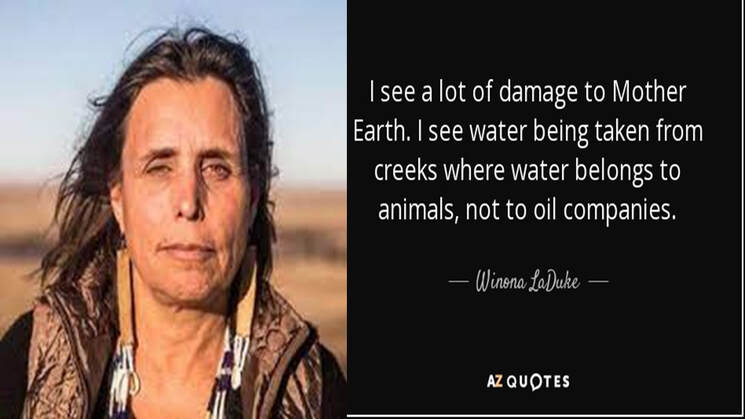 Small Groups Reflection Following this story, I had the congregation break into smalls groups of 10 to 15 people. In these groups, I got them to reflect upon the following three questions: 1. How is Mother Earth like the octopus in the children story? What are the sacrifices Mother Earth is making for humanity? 2. What makes it so hard to live out the practice of "only taking what we need"? What are the cultural beliefs and practices that get in the way? 3. What are some ways we could begin to practice "only taking what we need"? After 15 minutes, the small groups returned to one large group and I invited each group leader to share some highlights from their discussion. Questions 2 and 3 were the questions that caught the most traction within the groups. Let me share some of the responses I heard about question 2:
In terms of question 3, here are some of the responses I heard:
Closing Reflection There is one more feature that is unique to the octopus. It is very uncommon to find a octopus that has fewer than eight arms, at least partial arms. The reason for this is that as soon as an arm is lost or damaged, a regrowth process kicks in to make the limb whole again. While many lizards regrow their tails, these tails are of poorer quality than the original tail. Not so with octopuses. When the arm grows back, it is basically as good as new. I share this unique trait of the octopus because Mother Earth has similar regenerative properties. I remember the days in my youth when Lake Erie was a dead lake. In the 1950s. the population of fish plummeted due to overfishing caused by gill nets. Furthermore, it was due to human pollution. In fact, the pollution was so bad due to combustible chemicals that in 1969 the river that flowed through city of Cleveland into the Lake Erie caught on fire. But thanks to changes in laws outlawing gill net fishing, and changes in human behavior where we stop polluting the rivers flowing into Lake Erie, Lake Erie came back to life. During the past 5 years, the fishing for walleye and other fish in Lake Erie has been phenomenal. https://www.fieldandstream.com/sponsored-content/the-magnificent-resurrection-of-lake-erie-walleye-fishing/ 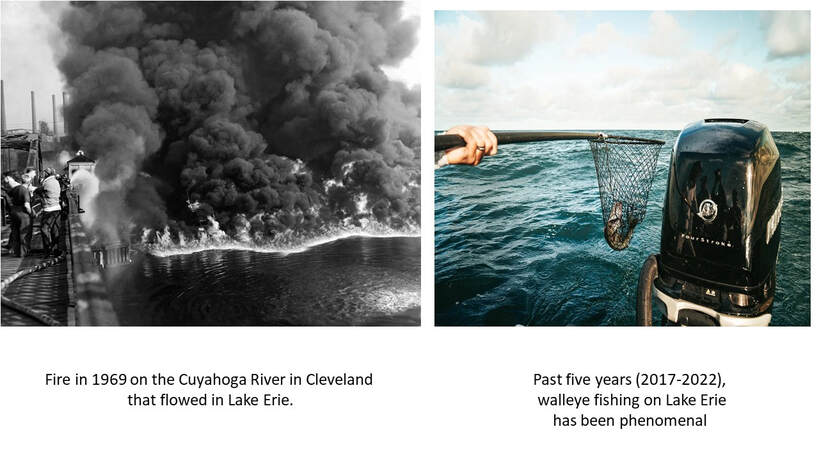 This suggests that if we, humans, only take what we need and care for Mother Earth, Mother Earth has the potential to heal itself, to restore itself back to its original healthy condition.
Let us become friends of Mother Earth that care for her…rather than be like the shark that only see friends as a resource to be used. Let us truly become caregivers of our world and the many people who live within it. Amen. Let it be so. Gord Alton MDiv RP CASC Supervisor-Educator Sunday May 28 was Pentecost Sunday within the Christian Church in 2023. During my church’s worship service, our guest speaker shared experiences from a large worship service of an African Independent Church she attended that echoed of the first Pentecost episode described in the Bible. As I pondered her modern day Pentecost experience, it occurred to me that the strange but profound events she witnessed in that African worship service reminded me of responses that people experience as they release their trauma. In this blog, I want to explore this connection between the strange phenomena that can happen during church healing services that are often compared to the first Pentecost and how it might be explained through the lens of trauma. It has made wonder if part of the purpose of worship services is to help people process trauma. 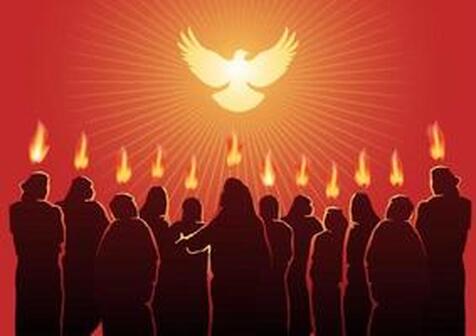 Within Church tradition, Pentecost Sunday occurs 50 days after Easter each year, the day when the church celebrates Jesus’ resurrection from the dead. Christian tradition teaches that the resurrected Jesus appeared to the disciples many times after his death beginning with Easter morning. During his last appearance, before the resurrected Jesus ascended into Heaven, Jesus instructed his followers to “not leave Jerusalem but to wait there for the promised coming of God’s Holy Spirit” (Acts 1:4). On the day that came to be known as Pentecost, the followers of Jesus were all together in one place when ‘suddenly from heaven there came a sound like the rush of a violent wind, and it filled the entire house where they were sitting. Divided tongues, as of fire, appeared among them, and a tongue rested on each of them. All of them were filled with the Holy Spirit and began to speak in other languages, as the Spirit gave them ability. Now there were devout Jews from every people under heaven living in Jerusalem. And at this sound the crowd gathered and was bewildered, because each one heard them speaking in the native language of each. Amazed and astonished, they asked, “Are not all these who are speaking Galileans? And how is it that we hear, each of us, in our own native language? Parthians, Medes, Elamites, and residents of Mesopotamia, Judea and Cappadocia, Pontus and Asia, Phrygia and Pamphylia, Egypt and the parts of Libya belonging to Cyrene, and visitors from Rome, both Jews and proselytes, Cretans and Arabs—in our own languages we hear them speaking about God’s deeds of power. All were amazed and perplexed, saying to one another, “What does this mean?” But others sneered and said, “They are filled with new wine”’ (Acts 2: 1-13). Our church guest speaker, Susan Allison-Jones, for this Pentecost Sunday, shared an experience she had while attending a large African Independent Church yearly healing conference. The African Independent Churches is a group of Christian denominations in Africa that take seriously their African context. Rather than accept Western forms of Christianity based on missionaries, they seek to develop a Christian Church that reflects their history and context. For example, many of these churches hold the practices of polygamy, chieftaincy titles, traditional religious habits, and belief in traditional African cosmology in a more graceful way than Western-based Christian churches. Furthermore, prophecy, visions and dreams are allowed in these churches. (A Review of African Initiated Churches and Their Contributions to the Development of Education in Nigeria Dr Tiwatola Abidemi Falaye Department of Religious Studies, Faculty of Arts, Olabisi Onabanjo University, PMB 2002, Ago Iwoye, Ogun State , Nigeria) (https://core.ac.uk/download/pdf/234690013.pdf). 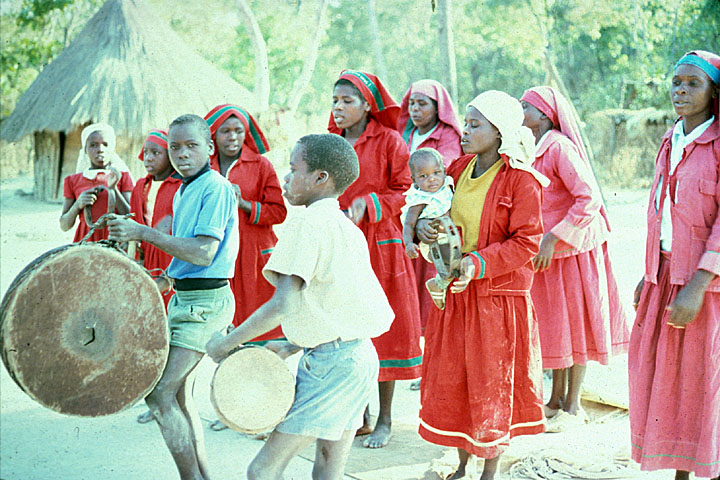 Susan described how African Independent Church services are not calm and orderly like Western Church services. When people sing, they use their whole body. And when the pastor preaches, strange things can happen in their services. And this is exactly what happened during this worship service. Over 3000 people had travelled to attend this yearly service, a service that many seek to attend each year. They met in a new unfinished church building. This building had been built larger to replace the old church building, but even this building could not begin to hold the crowds of people who came. While the roof was on, the walls were not fully completed which was a blessing in disguise. The walls only reached 4 feet from the ground which meant that people could gather around the building and still hear and experience the worship service. Being a guest Westerner Christian worker, Susan sat at the front of the church sanctuary along with other church leaders. She sat beside the wife of the preacher. She had a good view of everything. They first sang and then the preacher got up to preach. The preacher spoke in the language of the Botswanan people, a language that Susan did not understand. In talking to the preacher afterward, she learned that the preacher had preached a basic Christian sermon, nothing that made it different from a standard Christian sermon. As the pastor preached, suddenly someone toward the back of congregation shrieked…and then arms moved uncontrollably and a group of praying people gathered around them. And then commotion happened in another area of the worship space…more strange behavior, noises, and movements. Again, a circle of praying people circled this person. Throughout the preaching, these strange episodes kept happening throughout the worship area. Susan noted that she was glad she was up front away from all this strange behavior when suddenly the preacher’s wife began to shake and make noises. Soon a group of praying people gathered around her and she witnessed this phenomena firsthand. Susan has come to see this healing service with all these strange phenomena as an example of a Pentecost experience, an event when God’s Holy Spirit moves in strange and mysterious ways among the people of God, just like God’s Spirit did during the first recorded Pentecost episode some two thousand years ago. 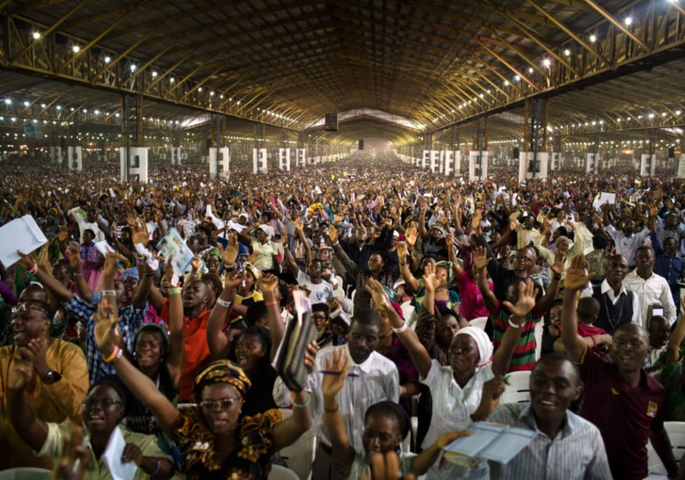 As I heard Susan described her Pentecost experience, it occurred to me that what she was witnessing was the release of trauma. In saying this, I am not discounting that these strange phenomena were not caused by God’s Spirit. In fact, I am saying the opposite, that when people’s psyches and bodies can deeply surrender and relax into the Presence of God’s spirit, this is exactly what I would expect to happen. Before you write this off as a crazy idea, it is important to understand how trauma works and how it is released within people. Peter Levine, PhD, a psychologist, researcher, and developer of Somatic Experiencing, wrote a landmark book, Waking a Tiger: Healing Trauma (1997). In it, he explores the question, “why are animals in the wild, though threatened routinely, rarely traumatized? By understanding the dynamics that make animals virtually immune to traumatic symptoms, the mystery of trauma is revealed” (book cover). His research has led to him to develop the psychotherapeutic modality of somatic experiencing. Typically, when humans are threatened, two responses happen. We either fight the threat or we flee from it. But there is a third response, a response that happens when fight and flight responses are not possible. This response is freeze or collapse.  Levine says that "the freeze response is one of the body’s involuntary defense responses to threats”, “an armor against an unacceptable feeling” (https://www.nicabm.com/experts/peter-levine/). Here are a few key signs that a person is in freeze:
Imagine a gazelle grazing on the Sahara. From close behind, a lion stalks this prey. Suddenly, the gazelle notices it’s being followed. To protect itself, the gazelle freezes. Perplexed by this abnormal behavior, the lion loses interest in the gazelle and wanders off in search of other prey. So as you can see, the gazelle was able to escape this predator thanks to its freeze response. (https://www.nicabm.com/experts/peter-levine/) (Click here to see a video that shows this freeze/collapse response in the wild)  Now, while this freezing can be adaptive in the moment, where it becomes harmful is when it persists even after the threat has passed. (https://www.nicabm.com/experts/peter-levine/). People can become stuck in their traumatic freeze/collapse response. While animals are capable of returning to a regulated, healthy state relatively quickly, “humans, on the other hand, tend to remain stuck in hyper-vigilance after experiencing trauma far more than animals do. Peter concluded that this happens because moving out of a trauma response often involves coming back into contact with painful sensations. For more primitive animals, this is a process they can’t resist. But as humans with higher-order thinking, we’re capable of avoiding those uncomfortable experiences. The goal of Somatic Experiencing, therefore, is to help a client reconnect with their inherent ability to tolerate distressing emotions” (https://www.nicabm.com/experts/peter-levine/). This involves getting in touch with their body through breathwork, body sensing, or through re-entering postures that help people connect with the shame and pain of the freeze response trapped in their bodies (https://www.nicabm.com/experts/peter-levine/) This is how trauma is realized in the counselling room with a therapist trained in somatic experiencing or other similar body-based therapeutic modalities that help clients process their trauma trapped in their bodies. My suspicion is that a similar trauma-release process is happening for those people in that African Independent Church service. Within that worship service, some people felt so safe within the community of God’s people and within the field of God’s loving presence that they allowed themselves to relax and surrender so deeply that the frozen trauma responses trapped in their bodies began to release. I think it is significant that worship within these African Independent Church often involves people being expressive with their bodies as they sing, pray, and listen to someone preaching. This intense body awareness and engagement sets up the right conditions for trauma to be discharged. I remember the Toronto Blessing phenomena that began in January, 1994 when similar mysterious manifestation happened here in Canada during worship at the Toronto Airport Vineyard Church (https://en.wikipedia.org/wiki/Toronto_Blessing). 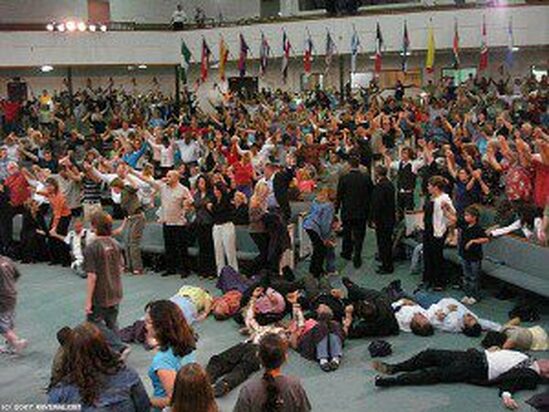 The Vineyard church is an “international neocharismatic evangelical Christian denomination” (https:/en.wikipedia.org/wiki/Association_of_Vineyard_Churches). Being a Mennonite pastor who pastored a church in Markham-Stouffiville north of Toronto during this time, I was quite curious and so I attended a worship service to understand for myself what was happening. During that service, there was an invitation to come to the front of sanctuary for prayer and anointing of God’s Holy Spirit and so I went forward. I witnessed firsthand people collapsing to the floor beside me as people prayed with them. Supporting staff would catch these people, and gently laid them on the floor. When my time came to be prayed over, I was surprised to notice the strength in my legs disappear, and while I didn’t collapse, I knew I needed to lay on the floor so I didn’t fall. All I can remember from that experience was how peaceful and relaxed I felt and the profound sense of love I felt internally. Knowing what I know now, I would conclude that such healing worship services created the right conditions for people to release aspects of the trauma they were carrying from their past. When I attend worship now, I regularly touch into a similar place, especially during certain congregational songs or when hearing others sing. During those times, I get so emotionally choked up, I can no longer sing. All I can do is just basked in the experience of love or gratitude that I am feeling in the moment. Last Sunday it happened again when a newer member to our church sang for the first time in our church along with his friend. I understand these moments as times when my soul is very open and receptive to the spiritual field where God’s spirit emerges, where I am in a deep place of surrender. But now, I wonder if some aspects of my past traumas are being released each time those sacred moments occur, what are often called corrective emotional experiences within the counselling office. In reflecting on this theme of worship and trauma, it has made me wonder if we, who attend worship services, need to approach this sacred time differently. Many of us come to religious sanctuaries in our best clothes and state of mind and praise God/Allah/Buddha/Creator/Life for the many blessings we have and hope to learn teachings that will help us in living a more fulfilled life. What if we approached worship like clients often approach their sessions of counselling, with a little fear and trepidation, but also with a deep longing to surrender into a mysterious Presence that allows Spirit to touch us at our deepest places, places where our frozen trauma parts are waiting to be freed a little more. I wonder how our worship services would change. Gord Alton MDiv RP CASC Supervisor-Educator
Throughout my blogs, I have been exploring how current developments in psychology and psychotherapy can bring helpful new perspectives and correctives to our religion and spirituality. No longer a pastor, I am one of five worship leaders within my current church at Shantz Mennonite Church near Baden, Ontario. Here I get the opportunity to shape the language that my congregation uses when I am worship leading. In this blog, I want to share with you how my training and experience as a psychospiritual therapist is changing the language I use in worship so that these prayers now reflect a theology and spirituality that nurtures better the faith of the people in my church. 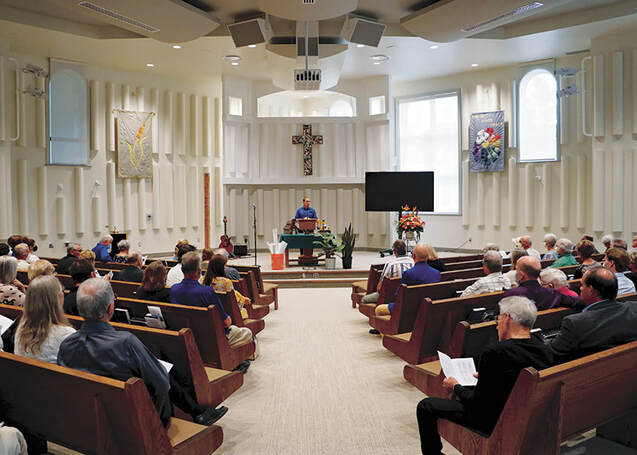 Back in March, when my church was recognizing the six-week season of Lent, I was struggling with the prayer resources that my church was using in worship. I remember one Sunday where I found myself unable to repeat the prayers found on the screen at the front of my church. I found the language so condemning of me, as a human being, and instead of these prayers lifting my spirit, I found they burdened me with unnecessary guilt and shame. Knowing that I was worship leader in a couple weeks, I shared with my pastor my struggle and ask him if I could rewrite all my worship resources for my Sunday when I was worship leading. I promised to still use the resources but rework them so that they spoke to and nurture my spirit more, and hopefully the faith of the people in my church. In this blog, I want to share with you the “before” readings and the “after” readings to help you see and experience what I was struggling with during Lent this year in my church. The “before” readings are the worship resources that I was given to work with. The “after” readings are the final readings and prayers I used that Sunday in worship. a. Reworking the Call to Worship Within my church, after a time of welcoming, worship begins with a call to worship. Here is the original call to worship that I was given. Leader: Out of the depths we cry to you. People: O Lord, hear our cry. Leader: If you kept a record of sin, who would stand a chance? People: O Lord, hear our cry, Leader: But with you there is forgiveness. All: We wait for you, O Lord. We hope in your word. Blessed be your name.  This Call to Worship is based closely on Psalm 130. Because it is based on a literal text of the Bible, there is often a reluctance to adjust the language found in this Psalm. However, I struggled with the language in this Psalm for the several reasons. First, there are not many Sundays where I am in this sad place, where all of me is crying out to God. So, it feels inauthentic for me say these words. I suspect this would be true for many people on a Sunday morning, not just me. Second, as a spiritual care provider, I know that when "all of me" is in this place where we identify with the experience of crying out to God from our depths, a merge has often happened. My sense of me, my centre, has merged with the painful sad part within my soul, and when this happens, we do feel that all of us is in pain and thus is crying out to God. However, when we are in a merged state with our pain, it is not possible for us to sense the presence of God in our lives. When we are in a merged state, we do feel totally abandoned by God…just as Jesus felt abandoned on the cross just before he died. This is what naturally happens when we are merged with the pain of any negative emotion: we feel disconnected from Presence or the Sacred. However, the purpose of prayer is to help people break this merge state, to help them realize that only a part of them is in intense pain, not all of them, and that God is actually there with them in their pain. How could this call to worship be changed so that it helps people break their merge state rather than support this merge, and open the possibility for them to experience the presence of God again during this time of worship? Third, I found the phrase “But with you (God), there is forgiveness” way too weak. When we are in this place of pain around sin and hurt, we want more assurance than that in God there is forgiveness. We want to know that all painful experiences of life are forgiven and healed by God. Fourth, I found it problematic for people to utter the words “we wait for you, O God.” It suggests that for some reason God is withholding God’s presence and healing from us, and so we are waiting until this reason is addressed. But is it true that we are waiting on God to respond to our pain? When Christian theology claims that God’s love is unconditional, does that not suggest that there is no reason, from God’s end, for us not to experience God’s loving presence. If this is true, then the psalmist is wrong when they frame their sense of aloneness as “we wait for you, O Lord.” I have found in my spiritual care ministry that many people hold this “waiting on God” form of theology, which causes them to feel powerless for due to this belief, they are powerless to do anything (God is in control) or angry at God for not responding to their prayers, and many other complex feelings. Instead of interpreting this “waiting on God” in this way, is not this “waiting on God” described better as our longing for God’s presence to come into our painful place? Finally, this call to worship focuses on hope, hoping that our theology is true, that God’s love is unconditional and thus God’s spirit is already present and actively engaging with our painful life experience. I find the word “hope” a weak word of faith compared to the word “trust” which captures the truth that God’s spirit is already here and interacting in helpful ways with our life. With these thoughts in mind, I rewrote the call to the worship that I was given to the following: Leader: Out of the depths, the painful part within us cries out to you. People: O Lord, we know you hear this cry. Leader: If you kept a record of sins, who would stand a chance, but you don't. People: O Lord, we know you hear this cry. Leader: But with you, all can be forgiven. All: We long for your soothing compassionate spirit. We trust in your word. Blessed be your name. I invite you to read these two calls to worship together, one after the other. Our experience of them is very different. One is heavy, the other is more life-giving. b. Reworking the Prayer of Confession Here again, the worship resources I was given contained a prayer of confession that was quite condemning. Leader: Lord, our lives are dry bones. We are cruel in our words and indifferent in our actions. We confess to the Lord …. (silent prayer) Leader: Breathe on us, Lord. Put your Spirit within us and make us alive. All: We place our hope in you. This prayer of confession is based on the Old Testament text from Ezekiel 37 which works with the image of dry bones.  How do you feel after saying this prayer of confession? Do you feel uplifted and forgiven or do you feel like you are waiting for the forgiving presence of God to come? As I did with the Call to Worship, I reworked this confessional prayer so that it became a prayer that helped people experience more the healing presence of God. The original confessional prayer nurtured the negative merge with the dry part of our soul by claiming “our lives are dry bones.” This is not totally true. There are some days when this negative merge is true but there are other times when our lives don’t feel like dry bones but are alive. This truth is the essence of narrative therapy where we help clients look beyond the dominant negative narrative in their life of dry bones and discover the less common but more essential counter narrative where they find ourselves alive with energy and optimism. Should not a confessional prayer carry a similar hopeful focus that is based on more truth? This means that it would be more truthful to pray that “there are days when our lives feel like dry bones”. This negative merge continues in this prayer when the congregation is invited to say, “We are cruel in our words and indifferent in our actions.” How is reciting those condemning words helpful to anyone? How are they even authentic for people who rarely are cruel in their words or indifferent in their action? Seeing these issues, I rewrote this confession with language that highlighted that these potential aspects of our fallen human nature are only a part of us, and only a part of us when we unfortunately express them in our lives, and this does happen sometimes. I was also troubled by the phrase, “put your Spirit within us and make us alive.” I have come to realize that God’s spirit is always within us, that we born with God’s spirit already present within our soul. The issue is not God’s spirit is missing in us and thus needs to be put in us. Rather, there are structures in our soul that have developed during our lifetime like unhelpful beliefs, painful memories, unhealed sins and hurts, coping patterns, addictions, compulsions, etc. that block us from noticing and sensing God’s spirit moving within our soul. This is why many people feel that God’s spirit is not present in their soul, and thus abandoned. These structures that restrict the flow of God's spirit in our soul is what causes this feeling of "waiting on God" and longing that we discussed earlier in this blog. I suspect that this was what Ezekiel, the Jewish prophet whose words are the basis of this confessional prayer, believed. He believed, due to his experience of dry bones, that God’s spirit no longer resided within his soul. For those who practice spiritual direction and psychospiritual therapy, we know that this belief is not actually experientially or scientifically true. Below is my final confessional prayer that I invited my congregation to participate in. Leader: Lord, there are days when our lives feel like dry bones. We can be cruel in our words and indifferent in our actions. We confess to the Lord . . . (silent prayer) Leader: Breathe on us, Lord. Allow us to become aware of your compassionate Spirit within us so that we can become more alive. All: We place our trust in you. Amen. Again, I invite you to read these two versions of the confession prayer and notice how they impact you differently. c. Composing an Offertory Prayer Each Sunday during worship, there is a time when our congregation has an offertory prayer. Since many people provide offerings to the church through electric funds transfers, we no longer pass the offering plate. Instead, the offering plate is by the back doors by the sanctuary and people, who wish to give a physical offering, can do so upon entering or leaving the sanctuary.  Even though the offering plate is not passed, our congregation still believes it is important to have an offertory prayer. I have given a lot of thought around the goal of the offering prayer. Many times, I have found offertory prayers often stress our responsibility as Christians to be generous with our time, money, and sharing of ourselves with others. There is truth is this, but I have come to realize that offering is not something we “should” do as Christians. Rather, offering is an expression of God's spirit moving within us causing us to be generous and wanting to respond to the needs within our church community and the many needs beyond the church in the world. I have come to realize that “shoulding” is not an expression of God’s spirit but rather a fallen structure within our soul that Christians and churches often appeal to so that we are generous in our offering to the church. With this in mind, in my offering prayers, I seek to connect with the deeper motivations and longings of our soul that have their roots in God’s spirit whether it be our longings to be generous, or our feelings of care toward those who are suffering in our community or world, or our desire to share offering as an expression of gratitude toward how God has blessed our lives. Below is the offertory prayer I shared on this Lenten Sunday when I was seeking to nurture a theological culture in church that would help people connect with their essential nature of their soul…where God’s spirit emerges from within us. I said the following words of introduction and then shared a prayer. Words of Introduction: During our offering time, I want to you to consider how all of us are part of God’s community. When one part of humanity suffers from dryness and lack of life, we are all impacted by that dryness. When one part of humanity is blessed, all of humanity is meant to experience these blessings for these gifts are meant to be shared. Let us pray: Wonderful God, we are so grateful for the many ways your spirit revitalizes our world and us so that we can experience life more fully. In response, we willingly share of these blessings …whether it be ourselves, our time, or our possessions so that others can be blessed…and thus experience the fullness of life that God wants all people to experience. In the name of compassionate Christ, the giver of life. Amen. d. Composing a Congregational Prayer Every Sunday, following the sermon/teaching time and singing, we enter a time of congregational prayer. This prayer can take on many forms. This congregational prayer is done often by our pastor, but we, as worship leaders, have the option to create a congregational prayer and lead our congregation through it. This is what I did on this Sunday. I wanted to create a congregational prayer that reflected a theology and used images that help people connect with their divine selves but also help people experience God’s spirit interacting with their painful parts if that was what was needed on this Sunday. Below are the 5 slides I created and used with my congregation to help them experience God's spirit ministering to them during this time in the worship service. As you read through them, you will see how I integrated many insights of spiritual care into this prayer as well as images from the scriptures, especially Ezekiel 37, that were read on this day.    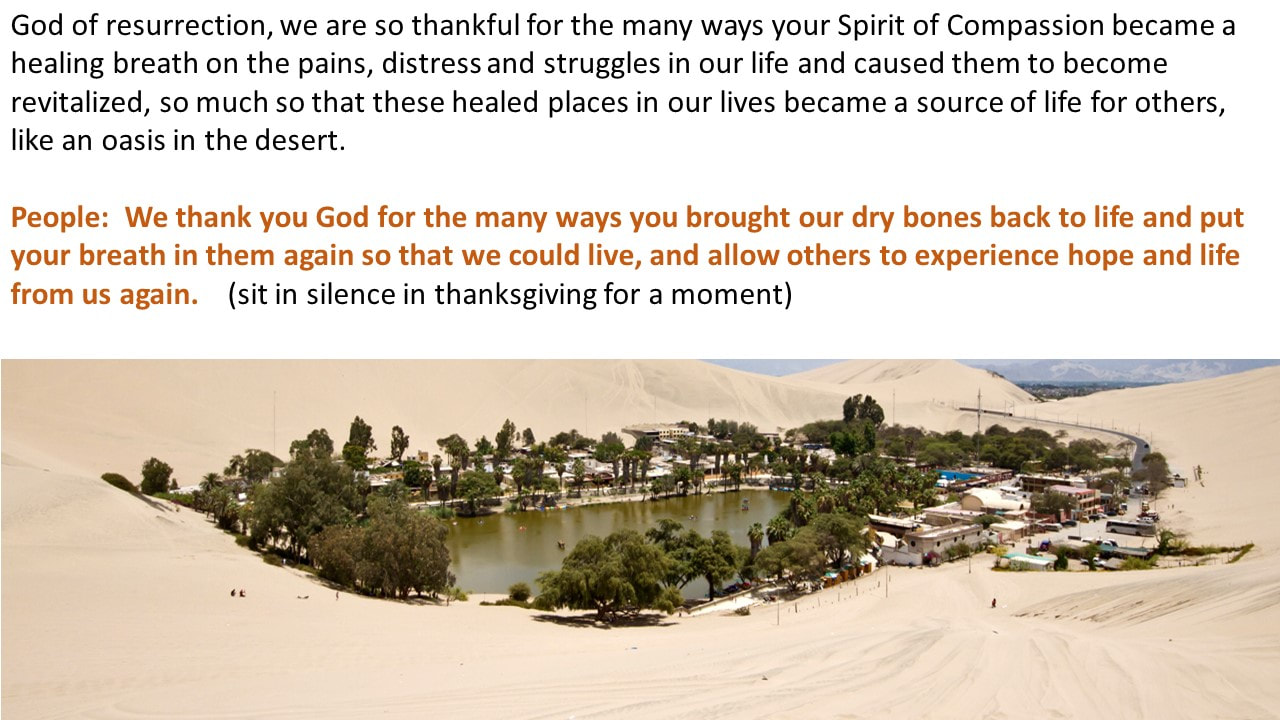  e. Reworking the Closing Blessing
Here is the final blessing I was given from the worship resources provided for this day. Leader: Put your hope in the Lord. People: The Lord is unfailing love. Leader: And with God is full redemption. People: God will bring us up from our graves. All: God will redeem us from our sins. Below is the final blessing I created using the above blessing as a starting point. Leader: Put your trust in God’s compassion. People: God’s love never fails. Leader: And God fully restores us. People: God will revitalize those parts of us that feel dead. All: God will heal us from our mistakes and brokenness. Conclusion: This whole experience of worship leading for this Lenten Sunday made me far more conscious of the language we use in our prayers, readings, and songs in the church, and how some theological language is very deadening to most people’s faith while other theological language is very life giving. My hope in sharing these reflections is that they may inspire us to become more conscious and reflective of the language we used in our religious and spiritual communities. It is important to realize that not all religious or biblical language is life-giving to people. Gord Alton MDiv RP CASC Supervisor-Educator Currently, the Christian Church is recognizing the season of Lent that culminates in the remembrance of the crucifixion of Jesus and the resurrection of Christ this weekend. Throughout this time of Lent, a major theme is that of "dying to self" which appears in many places in the Bible. But what does it mean to "die to self"? This is the question I explore in this blog for how one understands and thus practices “dying to self” determines whether this is a pathway of love or a pathway of self rejection. Many forms of "dying to self" are only self management strategies while some forms of "dying to self" actually lead to self hatred. Read on to learn more.  Within the Bible, there are three common ways of expressing this process of “dying to self.” 1. “Dying to self” as “taking up the cross” daily Sometimes this “dying to self” is understood as denying ourselves and taking up the cross daily and following the way of Jesus (Luke 9: 23). We read in Luke that Jesus taught “whoever seeks to save their life will lose it, and whoever loses their life for God’s sake, will save it” (Luke 9: 24). This act of “dying of self” captured in the symbol of the cross is often understood as striving to deny or renounce our selfish desire and align one’s life with the will of God. By managing our thoughts, feelings, and behaviours so we are good, many believe we will discover the fullness of life that comes from living this way. As the picture below suggests with Jesus carrying the cross, this practice of "dying to self" is difficult. It involves the persistent and consistent act of human will, We believe we can make this “dying to self” happen through human striving, through managing the pulls of our fallen nature and pushing ourselves to live our lives in ways that align with the purposes of God and the way of Jesus. 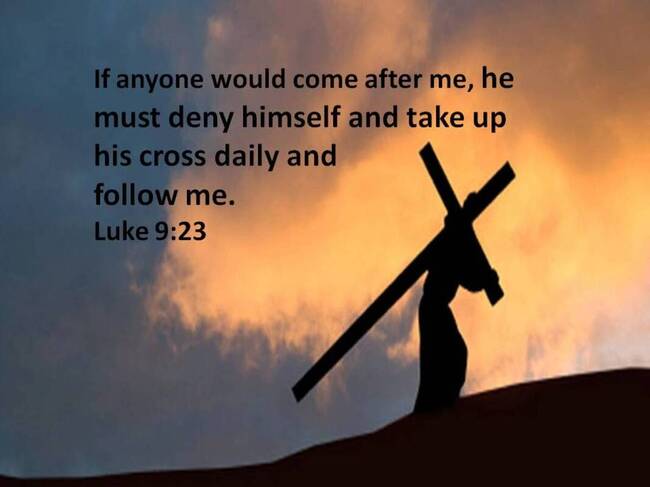 However, when we understand “dying to self” in terms of self management, we experience a struggle between the longings of our hearts to do what is good or right and the desires of our fallen human nature. Apostle Paul describes this inner conflict in this way, “I do not understand my own actions. For I do not do what I want, but I do the very thing I hate” (Rom 7:15). Due to this struggle that is implicit to this understanding of "dying to self", guilt and shame is a common companion. This view of “dying to self” is common in the church and is behind the 4-step practice of confession and assurance of God’s forgiveness that happens in many churches. I outline below how this confession often happens in a church worship service.
For those who are familiar with the psychology around addictions, as explained by Dr. Gabor Mate in his book, “In the Realm of Hungry Ghosts: Close Encounters with Addictions”, we know how the human will can easily become compromised. People who are addicted cannot through human effort alone overcome their addiction. The same is true when we are dealing with the process of “dying to self” for the fallen self has an addictive nature. It is not possible for our human will to “die to self” for the very part of us that is trying to make our self die is the very part that must die.  The downside to understanding “dying to self” through this self management lens is that in dying to our self, we come to see ourselves constantly as fallen selves, as very divided and broken human beings, longing for God’s grace, far from the picture of being beloved children of God. 2. “Dying to self” as crucifying “the flesh with its passions and desire” There are scriptures in the Bible that seem to take this act of self denial a step further. Instead of managing the problematic parts of our personality, some scriptures suggest that we should reject or hate these parts of us. The gospel writer John has Jesus teach “whoever loves their life loses it, and whoever hates their life in this world will keep it for eternal life” (John 12:25) Apostle Paul takes this sense of hating our life one step further by claiming that “those who belong to Christ Jesus have crucified the flesh with its passions and desires” (Galatians 5:24). Not only are we to deny and hate our fallen nature, we are to crucify it by nailing our sins to the cross of Jesus.  For the readers who are counsellors, there is a major issue in this form of Christian theology that stresses dying of self as involving hating and crucifying one’s sinful nature. Such a theology teaches people to hate themselves even though all people are created in God’s image and are God’s beloved children. For those of us who professionally provide counselling and spiritual direction to people living with mental health issues, often a feature of their mental health is profound feelings of self hatred. They don't need pastors or counsellors or Christian friends saying things that deepen their sense of self hatred. Unfortunately, within church history, this crucifixion theology has led to the ritual of exorcism whose purpose is to crucify, cast out, or excise spiritually, like a surgery, the evil part within our self. From the few people I have met who have gone through such a ritual, this act of exorcism led to profound self hatred, sometimes creating psychotic breaks in their psyches where this hated part became dissociated from their core self and thus created major mental health issues. It is clear to me that there is no place for the ritual of exorcism within the Christian church. Again, how we understand “dying to self” shapes how we come see ourselves. Through this lens of “crucifying our passions”, we come to see ourselves as full of evil and far from God, nothing close to being a beloved child of God. So far we have looked at two ways of understanding "dying to self", one of managing self and one of rejecting the fallen parts of self. Both of these frameworks of "dying to self" lead to some form of self rejection. Even self-management implies judging parts of our self as problematic and thus parts of us that need to be controlled in some way. This begs a question. Is there a way of practicing "dying to self" that leads to love and grace rather than be based on some form of self-rejection? This question leads to a third image of "dying to self" found in the Bible. 3. Dying to self is an act of self-emptying. This act of self-emptying, or kenosis, is described in Apostle Paul's letter to the Philippians where he writes how we are to empty ourselves like Jesus did, who “did not regard equality with God as something to be grasped, but emptied himself, taking the form of a slave, he humbled himself and became obedient to the point of death—even death on a cross” (Phillip. 2: 6-8). From this place of emptiness, we read that God exalted Jesus, and he became a human that expressed the fullness of God’s spirit. I have come to see this notion of self-emptying as very different than self-management or self-rejection. Instead of nurturing self judgement and self-hatred, the act of self-emptying involves a profound love. This notion of self-emptying suggests a different understanding of self then found in the other views of “dying of self.” Rather than the self being a unified sense of who we are that we are to deny or crucify, the practice of self-emptying suggests a very different notion of self. Here, the sense of self is seen as a container that has parts that can be emptied out of it, like a toy chest that can be emptied of all the things that are stored within it.  This Biblical understanding of self as a container that hold many parts resonates with insights of psychology, like Internal Family Systems and the Diamond Approach, the two psychological systems I am most familiar with. For me, this Biblical sense of self is similar to how I understand the human soul, which I described in my previous blog on the anatomy of the soul, a container that holds many different parts like the primitive animal soul and egoic soul and all of its many structures. The other thing this text in Philippians stresses is that Jesus practiced this self-emptying and that this process involved Jesus humbling himself to the point of becoming a servant or slave; he was no longer in control. It is clear when we see self-emptying described in this way that it is very different than self-management or self-rejection for in both of these cases, our sense of self is in control. We believe we can deny our fallen through striving and self management. We believe we can crucify our sinful passions through some form of spiritual surgery of the parts of us that we reject. How Apostle Paul describes self-emptying is a very different process, one where we have give up our sense of control and become a servant. As I was considering how Jesus practiced this self-emptying, it occurred to me that self-emptying happens for us when we share our burdens and distresses with someone we trust who is full of grace and unconditional love, no sense of judgement. In that act of self-emptying with a caring other, we are able process what is distressing us leading to healing and personal transformation.  For Jesus, this self-emptying with another happened through his prayerful relationship with God. In the temptation story of Jesus with the Evil One, we see Jesus practice self-emptying as he shares these temptations with God (Luke 4). In Jesus’ prayer in the Garden of Gethsemane on the night before he was betrayed and denied by his followers and crucified, we see Jesus self-emptying when he prayed, “God, if you are willing, please take this cup from me, yet not my will but your will be done” (Luke 22:43). Even when Jesus was dying on the cross, we see Jesus praying to the one Presence who had been faithful, loving, and gracious throughout his life, “My God, My God, why have you forsaken me?” (Mark 15:33). I am sure there were many more moments of prayerful self emptying in Jesus’ life. In each of these moments of prayerfulness, self-emptying was happening. If instead of taking control of managing his life, including his emotional and mental life, Jesus surrendered himself to God by sharing his burdens and distress with God, and embracing whatever guidance or insight he received. This is what the following words of Apostle Paul mean: “He did not regard equality with God as something to be grasped, but emptied himself, taking the form of a slave, he humbled himself and became obedient to the point of death—even death on a cross” (Philipp. 2: 6-8). In self-emptying this way, Jesus experienced the fullness of God’s spirit, not just through the resurrection of his life at his death, but throughout his earthly life as he lived out the spiritual practice of self-emptying. I find that the church has not done a good job of teaching their members the practice of self-emptying. I know I didn’t do this well as a church pastor for over 25 years. Where are the safe and gracious places where people can practice becoming vulnerable by sharing their distress and burdens with God and others with the goal of becoming a servant to whatever guidance and insight they receive from these prayerful moments? In writing this blog, I have come to realize that this practice of self-emptying is what happens in my spiritual direction and psychospiritual therapy sessions with my clients…or in supervision with our psychospiritual therapy interns and students. When we practice “dying to self” in terms of self-emptying, we quickly notice that this form of “dying to self” feels very different than self-management or self-rejection. It lacks the pressure of self-denial to constantly manage one’s fallen nature and the rejection that ultimately arises every time we fail. In contrast to the self-hatred that we nurtured through crucifying our unwanted fallen experiences , self-emptying opens the doorway to a different type of with our struggling parts, one of curiosity, compassion, and grace. Here, we discover the experience of love that emerges as we bring the fallen parts of ourselves to our compassionate God or prayerful person for understanding and gracious healing. Questions to Ponder: 1. Consider how you have practiced" dying to self" in the past. How much of this "dying to self" was a form of self management and required a lot of striving? How much it involved some aspect of self rejection? How often did your practices of "dying to self" lead to moments of love, grace and connection with others? 2. I am suggesting in this blog that our sense of self is like a chest that holds many different parts, parts that we can separate from and place outside our chest. As we place different parts of ourselves outside our chest, that is, practice self emptying, this gives us the space we need to explore these aspects of ourselves with God or caring others with curiosity, compassion, and grace. When have you practiced self emptying in this way? Who were the people you practiced self emptying with? 3. How was this experience of "dying to self" through self-emptying different than self management and self rejection? Gord Alton MDiv RP CASC Supervisor-Educator In each of these moments of prayerfulness, self-emptying was happening. If instead of taking control of managing his life, including his emotional and mental life, Jesus surrendered himself to God by sharing his burdens and distress with God, and embracing whatever guidance or insight he received. This is what the following words of Apostle Paul mean: “He did not regard equality with God as something to be grasped, but emptied himself, taking the form of a slave, he humbled himself and became obedient to the point of death—even death on a cross” (Philipp. 2: 6-8). In doing so, Jesus experiencing the fullness of God’s spirit, not just through the resurrection of Jesus at his death, but throughout his earthly life as he practicing the spiritual practice of self-emptying. I find that the church has not done a good job of teaching their members the practice of self-emptying. I know I didn’t do this well as a church pastor for over 25 years. Where are the safe and gracious places where people can practice becoming vulnerable by sharing these distress and burdens with God with the goal of becoming a servant to whatever guidance and insight they receive from these prayerful moments? In writing this blog, I have come to realize that this practice of self-emptying is what happens in my spiritual direction and psychospiritual therapy sessions with my clients…or in supervision with our psychospiritual therapy interns and students. When we practice “dying to self” in terms of self-emptying, we quickly notice that this form of “dying to self” feels very different than self-denial or self-crucifying. It lacks the pressure of self-denial to constantly manage one’s fallen nature and the rejection that ultimately arises every time we fail. In contrast to the self-hatred that we nurtured through crucifying our unwanted sinful experiences , self-emptying opens the doorway to a different type of nurturing. Here, we discover the experience of love that emerges as we bring the fallen parts of ourselves to our compassionate God or prayerful person for understanding and gracious healing. Within the Christian tradition, the human soul is often seen as having two natures, a Divine nature and a sinful or fallen nature. But what do those terms mean for they don’t appear in psychology, which is usually the place we turn to understand human experience? In this blog, I plan to describe how the Diamond Approach understands the human soul, a spiritual psychology based on the insights of Western psychology and the mystic traditions of the major religions. I have been an active student of a Diamond Approach Work School for 17 years now. Within this Diamond Approach framework, we get a far better understanding psychologically of what the Christian tradition describes as the two natures of humanity. Within biology, science has developed a clear picture of the anatomy of the human physical body as the picture below shows. If one could could conceive the human soul in a similar anatomical way, what would be its parts? 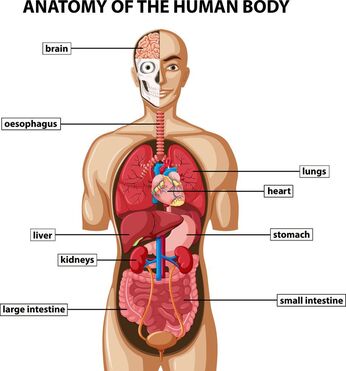 The Diamond Approach teaches that the human soul has 3 aspects to it: the animal soul, the egoic soul, and the angelic soul. Lets look at each aspect of the human soul in more detail. The Animal Soul One component of the human soul is called the animal soul, one that has its roots in the biological human brain. Our animal soul is run by survival, social, and sexual drives and instinctual appetites where we seek pleasure and avoid pain. The animal soul “is not particularly destructive or grossly and intentionally selfish, but similar to animals in the wild....  ...However, because it is disowned, the animal soul loses contact with the other elements of the soul, and becomes distorted and extreme in the intensity of its aggression, worse than actual animals” (The Inner Journey Home, pg. 203). This disowning happens when the dynamics of our animal soul are judged as wrong and thus denied, buried, and hidden away in our unconscious. When that happens, our animal soul becomes “full of desires, cravings, uncontrollable impulses, lust, and passion for what the world offers. We want with passion, crave with hunger, and desire with instinctual abandon. We desire instant gratification, but our appetite for such gratification has no bottom and no end. We want and want and want. We want to eat, copulate, possess, dominate, even nourish and nurse ad nauseam…The animal drives for shelter, survival, pleasure, and sex reveal their true primitive potential when we experience a barrier to their satisfaction. Our animal side can instantly become inhumanly brutal, grossly aggressive, crassly greedy, heartlessly selfish, and totally uncaring for others to the degree of complete disregard of what they feel" (The Inner Journey Home, pg. 142). Within the Christian tradition, these distorted qualities that arise from our animal soul are what Apostle Paul calls in the Bible the “works of the flesh.” They include “sexual immorality, impurity, debauchery, idolatry, sorcery, enmities, strife, jealousy, anger, quarrels, dissensions, factions, envy, drunkenness, carousing, and things like these” (Gal. 5: 18). Apostle Paul taught that “what the flesh desires is opposed to the Spirit, and what the Spirit desires is opposed to the flesh” (Gal. 5: 19) . As a result, within Christianity, and this is true of the other major religions too, the dynamics of the animal soul are seen as sinful and evil and need to be tamed, managed, and eradicated if possible. Such religious judgmental teachings, rather than transforming our fallen animal nature, distort it even further and even energize it causing it to be more problematic in our lives. 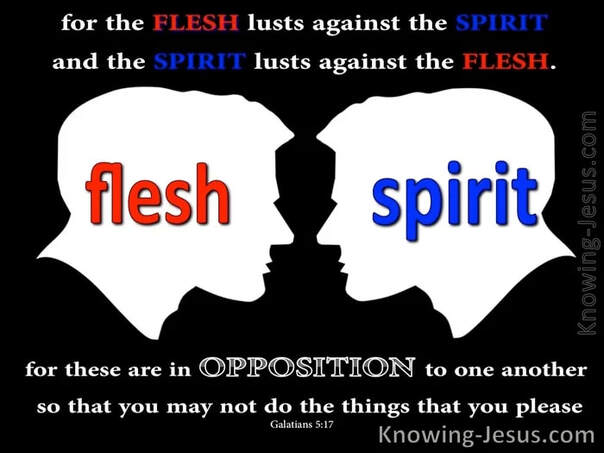 The Egoic soul (ego-self) The second aspect of the human soul is what the Diamond Approach labels the ego-self or what I call the egoic soul. Unlike the animal soul that is driven by our biology, our egoic soul contains psychological structures that form in our soul based on our history and experience. These psychological structures form because our ego-self has a need to preserve itself. It cannot not handle the experience of non-structure that comes with the natural flow of the Present Moment for to the egoic self, this feels too dangerous. The egoic self “is always looking for something concrete, something solid, stable, graspable, to support itself with, to depend on. That is because the self believes that if there is no bedrock, it is going to sink; if the bottom of reality is not solid, the self will get submerged and drown. So we believe that we have to locate some kind of island or rock of solidity to stand on to keep us from drowning” (The Unfolding Now, p. 202). At the center of our egoic soul “is a psychic structure characterized by a specific pattern and by incessant psychological activity. The pattern, or the particular psychic organization, provides the direction of action, while the activity provides the drive to act. This gives the self a sense of orientation, center, and meaning. The psychological activity includes hope—the self is hoping, consciously or unconsciously, to achieve its aim or ideal” (The Point of Existence, p. 85). Now, the structures and activities of our egoic soul are based on history. Our egoic soul contains all our history, our positive memories but also our negative experiences including attachment wounds from our childhood when we, as children, were not seen, valued, and loved by our parental figures and caregivers. This negative history also contains the painful traumatic experiences that occurred throughout our life. However, our egoic part of our soul contains more than these memories. Our egoic soul is also the manager of our life based on our ego ideal. “The ego-self has preferences for what should happen and shouldn’t happen, according to its ideal of what we believe is enlightened or not, and what we think is pleasurable or painful. We have all kinds of value and judgment standards about what’s good and what’s bad, what is scary and what is not. Some of this is conscious, some of it is unconscious, and much of it divides us within. This division creates a kind of war, like a resistance movement within us…When you are resisting, you are basically resisting yourself. It is a kind of self-resistance. Instead of being with yourself, you are resisting being with yourself…The moment we take the posture of ego, of identification with our history, it implies resistance” (The Unfolding Now, pg. 36). Our egoic soul judges pleasure as good and all emotional distress as bad. As a result, the thinking, feeling, doing, and relating structures of our egoic soul are designed to seek pleasure and to avoid the emotional distress trapped in these unhealed memories. Here is a sample of some of our coping patterns around pain…such as denial, avoidance, emotional numbing, medicating through food, alcohol or drugs, distractions like smart phones, TV or movie watching, addictions of various types, living in our heads instead of feeling, focusing only on the positive, and many other spiritual pain management strategies. 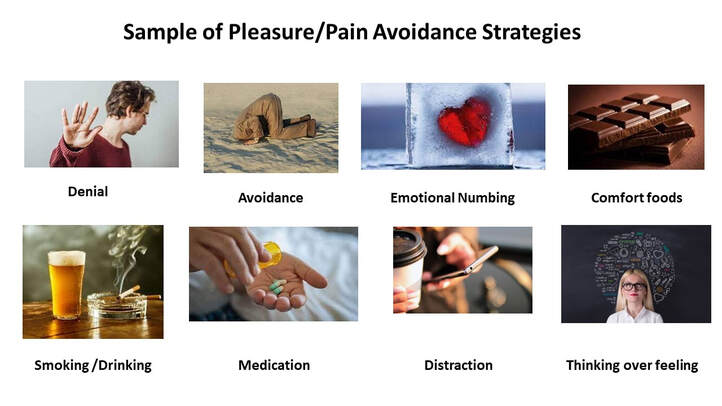 I want you to notice that all the coping strategies located within our egoic soul take us away from the Present Moment. When we are experiencing pain and distress, we are living in the Present Moment, that is a given. And so if we are rarely in the Presence Moment, there is little risk of experiencing the pain hidden away within our soul. This is why many people spend very little of their lives living in the Present Moment. By now, you are starting to notice some of the intrinsic qualities of our egoic soul. Let me list them to make them more apparent.
The Angelic Soul (True nature) Seeing how the egoic soul works, you can begin to appreciate and understand that there is another aspect of our soul that involves all the experiences of the Present Moment, dynamics that our egoic soul seeks to manage and control, but in doing so, often distorts leading to further spiritual distress for us. When we pay attention to the angelic part of our soul, we notice that there are many energies or qualities that emerge within us in the Present Moment in response to what we are experiencing in our life. These energies arise from what the Diamond Approach calls our True or Essential nature. As Almaas, the co-developer of the Diamond Approach, shares below, this Essential nature is the essence of who we are, when we are not identified or merged with our egoic soul or animal soul. 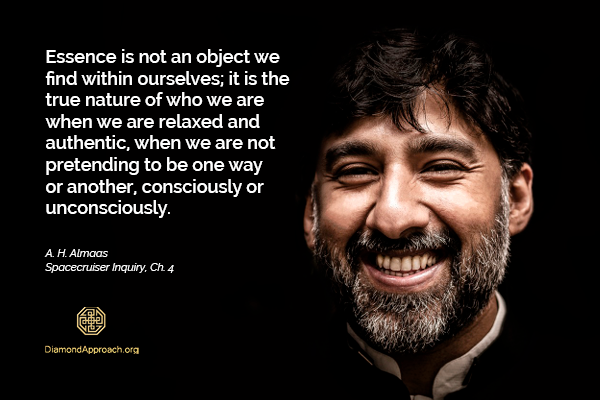 The Diamond Approach has discovered that experiences of True nature have five unique qualities. One is that our True nature is inherently aware, sensitive, a sense of in-touchness, or consciousness. Just as heat is inherent to fire, so is awareness inherent to our True nature (Spacecruiser Inquiry, pg. 32). Two, True nature is an indivisible unity, a field of oneness that includes everything within it (Spacecruiser Inquiry, pg. 32). In contrast, within egoic reality, we lose the perspective that everything is connected and instead perceive everything as divided into disconnected parts, me and you, us and them, inside and outside, good and bad, etc. When we recognize True nature and lose this sense of boundaries, we recognize that oneness pervades the whole universe, and that we are part of this oneness. Three, True nature is dynamic, always moving, changing all the time. Reality is a movie, in constant motion, never a snap shot. Without this sense of change, there would be no awareness (Spacecruiser Inquiry, pg. 32). Four, True nature is totally spacious, unstructured and open to all possibilities manifesting, unlimited in potential (Spacecruiser Inquiry, pg. 32). And, five, True nature has a sense of knowingness to it, that it can reveal to us the knowledge of what qualities are emerging, inform us of what we are noticing in our experience of the Present Moment (Spacecruiser Inquiry, pg. 32). These qualities of True nature arise in us in response to what we are experiencing in the Present Moment. When we see pain in others or experience pain in ourselves, a tender compassion arises within us, possibly with tears, that soften us and allows us to comfort others or ourselves. When we see injustice, an anger-like strength arises that causes us to speak truth and act in ways that confront this injustice. When we see a gorgeous sunset, a feeling of joy, awe and wonder may emerge within us. 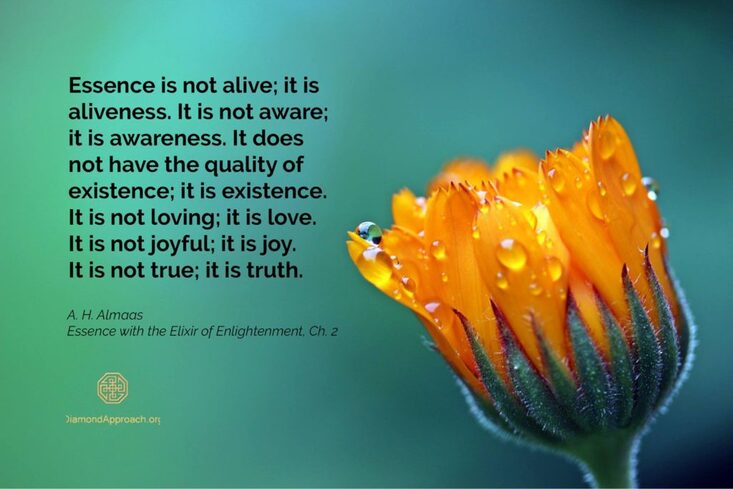 There are many other such spiritual qualities such as curiosity, insight/truth, joy, love, grace, determination, awareness, kindness, curiosity, etc. that can arise from the angelic part of our soul. It is important to note that we don’t create these energies, that they are not products of our egoic soul. They emerge naturally in us in response to what we are noticing. This is why they are often seen by some religions as fruits of God’s spirit (Gal. 5: 22-23). 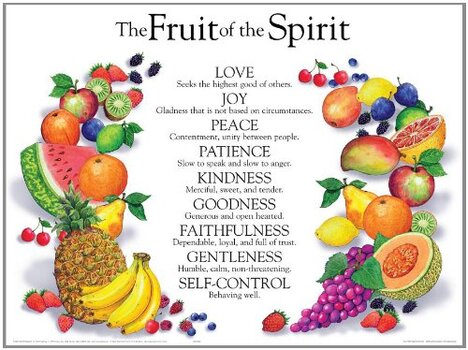 When we are developing our ability to experience the angelic aspect of our soul, we cultivate our ability to live more from our True nature, that aspect of our Soul that is beyond our egoic soul. As this maturation happens, our True nature “reveals its omnipresence, disclosing that it is the ground and nature of everything. This appears as True nature revealing its boundless and formless dimensions that transcend the limited boundaries of the ego-self, even the individuality or personhood of the soul” (The Inner Journey Home, pg. 225). When this happens, “our soul does not experience herself here as an individual soul, but as a boundless and nonlocal presence that is part of an eternal nowness that transcends all time, and as a mystery that transcends all determinations” (The Inner Journey Home, pg. 225). These words of Almaas may sound very esoteric, other-worldly, but many people do have moments like this that they see as sacred...that can arise when we are watching a sunset, or kayaking on a river, or watching the twinkling stars in a dark moonless night, or during sexual organism with one's love partner, or playing with our young child or grandchild, or singing at a concert or during a worship service, or during a profound moment in our counselling/spiritual direction session. What we don't realize is those sacred moments are not just profound moments where God's spirit enters our world. Rather those moments are really moments when we dropped down from our merged state with our structured egoic soul into the deeper angelic realms of our soul where we discovered the essence of who and what we really are. When we are able to live more and more of our time from our angelic soul, we eventually realize that our egoic soul that we often think is "me" is not me at all. This is why the Diamond approach calls our ego self the "false pearl" for it is a false version or structured imitation of our Essential nature. When we realized that our sense of "me" is True nature, what is sometimes called the Pearl of Great Price in the Christian tradition (Matt. 13:45-46), and not our egoic soul, a whole new world of possibilities opens up for us, a world when we learn to live more and more of our lives from the Present Moment and our True nature. 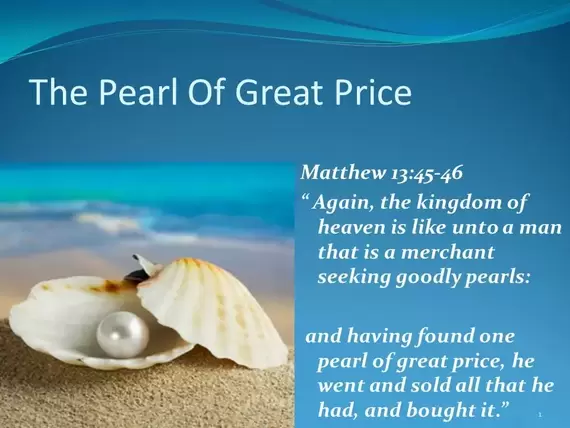 The Purpose of Spiritual Care
When you understand the human soul through this framework of these three aspects, the animal soul, egoic soul, and angelic soul, you begin to understand what spiritual care and spiritual direction is all about. Spiritual care and direction involves creating a safe supporting space so that the angelic soul of our client can interact with the different structures and dynamics of their egoic soul and animal soul. For this to happen, we must help people move into the Present Moment, for it is only here that people can experience what the Diamond Approach calls Diamond Guidance, what some religious traditions call “the angel of revelation, the holy spirit that brings the word or message from the source. It is the angel that guides us to Beingness that is our ground, our nature, our source. It is the true friend, the total friend, because the Guidance’s only concern is for you as a soul to go back to your source, to be who and what you can be, with total acceptance, total support, total guidance, total kindness” (Spacecruiser Inquiry, pg. 223). This Diamond Guidance refers to the insights that arise as people pay close attention to the dynamics within their experience of the Present Moment…with curiosity, grace, compassion and a longing for the truth. As we help people receive these insights and internalized them, the structures of their egoic soul begin to transform and they find ourselves living more from their True nature in the Present Moment and less time lost in the many complex and often painful structures of their egoic soul and false pearl. Questions to Ponder: 1. When do you find yourselves being influenced by the dynamics of your animal soul: craving pleasure, avoiding pain, fight, flight, freeze dynamics, etc. 2. When do you find yourselves being influenced by the dynamics of your egoic soul? What are some of the ways you manage yourselves to maximize pleasure and reduce feelings of pain, anxiety, fear, anger, guilt, shame, etc.? 3. When do you find yourselves living in the Present Moment and experiencing the dynamics of your angelic soul? What aspects of spirit have you experienced? 4. Most people identified themselves in terms of their egoic soul..."this is who I am." How would your life change if you realized that this sense of self was wrong, that your true identity was based on those sacred moments when you were in touch with your angelic soul...that this is who you truly are? Bibliography Almaas, A. H. Essence with the Elixir of Enlightenment. York Beach: Samuel Weiser, Inc, 1984. Almaas, A. H. Spacecruiser Inquiry. Boston: Shambhala, 2002, Almaas, A. H. The Inner Journey Home. Boston: Shambhala, 2004. Almaas, A. H. The Point of Existence. Boston: Shambhala, 2001. Almaas, A. H. The Unfolding Now. Boston: Shambhala, 2008. Gord Alton MDiv RP CASC Supervisor-Educator (based on sermon I did at Shantz Mennonite Church on Jan 29, 2023) 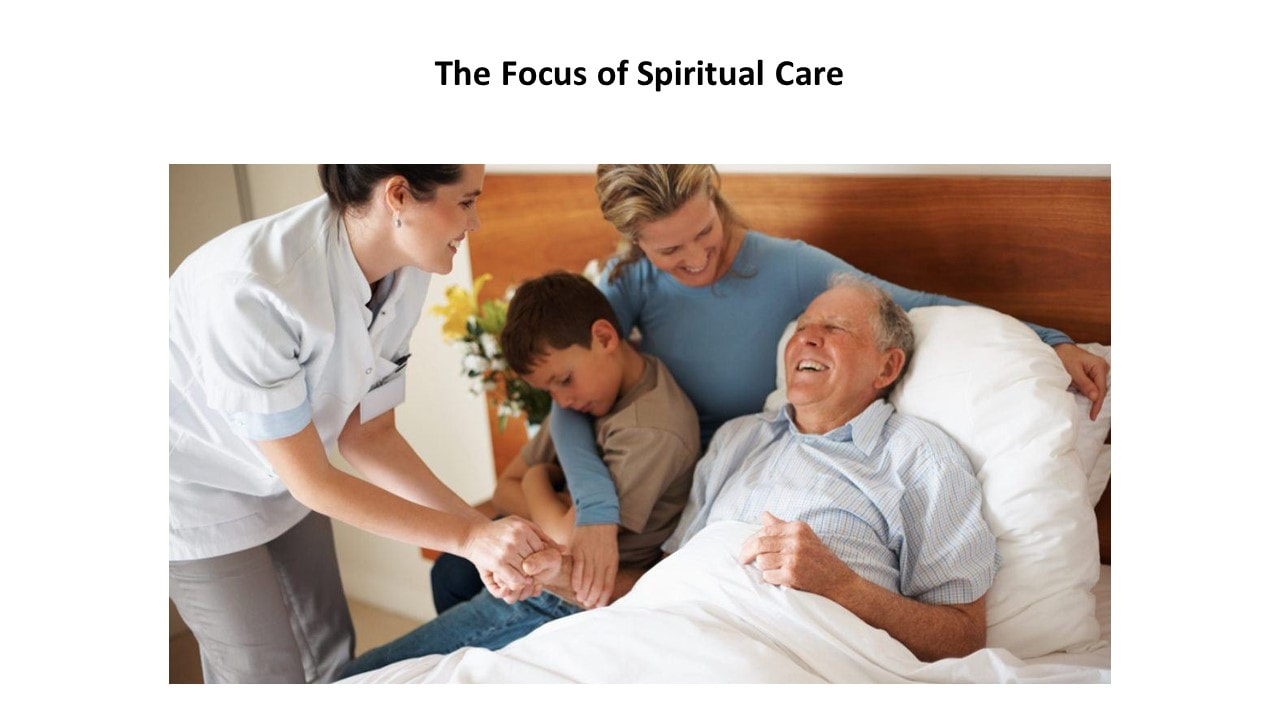 The focus of spiritual care is not what many people think. Many people see spiritual care in terms of religious care…like reading scripture to people or praying with people for healing or for God’s presence. This type of activity happens at most in ¼ of my visits. Spiritual actually looks very different than that. In this blog, I want to describe what spiritual care looks like in my ministry. 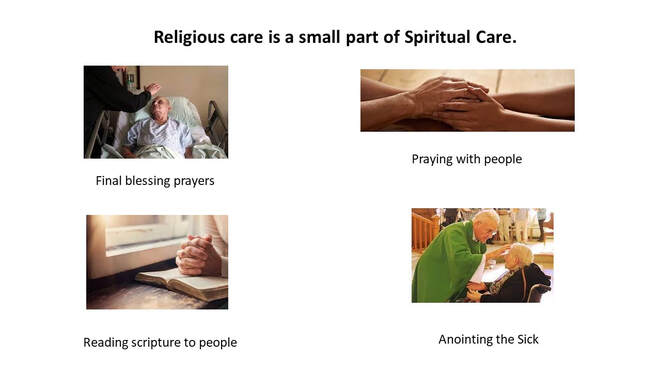 In my spiritual care ministry, I find myself driving around the regions of Waterloo and Wellington, including the cities of Kitchener-Waterloo, Cambridge and Guelph, visiting individuals, couples or families in their homes. My ministry resembles more the stories we see in the gospels where Jesus is wandering from village to village interacting with people who are often on the fringe of society. Through these interactions with Jesus, these people found themselves discovering God’s presence, and different forms of healing happens. 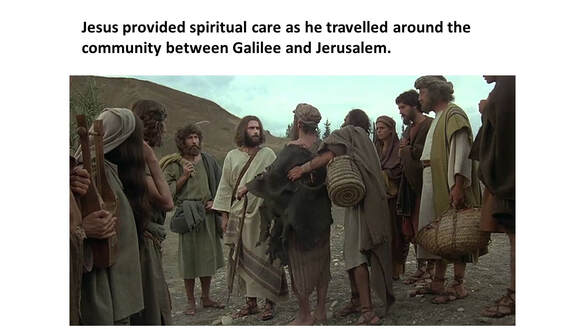 How did this healing process occur? How did spiritual care and healing happen through the interactions between Jesus and those he met on his travels? In today’s world, to help spiritual care and psychospiritual therapy students understand this healing process, supervisors asked them to shared verbatims of sections of a session they had with a client the previous week. These verbatims are quite detailed capturing the interactions that happened between the client and the student along with non-verbal cues. Now these verbatim are never 100% accurate for counsellors can’t capture perfectly a session based on their memory, even if the session just happened the hour before. When we turn to the Jesus healing stories found in the gospels, they are far from being a verbatim of what actually happened between Jesus and the person he healed. Rather these healing stories were written down some 30 years later, as in the gospel of Mark, some 40 years later in the gospel of Matthew and Luke, and some 60 years later in the gospel of John. Because these stories were written so many years later, we can’t treat them like verbatims in a counselling training. These healing stories began first as memories within the Jewish community and then over time transformed into legends about how Jesus miraculously healed people he met as he wandered between Galilee and Jerusalem. As all of us know, healing does not happen as easy as we see recorded in the Bible. If it was, our churches would be packed with people coming to be healed. There is no doubt in my mind that a healing process happened between Jesus and the person he healed…but the details of this process is missing in the healing stories of Jesus. What would be a 5 or 7 page verbatim in a counselling session has been condensed down to just 2 or 3 sentences. Part of my faith journey as a spiritual director and psychospiritual therapist in life has been trying to understand the healing process that happened between Jesus and the people who were healed. The healing story I have chosen to focus on is found in the gospel of Mark. It is the story of Jesus healing a blind beggar named Bartimaeus. The scriptural text is found below. 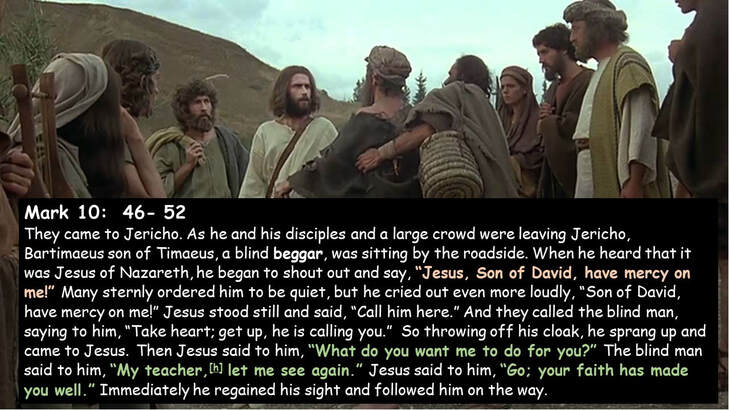 This Jesus healing story provides some clues of the divine healing process. The first clue is that the blind man, Bartimaeus, wanted help from God. He said loudly, “Jesus, have mercy on me.” Upon getting a positive response, he jumps up and comes to Jesus. This may seem self-evident but people need to own their desire for spiritual healing. Within my spiritual care ministry, this means that people need to ask for spiritual care help. I and my spiritual care colleagues only receive a spiritual care referral when people put a request in for spiritual care. Many of the doctors, nurse practitioners, nurses, care coordinators, PSWs, etc. in the Home Community Care Support Services (HCCSS) often encourage clients to request spiritual care. But many are not open to it for various reasons. Some people are skeptical of anything religious or even spiritual. Some people are not willing to be vulnerable with someone else and need to stay in control. Some people are not willing to face the fact that they may be palliative and possibly dying. Some people want to avoid anything that may make them sad. And many other reasons. Without some interest in spiritual healing, it is not possible for people to experience healing beyond the physical healing methods provided by our health care system. The next three sentences in this story capture the essence of healing process between Jesus and Bartimaeus. Jesus said to him, “What do you want me to do for you?” The blind man said to him, “My teacher,[h] let me see again.” Jesus said to him, “Go; your faith has made you well.” What happened here between Jesus and Bartimaeus that make this healing possible? To answer this question, I want to turn to self-psychology, one of the primary frameworks I use in my spiritual care ministry. Self-psychology teaches that healing happens for people if they are listened to in such a way that their three primary needs are met. These three primary needs are the needs of every child, and these follow us into our adult years, especially if they have not be met well in our childhood. The goal of any Spiritual Care Provider, like myself, is to seek to meet these three primary needs of the people I am visiting.  The first core human need is that of mirroring. Each person wants to be seen and heard by another. This means that people who are sick or struggling need someone who is able to listen and then share back to them what they are experiencing whether it be pain, sadness, anxiety, angry, despair, gratitude, or other emotions. I believed Jesus practiced this type of mirroring with Bartimaeus. He asked Bartimaeus what he wanted. 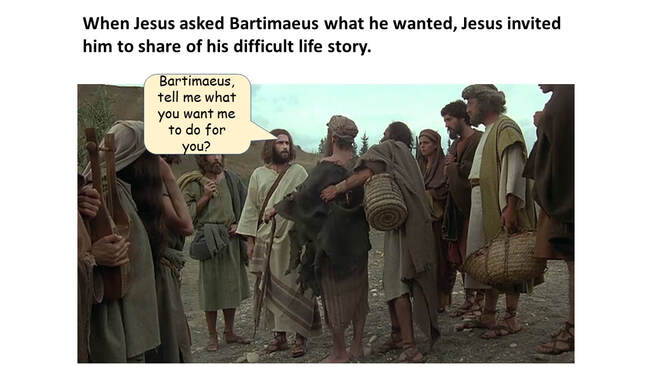 And I am pretty certain Bartimaeus shared his story of how he became blind and how hard it was to live as a blind person. He shared how his blindness caused everyone to reject him, to see him as sinner, just like people with severe addictions or people living on the streets are seen in our world today. He shared of his struggle of being on the fringe of his community begging to hopefully get some food so he would not have to starve. I am sure Jesus listened to him and mirrored back to him what he was saying so Bartimaeus knew Jesus saw and heard him. To be truly seen and heard was a rare experience for Bartimaeus…as it can be for people living with life threatening or terminal illness. 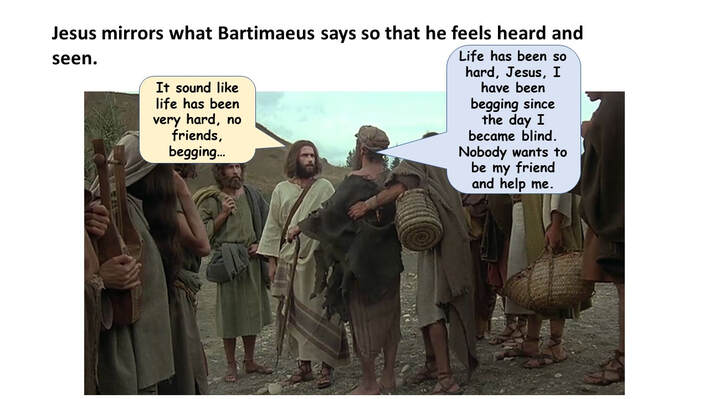 The second core human need is that of validating. Not only do people need to be seen or heard, they need their experiences of life validated, that we can understand and appreciate why they think, feel, and behave the way they do. To validate in this way requires us to be a very safe person, a nonjudgmental person…for it is very hard to validate any thought, feelings, or behavior that we judge as wrong.  This is what made Jesus so special in his time: he was gracious person to the nth degree. This was why he was such a safe person to the people who found themselves on the fringe of society, people judged sinners by the religious people and most people in his culture. I am sure Bartimaeus experienced this nonjudgement nature in Jesus. Jesus was someone he could bare his soul to and not worry about being rejected or ridiculed or scorned. Jesus could truly understand what his life as a blind person was like. Here is an example of a possible interaction that might have happened between Jesus and Bartimaeus. Here we see Jesus validating Bartimaeus’ experience and his doubts that God even loves him anymore. 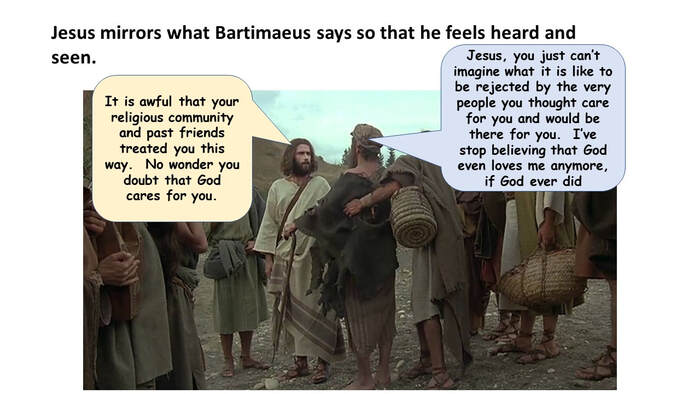 A lot of my work in spiritual care involves validating people’s experiences. So many people have been taught that it is wrong to cry, or wrong to be angry at God or wrong to doubt. People often tell me that they have to stay positive…and that often means that so much of their life experience, whether it be sadness, despair, grieve, fear, guilt, shame, helplessness, etc. has to be hidden away, buried, or dismissed. When this happens, people are actually rejecting themselves for having these negative experiences. That self-rejection soon turns into self-hatred where they start judging and hating themselves whenever such negative emotions arise. So, a lot of my work involves validating people’s experience, even validating that part of them that wants to dismiss all those negative experiences. It is important that I hold all their problematic behaviors with a gracious touch. I may say things like the following:  As I have grown in my ability to be nonjudgmental like Jesus, I have discovered that one can find ways to validate every experience in life. When we are able to validate a person’s experience, we help them break this pattern of self-rejection and self-hatred which research is discovering can contribute not only to mental health issues but also physical health issues. Instead, through our validation, we are nurturing a healing Presence to arise in the person we are validating. It allows them to connect with a deeper part of them, the God or divine part of them that begins to validate their own their feelings and experiences. The third core need that a person has, based on Self psychology, is the need to experience twinning.  People need to feel that they are not alone, that they are not too different, too strange, and thus someone truly can understand or empathize with them. When we allow ourselves to twin with someone, we open ourselves enough so that we can sense inside ourselves a little of what our friend/client is experiencing. When we do this, we become more attuned to our client’s experience causing them to no longer feel alone with their struggle. In meeting each core need of our friend or client, we are forming a deeper connection with them. By meeting the need of mirroring, we are forming a connection with them as we reflect back what we hear and see. By fulfilling the need of validating, we are developing a deeper relationship with them, but this demands that we become nonjudgmental in how we feel toward what they are sharing with us. When we address the need of twinning, we are establishing an even deeper connection with them, one that involves us forming a relational field with our friend/client that makes it possible for us to sense what they are experiencing. To form such a shared relationship requires an even deeper practice of nonjudgement for now we are allowing ourselves to feel a little of what our friend or client maybe feeling whether it be sadness or anger or despair or guilt or anxiety or helplessness. Many people can twin with sadness and the positive feelings, but it requires a lot of training and personal work to nurture the psychological maturity needed to twin well with anger, depression, anxiety, shame, helplessness and other negative feelings. Many people are uncomfortable with most negative experiences and thus can’t twin well with such feelings. I am certain Jesus practiced this experience of twinning with Bartimaeus. Jesus felt inside himself a little of the loneliness that Bartimaeus was feeling. Jesus sensed Bartimaeus’ anger at how his religious community and friends had abandoned him. Jesus recognized the doubt that Bartimaeus probably had…wondering if God existed let alone cared for him. If Bartimaeus felt any self hatred, which is common for people who live with chronic health conditions, Jesus would have experienced that too in the relational field that had formed between Bartimaeus and him. 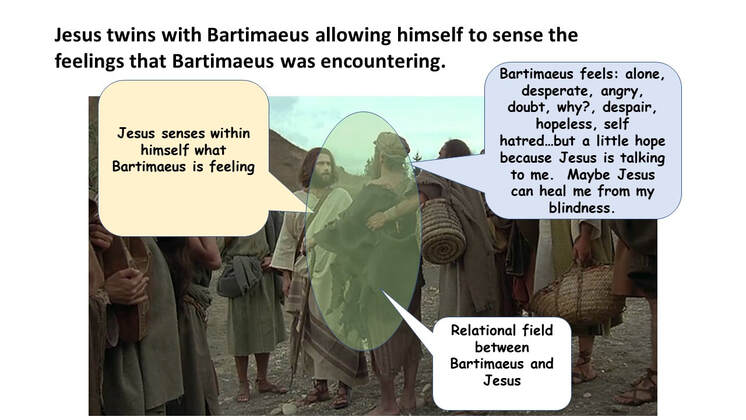 In my spiritual care ministry, not only do I do a lot of validation, I also allow myself to twin with clients who need my twinning to help them hold and understand the many complex feelings they may be encountering. I remember a man in his sixties who had wrestled with health issues all his life beginning with cancer in university days. He beat that cancer but the radiation treatments he encountered then caused major damage to his pancreas and heart leading to serious health complications and medical interventions throughout his life…until finally he came down with a cancer again that couldn’t be beaten. He never lived a normal life. He had a lot of anger toward life and God and so every session I met with him involved being with the why question and all that intensity. I could twin with that anger in a good way for I had spent years processing that same anger when my brothers died from HIV/AIDs 25 and 30 years ago. In the end, he said he would concede his life into God’s hands, that was his way of surrendering into God at death, but he also said, he planned to have a big debate with God around how unfair his life had been. I applauded him for his honesty. I remember visiting a mother and two sons who had lost a husband and father my age to cancer. This man was a very private man who kept all his feelings and pain to himself so when he came to hospice, he died within a couple of days. His family were shocked. Nobody knew except him knew how sick he really was. Because of the intense grieving happening in family, I was allowed to do more than one bereavement visit with the family. During these visits, I did a lot of validation for the temptation for all of them was to treat their negative feelings in the same way their husband and father did: bury them, deny them, keep oneself busy so they didn’t feel them, and put on a happy, smiling persona that says…”everything is fine. How are you?”. I remember a visit where I met with the three of them for the first time. In that first visit together, I had shared the importance of simply being with their feelings allowing their feelings to simply be there without getting lost in them but also without managing them through denial or being busy. I had also done some teaching around centering prayer which is a Christian spiritual practice similar to Eastern meditation where you practice being with your experience without managing it for 10-20 minutes each day as you are able. During the next visit, the one son commented that he had tried the centering prayer thing but it didn’t work for him. (I smiled inwardly for this is a common response to meditation/centering prayer). But then he said he had noticed that “being with his experience” happened naturally when he was interacting with his 3 year old son. When he was with his young son, he found himself naturally in the Present Moment and doing so brought back memories of times he had with his father as a little boy. And while these memories brought up sadness and caused him to tear up, they also brought up love for his Dad. And then he said, “it was weird… there I was playing with my son and at the same time crying. I fought the urge to stop my crying, like you said Gord, and allowed my tears to continue. And then I felt a happy feeling come to me as I was crying and playing. Strange.” I told them that this is what can happens when we are able to be present to our feelings without judgement….even the negative ones. We may have a feeling of goodness arise at the same time we are feeling our negative emotion. That feeling of goodness, which I believe comes from God, informs us that this feeling is authentic and valid and holds a truth that God wants us to honour. It is hard to explain but through this process of mirroring, validating, and especially twinning, healing happens. It is interesting that the final interaction between Jesus and Bartimaeus is the following: "Jesus said to him, 'Go Bartimaeus; your faith has made you well.'” What did Jesus mean when he said that Bartimaeus’ faith made him well? The gospel of Mark indicates that right after this pronouncement from Jesus, Bartimaeus was instantly healed. From my experience, healings don’t instantly happen. They happen over a period of time, in this case, the healing dynamics were occurring during the entire time Jesus and Bartimaeus were interacting with each other, 15 minutes, 30 minutes, maybe longer. I suspect many healing moments and insights happened during that entire interaction that ultimately led to Bartimaeus finally being able to see again. I read a book this past fall titled Cured written by Dr. Jeff Rediger that was published in 2021. Rediger is on the faculty of Harvard Medical School, a medical doctor and a psychiatrist, and leader in groundbreaking neuroscience research. He also has a Master of Divinity which means he is receptive to religion and spirituality. 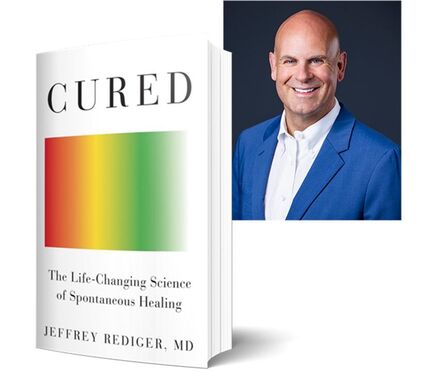 He claims that medical science does not believe in healing miracles. However, when such mysterious healings happen, they are labelled as spontaneous remission, a healing that occurred without any medical explanation. Since there was no medical explanation, this meant that these healings occurred through something else causing the person’s body and immune system to naturally heal itself. Strangely, no one has ever chosen to studied scientifically these spontaneous remissions to see if there is anything we can learn from them. After researching these types of healing for almost 20 years, Rediger discovered that there were four factors that affected the body and our human immune system. One involved healing our diet. Another focused on healing our immune system. A third centered on healing our stress responses, that is, healing our traumatic memories that are at the foundation of our stress responses. And the final factor, which Rediger saw as key to all the other healings, was healing our identities, that is, healing how we saw and experienced ourselves. The healing story of Bartimaeus does not tell us how Bartimaeus became blind. But we are told how Bartimaeus was healed from his blindness. Jesus tells us that Bartimaeus’ faith has made him well. Through his interactions with Jesus, Bartimaeus’ faith had changed, shifted, transformed… which opened the door for this miraculous healing to happen. This suggests that Bartimaeus’ blindness had a psychological or faith root to it. When I did some research to see if there can be a faith root to blindness, I was surprised at what I found. I discovered there is actually a medical category in the most recent DSM-5 for people who are blind, but there is no medical reason for it. It is called “conversion disorder”, a mental condition in which a person has blindness, paralysis, or other nervous system (neurologic) symptoms that cannot be explained by medical evaluation. The only known way to heal this form of blindness is through psychotherapy and spiritual care. 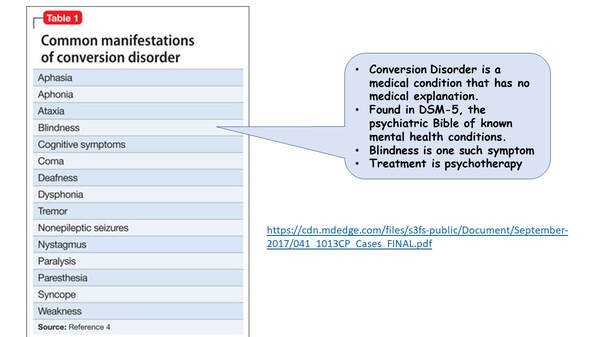 Something happened in the interactions between Jesus and Bartimaeus that led to Bartimaeus’ faith changing, a change that Jesus noticed and proclaimed to him, “Bartimaeus, your faith has made you well” and with that realization, Bartimaeus discovered that he could now see. How I wish we had a verbatim of Jesus’ healing session with Bartimaeus to understand how Bartimaeus’ faith changed. Clearly the dynamics of mirroring, validating, and twining were significantly at play allowing a deep and intimate healing relational field to form between Jesus and Bartimaeus. Nurturing this healing relational field is the essence of effective spiritual care. One could see this healing relationship field as the place where we, spiritual care providers, help people discover their connection to the vine of God that all humans are connected to. 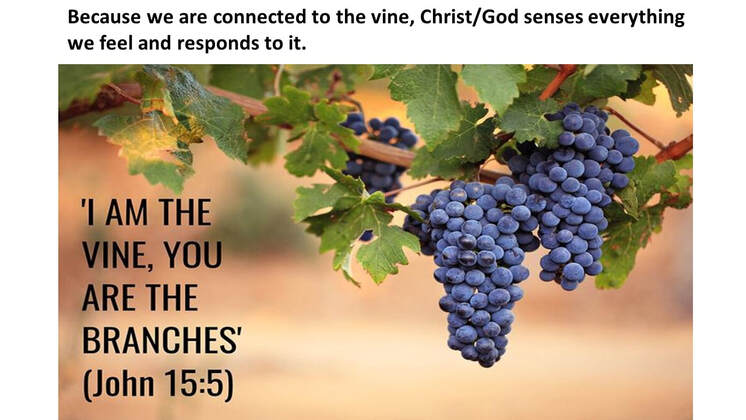 As we deepened this healing relational field through mirroring, validating, and twinning, we help clients move more deeply into the present moment where they are able to abide and connect more intimately with the vine of God. It is here when our client is abiding in this special divine place that they discover the spirit of God abiding in them. This intimate connection to the vine found in the present moment allows our client to experience all the aspects of God’s spirit in response to what he or she is experiencing in that moment.
Through such sacred experiences, we, as spiritual care providers, begin to notice our client’s faith changing, sometimes quickly, often slowly. And when we do, we reflect this observation back to them so they can realize this truth and thus internalize this truth to a deeper level. This is how I would practice Jesus’ words to Bartimaeus, “Go, your faith has made you well.” Today, I have tried to help you see how my Christian faith flows into my spiritual care ministry. In doing so, I hope I have also helped you realize how these healing stories of Jesus have huge relevance still in our time. The role of spiritual healing is as important now as it was then. Gord Alton MDiv RP CASC Supervisor-Educator In my spiritual care ministry with palliative care clients, I often run into the why question. As one sixty-five year old wife and mother complained to me again this month, “why do I have to die from cancer? There is so much that I want to still enjoy…with my husband, children, and grandchildren?” The answer to these types of why questions is one I have wrestled with a lot beginning 30 years ago when my first brother Jamie died from HIV/AIDS in 1992. In this blog, I want to share how I currently process the why question.  Examples of the Why Question This week in church I again heard a common way this Why question is asked. The preacher was talking about the tragic story that is often skipped over when celebrating Epiphany. On this particular Sunday, the preacher focused on the very end of the Wisemen story where all the baby boys under the age of 2 were killed by King Herod because he was trying to kill the baby Jesus, a baby who he saw as a threat to his throne. The preacher asked the why question in this way: Why did God warned Joseph, the father of Jesus, to flee Bethlehem to save his young son but not the other parents whose sons ended being murdered in this killing spree? Why? If this Wise Men story is historical, scholars estimate 20 baby boys were slaughtered in Bethlehem. I had similar questions around my brothers’ death in 1992 and 1997. After all the medical advances in treating hemophilia, why would God allow my brothers to die at the prime of their lives? And why did my two brothers become hemophiliacs through getting the bad X chromosome from my mother while I got the good X chromosome and so was hemophilia-free. Why was I hemophilia-free and my brothers were not and thus got HIV/AIDS? And why did my God not heal my brothers of their HIV/AIDS? They were good people. They had done nothing that sinful that demanded the punishment of death as a consequence. I remember preaching a sermon at First Mennonite Church in Kitchener in 1992 where I expressed my anger at God for what was happening to my brother Jamie. A month later he died. I remember a 65 year man who I visited many times two years ago and in the end did his funeral. The why question was very alive for him. He had asked this emotional question many times in this life. When this man was in his late teens, he was diagnosed with Hodgkin’s Disease, a type of cancer. That was the beginning of his journey with the Why question. At the time, he was a student at University of Toronto, very athletic, and a member of the University football team. He had a full life before him...and then cancer. They treated it in those days through massive radiation of the chest area where many lymph nodes are. He was able to beat the cancer. But then 15 years later in his mid 30’s, his pancreas failed and he became a severe diabetic needing to take insulin for the rest of life. Doctors concluded that his failed pancreas was due to the severe radiation he received when he was young. Why God? Then at the age of 40, he had a serious heart attack due to his heart being damaged by that earlier radiation. Why God? In his early 50’s, he again had heart issues, and a damaged heart valve needed to be replaced. Then he started losing his voice due to vocal chords that were damaged by the radiation. And then over 2 years before he died, he learned that he had cancer again...lung cancer that had spread, and this time, he knew he could not beat it. Why God, why me? We spent many visits processing this question. Asking the Why Question is a Sign of a Strong Faith As I visit people who are asking the why question, I want them to realize that this is a good question. The question is not, as some people of faith suggest, a sign of having a weak faith. That is far from the truth. In fact, I think asking this question is a sign of the very opposite…a sign of a very strong faith, a sign that one does care about their faith and their relationship with God, so much so that they are willing to confront God with their why questions. Is this not what we see happening when Jesus asked the why question as he suffered on the cross: “My God, my God, why have you forsaken me?” The psalmist elegantly expresses the why question in this way, “When shall I come and behold the face of God? My tears have been my food day and night, while people say to me continually, ‘Where is your God?’”(Ps 42: 3). 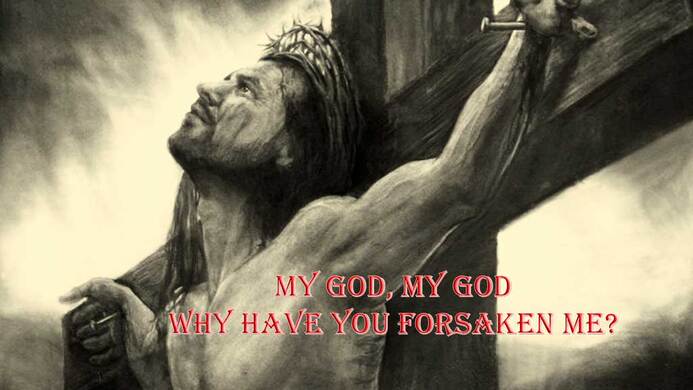 Biblical Understandings of the Why Question Within the Bible, we see many stories of religious people connecting illness of people to the sinful behaviors in the person’s life. But we also see this direct connection between sin and suffering also challenged. One such example is the story of Job. Job is portrayed as a good and prosperous family man who suddenly experiences many horrendous disasters that take away all that he treasures: his family and his agricultural business. Job is convinced that he has done nothing to deserve this suffering but three of his friends come visit and they all articulate the common understanding of that time that he has done something wrong to deserve these sufferings. In the end of the story, God does come but God never answers Job’s why question. God simply states that it is beyond human comprehension. Within New Testament, we see a similar tension around the connection between human sin and suffering. In Jesus’ time, if a person became sick, they were immediately considered religiously unclean and needed to be separated from the community, which makes sense from a modern day public health perspective. Once the sickness was healed, the person went through a healing ritual that re-connected them back into the community. This healing ritual is evident in the New Testament when Jesus instructs a healed man to go to the priest and offer an offering required by Jewish Law (Matt. 8:1-4). This ritual would restore his purity status within his community. However, if this sickness didn’t disappear, these people were forever judged and condemned as unclean and sinful for the culture believed they were no longer part of God's holy people. We read stories in the New Testament where uncleaned people found themselves at the healing pools of Bethesda (John 5) and Siloam (John 9) hoping that someday they would be healed by God and thus regain their purity status and become part of their family and God’s community again. Both sickness and healing had significant physical and social implications in Biblical times. We also read in the New Testament how Jesus challenged the belief that sickness is a sign of God’s judgement on sin. The most well-known case is the story of a man born blind from birth. His disciples asked Jesus about this blind man, “Who sinned in this case, his parents or the blind man?” Jesus answered, “Neither. He was born blind so that God’s works could be revealed in him” (John 9). 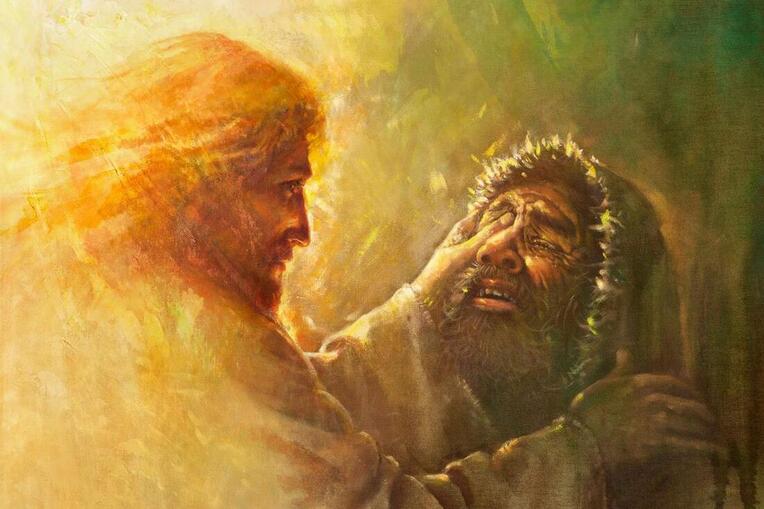 This belief that God’s work is revealed in the healing of people’s suffering has become a major tenet of my palliative care ministry. The answer to the why question is never God’s punishing people for their sinful choices. Rather, suffering is an opportunity for God’s healing presence to be revealed. There are many Bible verses that promote this positive relationship between God and sickness. So how do we make sense of this relationship between sickness and sin and the why question tied to God’s will? Suffering: The Gift Nobody Wants As I processed this why question 25 years ago, the book “Pain, The Gift Nobody Wants” was a key book that help me find my way out of the wilderness created by the why question. In this book, Dr. Brand and Philip Yancey use the disease leprosy as a framework to make sense of the purpose behind suffering. The disease leprosy is caused by a bacteria the kills the nerves that come from the external parts of our body like eyes, hands, and feet. With these nerves dead, a person with leprosy is no longer able to feel pain. If the nerves in a person’s eyes are affected, their eyes will stop blinking, no longer able to feel an irritant in their eyes. Soon, these unprotected eyes would become blind. When the nerves in the hands and feet stop sending pain messages to the brain, you would not know if you have walked on a thorn or have injured these parts of your body. Over time, the tissues in these areas break down due to infections leading to deformed hands and feet. Dr. Brand concludes that physical pain is a gift to the human body, information that our body and we use to keep our physical selves healthy.  Following the same logic, the authors argue that suffering is soul pain, a sign that our soul needs attention so that spiritual healing can happen. When we disregard these signs of suffering, our soul has to take on coping patterns like numbing, avoidance, comfort activities (overeating, drinking, medication, etc), trauma survival strategies (fight, flight, freeze, collapse), control behaviors, etc. These coping patterns help us survive in the short term but they are not meant to heal our soul pain. In the long run, these coping patterns will eventually cause our soul and body to physically, mentally, emotionally and spiritually break down and deform, and we begin to really struggle with long term or chronic health conditions. Suffering is a Sign that our Soul is Struggling Seen in this way, we see a new way to understand the why of suffering. We no longer see suffering as caused by God. Rather, suffering, like pain, is a sign that something is wrong causing our soul to struggle experiencing a vibrant life. It is here that I find the Theory of Holes, as taught by the Diamond Approach, a helpful way to understand the various forms of suffering within the human soul. The Diamond Approach teaches that all humans are born with complete healthy souls that are in a state of oneness with reality, life, and God. All the various aspects of Spirit naturally arise within us, as a child, when we are held well by our parents, life, and God. As a result, the dynamics of compassion, love, grace, truth, strength/courage, value, trust, joy, power to be oneself, resilience, etc. all manifest freely within our experience as we encounter different aspects of life. However, we were not held well all the time by our holding environment like the woman I saw recently. Her mother had many rules that made her life very scary. She, as a little girl, learned quickly to not cry for her mother would say to her when she cried, “stop your crying or I will give you something to cry about.” This caused her to develop a hole in her psyche around compassion and now, in her adult years, when compassion would naturally emerge, she quickly moves to judgement, self judgement and judgement of others. She also discovered asking questions was dangerous and so she soon learned to shut down her natural child-like curiosity. As a result, she stopped asking questions and listening to her curiosity and truth creating another hole in her soul. Instead, she learned to live with the anxiety that arose from this hole of not knowing, an anxiety that arises now every time she enters the unknown which happens a lot for she still fears asking questions. While she often felt angry toward her mother, she would never dare show it and so she learned to smother her anger causing her now to struggle with a hole around anger, namely the experience of weakness. Any sense of anger or perceived anger or intensity from others now scares her as an adult because of this hole. And thanks to this constant fear of her mother, she found herself, as a little girl, constantly walking on egg shells and thus she lost touch with a basic trust toward others, self, life, and God. She now sees all life as potentially very dangerous. With all of these psychic holes and coping patterns, you can perceived how her soul became deformed causing her to experience many mental health and physical health challenges. She struggles, as do all of us to some extent, with the impact of spiritual leprosy that she experienced as a child.  The Theory of Holes applies this same pattern to all the different aspects of Spirit. As each spiritual dynamic is blocked or distorted, it leads to a distinct expression of soul pain. If this suffering is not addressed, a deforming process will happen to our soul, similar to what happens to our physical body when pain is ignored, leading to sporadic or chronic forms of suffering. The gift of suffering is that it points to the areas were healing needs to happen. This is the why of suffering. Death: Another Gift Nobody Wants But the why question is not just about the reality of suffering. The why question must also address the reality of death for one of the biggest causes of suffering in life is the reality of death. The medical profession, along with most people, see death as an enemy that we hopefully one day will destroy. This thinking is also in the Christian Church for death is often seen as an expression of our fallen world. After many years of wrestling with this question, I have come to a very different place around the reality of death. In fact, I hope we never find the cure to physical death. Seeing how human suffering is a gift, I began to wonder if death could be a similar gift. What would we lose if someone waved a magic wand and death disappeared? Death Brings Meaning to Relationships and Life If death were to disappear, I wondered how our relationship to our children would change…now that there would be no need to physically protect them since there would no risk of them dying. As it is now, parents are challenged to meet the many psychological and physical needs of their children due to the competing demands of work, family life, financial needs, friendships, and self-care needs. If death was no longer a reality, would we care for them in the same way? There is something about the physical vulnerability of our children that deepens our concern and love for our children. I think of marital and significant love relationships, in fact, all our close friends and family. Would we treasure each of them in the same way if we knew they would live forever or does the reality of death cause us to cherish them and not take them for granted. I see in my palliative care ministry many significant moments of sharing love happen as a loved one approaches death. In other words, the reality of death deepens our love for loved ones.  Without the reality of death, I wonder how deep our love relationships would be. And what about purpose in life? Does not the shortness of life not only cause our relationships to change but also make life far more meaningful for us? We often only have 40 or 50 years to do productive work, to make a difference in this world, to leave some sort of legacy. If we knew we would live forever, would we cherish work? Would we seek to make this world a better place or would we echo the words of Ecclesiastes in the Bible who concluded that life is meaningless so we should just go out and enjoy life? Death is the Doorway to the Release of Suffering There is something else that is lost if death disappeared. Often, when we imagine death disappearing, we also imagine that there would be no suffering in this world without death. But would that be true? I am very suspicion that the opposite would be the case, that our human world would struggle more with injustice, greed, hate, war, oppression, racism, disease, earthquakes, climate change, etc. Since nothing could kill us now, we would live forever in our fallen world that would be full of suffering. In fact, the realities of this suffering may even become worst in this eternal world. We would soon discover in this eternal world that our planet Earth is a close system with a limited number of resources. With births continuing and deaths stopping, we would soon realize that we need a moratorium on childbirth for our world's population would balloon to a place where we could not produce enough food for everyone. We would have more starving people then we have now, more issues around food and wealth distribution, more expressions of injustices, more "us and them" divisions, more suffering than we do now. Furthermore, in this world of eternal life, I can easily imagine that there would be many suffering people begging for the existence of death. For people who are on the palliative journey, there is a natural transition that eventually happens when people begin to see death as their friend and no longer their enemy. This happens as life in this earthly world becomes less joyful and meaningful. Physical death becomes a friend, a gift from God.  This is probably why the future vision of a new Heaven and New Earth within the Christian tradition involves a world where there is no longer death and No More Suffering, “nor mourning or crying or pain, for the old order of things has passed away” (Rev 21:1-4). Until this future time, death is a friend from God that allows us to leave this world of earthly suffering to a new afterlife world free of suffering where life is eternal. God is not the Cause of Suffering But the Healing Agent of Suffering Throughout this blog, I have purposely worked at separating out God from the cause of suffering. This belief has not always been true for me. Through my upbringing in the church and pastoral education, I, at one time, believed that God was both the cause of our suffering, that is, suffering was the consequence of sin and disobeying God, and the healing agent of this suffering. I have come to realize that such a schizophrenic view of God who both punishes and heals does not truly believe that God is an unconditional lover whose love is everlasting and eternal. Instead, this view believes that God loves us and heals us when we are obedient and causes us to suffer when we are sinful. It also didn't help that I, like most Christians, was taught in the church that God is all powerful, that God can do anything God wants in this earthly world. If this is true, then it follows logically that such a powerful God could heal anyone of their diseases, like my brothers with HIV/AIDS. So why was God not healing my brothers? Why has and is God not answering the millions of prayers asking for God to heal them? Yes, we occasionally learn of divine healings here and there, but these rare healings only amplify the why question: Why them and not all the others? What makes them so special in God's eyes? Did they have more faith? This Christian teaching that God is all powerful really set us up to doubt and lose our faith in God. This notion that God is all powerful, when understood in this way, also challenges the belief that God is an unconditional lover, that God loves all the time and that God loves all people equally, no favourites. Let me propose a way out of this theological mess. What I now believe is that God loves us and wants to heal us all the time from now to eternally. There is no time or condition when this agape love and healing spirit is absent within our physical and human world. This love is always flowing from God within our physical reality like the sun is always shining on our Earth. However, we are born into physical bodies, human families, human cultures and civilizations, and a very earthly physical world. The physical laws of our earthly world restrict how completely the power and all the other qualities of God's spirit can incarnate into our human reality. How much God’s spirit can express itself within a child’s soul and body is quite limited due to physical, emotional, and mental developmental reasons compared to an adult's soul and body. We also know that our child's holding environment shapes in profound ways how our soul is structured, and as I have already highlighted in this blog, these psychic structures interfere, limit, and distort how we experience God's spirit in our soul, body, and life. This is why a child’s holding environment is so important to a person's spiritual development. God’s spirit can shape far more the soul of a healthy family system then a dysfunctional one. How healthy a culture and civilization is functioning determines how well God’s spirit can influence its communal soul to reflect the character of God. It is important to realize that God’s spirit is continuously trying to heal our world through manifesting within our world and us. This is the unconditional nature of God’s spirit of love. However, due to the limits of our physical bodies and souls, families, cultures, nations and civilization, and earthly world, the spirit of God cannot manifest in all of its fullness in all aspects of our life and world. Due to these limitations, we only experience certain aspects of God’s spirit in true complete ways in certain places and times. The remaining dynamics of God’s spirit we experience in limited ways causing some discomfort, sometimes in distorted ways creating some suffering, and if God’s spirit is fully blocked, we experience a lot of painful suffering. In seeing the why of suffering in this way, we see that God is not the source of our suffering. The why of our suffering is due to the limitations and brokenness found within our bodies, souls, families, cultures, civilizations and physical world. Rather, God is the healing agent within every aspect of life including our individual human souls and bodies.  This means the goal of anyone involved in spiritual healing is helping people, families, cultures and civilizations bring their sufferings into the Present Moment where God’s Spirit can be experienced. It is here that we will discover the truth of what Jesus said about the blind man. He was not blind because of his sin or his parents’ sin. He was blind so that God’s works could be revealed in him (John 9). This is the ultimate answer to the why question around suffering.
Gord Alton MDiv RP CASC Supervisor-Educator The Advent and Christmas season is upon us. Within the Christian Church, we focus on the incarnation of God in the birth of Jesus, where the Word became flesh. This past month I have read Rob Bell’s latest book, “Everything is Spiritual.” Within it, he plays with quantum theology, a theology based on the insights of quantum physics and uses it to help us understand different aspects of our Christian faith. In this blog, I want to play with quantum theology to help us better understand how the Word of God became flesh in the human Jesus. In doing so, it helped me understand how all of us are incarnations of God, the Word becoming flesh in us. 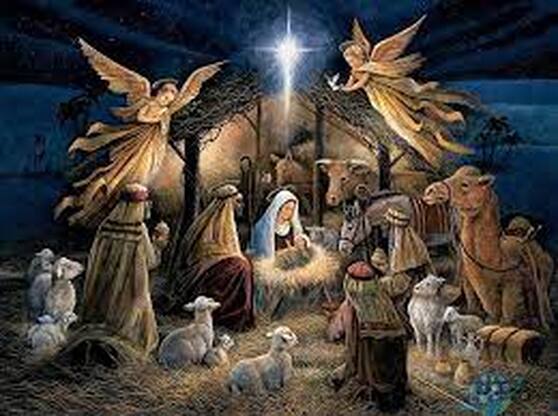 Each year in the church during the season of Advent, we often treat the incarnation story of Jesus as one unified story based on the stories of Jesus in the Bible. But the truth is that there are 4 different understandings of Jesus’ incarnation in the Bible written at a different times independently of each other. Four Biblical Understandings of the Incarnation Based on Bible historians, the earliest Biblical documents referencing Jesus are the letters written by Apostle Paul some 20-25 years after Jesus’ death, between 50 and 60 CE. It is interesting to note that Apostle Paul writes nothing about the birth, life, and ministry of Jesus. It seems that he has little or no knowledge of these aspects of Jesus' life. His focus was the crucifixion and resurrection of Jesus and these historical events formed the foundation of his belief that Jesus was the incarnation of God in human flesh. The earliest gospel Mark, written 10 plus years after Paul’s letters (around 70 CE), connects Jesus’ incarnation to Jesus’ baptism which is recorded happening at the beginning of his prophetic and healing ministry. Jesus is often seen around the age of 30 when he began his three year ministry. During his baptism, the writer of Mark’s gospel writes that ‘as Jesus came out of the water, he saw the heavens torn apart and the Spirit descending like a dove upon him. And then a voice came from the heavens, “You are my Son, the Beloved; with you I am well pleased”’ (Mk 1:10-11). This is where the gospel of Mark begins his gospel. The gospel writer of Mark seems unaware of Jesus' birth stories. The gospels of Matthew and Luke written some ten years after Mark (80's CE) are the only Biblical documents that contain the birth narratives of Jesus. Matthew focuses more on Jesus’ father Joseph while Luke highlights Jesus’ mother Mary. But the key thing these gospels both stress is that Mary was a virgin when she found herself pregnant with child meaning that God was the father of Jesus, not Joseph. From a Jewish perspective, there was no prophetic expectation that their Jewish Messiah had to be born from a virgin. Typically, the Jewish word, translated by early Christians thinkers as virgin, is more commonly translated as “young maiden”. Many Jesus historians suspect the reason why this virgin interpretation became important to Luke’s and Matthew’s Christian communities was because there was a competing narrative around who was the son of God at that time in history. In 42 BCE, the Roman Caesar Julius was deified as god. His adopted son, Caesar Augustus, who was the Roman Caesar when Jesus was born, was known as “son of the god” (Wikipedia “son of god”). Within this context, the early Christians possibly found it necessary to show Jesus was the Son of God by stressing Jesus’ mother Mary was a “virgin”, just as the prophets predicted. 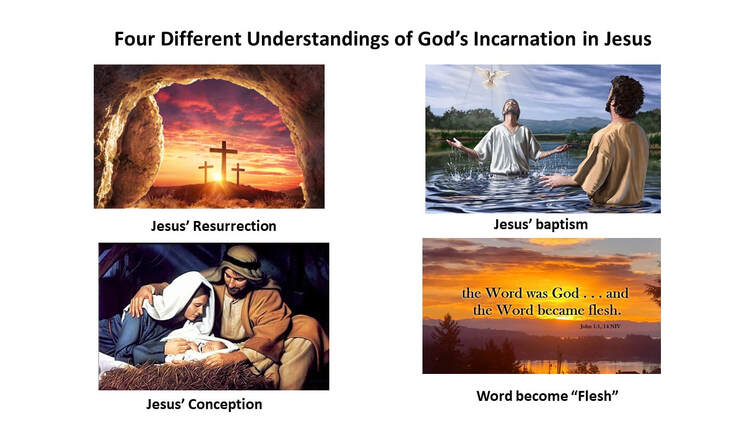 The gospel of John, written some 10-20 years after Matthew and Luke, also has no mention of the birth narratives. Instead, John uses a philosophical mystical argument of how the Word of God became flesh in the human person of Jesus. By this time in history, the members of the Johannine Christian community had elevated Jesus to the status of God. Jesus was now the Great “I Am”, that name that God gave himself in the Jewish story of Moses and the burning bush. Many stories in this gospel reflect the theological beliefs of this early Christian community and contain less the historical details of Jesus’ life. The Four Aspects of Incarnation Four different ways of understanding the incarnation of God in human flesh through Jesus. I want to suggest that each biblical understanding of the incarnation provides a window into understanding what the incarnation really is. Many of you know the parable of the blind men and the elephant. Each blind man was touching a part of an elephant, the trunk, the trail, a leg, a side, an ear, and a tusk. Each were convinced they knew what an elephant was based on their experience, and yet they knew only a small part of the elephant. 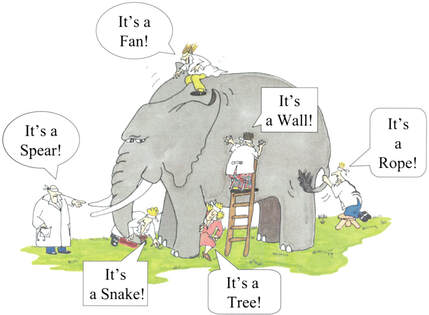 I think a similar dynamic is happening around the 4 different Biblical understandings of incarnation. Through Apostle Paul, we see how the resurrection reveals that Jesus was more than a physical human being. He was a Soul that transcended death. Through Mark’s gospel, we see how Jesus’ baptism revealed to us and Jesus that he was more than a human being: he was also a beloved child of God. Through Matthew and Luke’s understanding of incarnation, we notice that Jesus’s divine and human nature were both present at his conception. Finally, John helps us see how the incarnation involves a mystical union between our human and divine nature, the Word of God becoming physical in the form of the human Jesus. This understanding of Incarnation only makes sense to a Christian. Unless you buy into this Christian worldview, this notion of Incarnation makes little sense. This is why it is hard to talk about the Christian notion of the Incarnation outside the church. This has made me wonder, is there another way to talk about the Incarnation of God that non-Christians might understand, one that possibly helps us get at more clearly the underlying dynamics of Incarnation? Here is where I find quantum physics useful. I think quantum physics provides us a way of understanding the dynamics of incarnation without using Christian language. Let me illustrate. Quantum physics has discovered that light is both a particle (photon) and a wave. Normally, light, and energy in general, have the properties of a wave, like a sound or water wave. When waves bump into each other, they create interference patterns. Scientists have done many experiments with light that create these interference patterns. When light is a wave, we do not know exactly where each particle is. The light photon could be anywhere within the wave, many millions of potential locations. 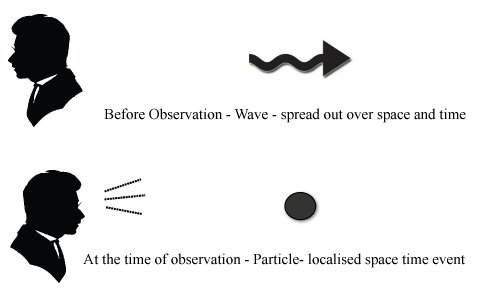 When light is functioning like a wave, it does not function like a particle until someone observes it at a particular location and time. In that moment, the wave nature of light collapses and it now becomes a photon in a particular location and particular time. This is called the observer effect; as soon as something is observed, the wave function of reality collapses and it becomes manifested into earthly reality with mass, location, and time. There may be a similar relationship between energy and mass for energy follows the laws of wave and mass follows the laws of particles. What I have just described where the wave properties of light, energy and reality collapse into a particle, mass, and physical reality could be seen as a scientific description of physical incarnation. I see this scientific incarnational model providing a way of understanding of how the Incarnation happened through a Christian lens, how the Word of God became flesh in the human Jesus and in humans in general. This past month in a spiritual direction session, my directee and I played with this scientific framework and applied it to understanding the Incarnation of God in Jesus and in us. The wave dynamic of reality could be seen as the heavenly realms, divine reality, where the different qualities of God’s spirit exist as potential, waiting to manifest into earthly reality. These qualities include love, compassion, courage, power, joy, resilience, grace, truth/insight, value, peace, etc. All of these qualities are always unconditionally present, waiting to manifest into our earthly reality in response to what is happening there. In contrast, the particle dynamic of reality is the earthly world we live in, where reality manifests in time and physical space. However, it is important to note that this incarnation is temporary, not permanent. Our physical world is constantly changing. Nothing is totally static. All living physical reality involves the cycle of birth, development, aging, and eventually death. Even the cells within our human body are constantly changing, some reproducing, same dying. Nonliving reality also has a life cycle where it manifests from energy into physical reality and eventually over many years, sometimes millions of years, returns to energy. There is one observation I want to make. Our Christian traditions teaches that we, as human beings, are as the word suggests, both human and Being, both human and divine. Within this quantum framework I have described, this suggests that we are both particle, as manifested in our physical body, and wave, as embodied by our soul that is connected to this physical body. Seen in this way, this means that when we pay attention to the dynamics of our soul through prayerfulness, mindfulness, and contemplation, we are noticing the wave of God’s spirit flowing within our soul. As soon as our sense of “I” joins or unites with these dynamics, these dynamics become realized in our physical world through our words and actions. The wave function happening within our soul collapses and becomes manifested into our physical lives and world. The Word of God we sense within our soul like compassion, grace, courage, truth, and resilience becomes flesh through our human actions. This is the incarnation as we, Christians, understand it: The word of God becoming flesh. 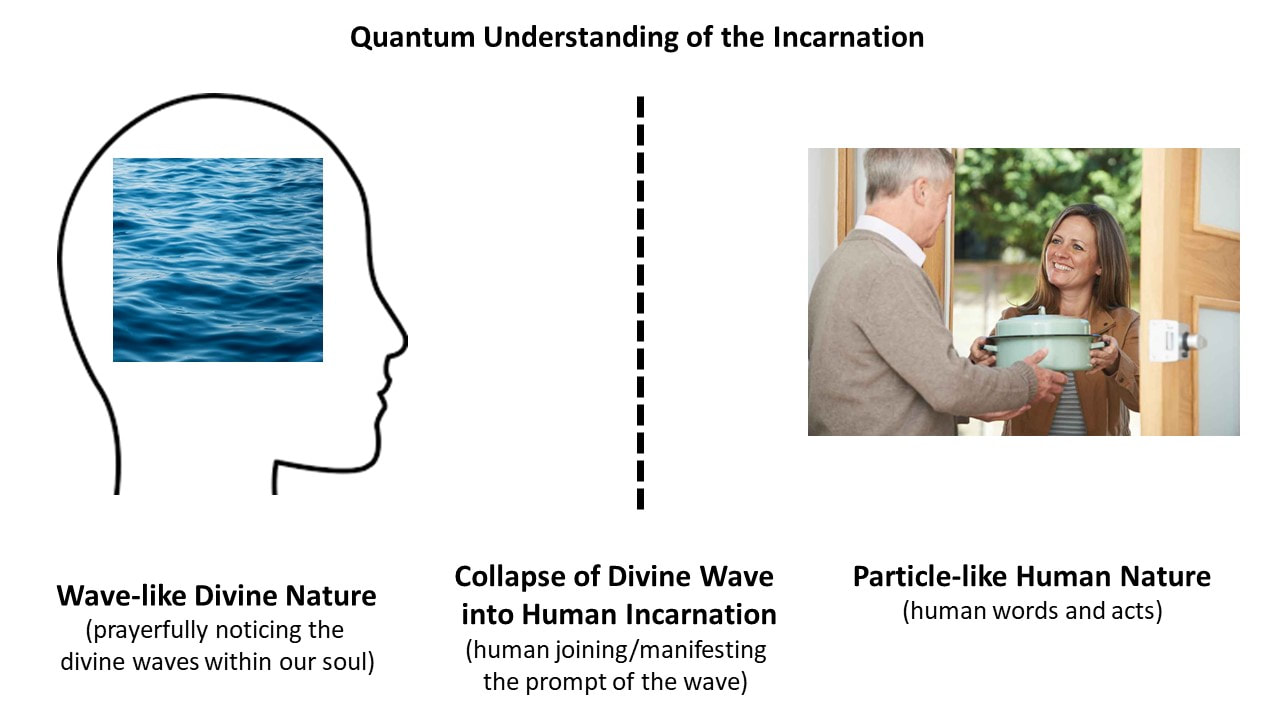 For me, this is how Jesus became the incarnation of God. It was not because God was his miraculous biological father and Mary was his mother. Rather, it was because Jesus was a very contemplative person who was in regular communion with God. As a result, due to Jesus’ prayerfulness, the wave function of God’s spirit within Jesus’ soul constantly was collapsing into various physical manifestations on earth through his teachings, healings, and how he related to the various people he met in his life. This was why people came to see as Jesus as “Emmanuel” which means “God with us” for they experienced God deeply in the presence of Jesus. What made this Emmanuel state possible for Jesus was that God was also Emmanuel to him in a deeply personal intimate way, a way that allowed the wave function of God to manifest in Jesus’ life in very concrete and physical ways.
When we understand the incarnation in this way, we soon see that this dynamic of God becoming flesh is not unique to Jesus. Rather, all humans have this potential for we are all human beings, both human and divine. Just as Jesus was born with both a divine and human nature, so were all of us. Each human being is a child of God. Just as Jesus heard at his baptism that he was a “beloved one” of God, this is true for all of us. God wants all of us to hear, to realize deeply that we are one of God’s beloved children. Just as Jesus manifested his divine nature through abiding daily in God’s loving and gracious presence, so we too manifest our divine nature through abiding each day in Christ’s loving and gracious presence. We are all connected to the vine of God (John 15). Just as Jesus discovered at this death that he was more than his physical body, that he was a soul that transcended death, so all of us will discover at our death we are not just earthly creatures. Our souls too will transcend death. And so in Jesus, we see how we, as humans, can also realize our divine birthright as God’s children. Jesus shows us the way to being incarnations of God ourselves. One could called this the way to our ongoing salvation, where we are made in the likeness of Christ through living it out each day in our lives. This is the amazing truth of God’s incarnation, an incarnation that I think the framework of quantum physics helps us understand in a very real, personal and powerful way. A teaser: What would the Christian notion of sin look like through this quantum framework? There is a huge human temptation to become attached to the physical incarnations that arise in our life like money, youth, sex, beliefs, possessions, people, etc. This leads to many forms of injustices in our world: the "haves" and the "have nots." We resist change. We resist surrendering, trusting, generosity and sharing, and going with the flow of life. We want our lives to be fixed and predictable. We resist allowing the particle nature of life return to its wave-like reality that it came from. Instead, we want to create a God in our own image, one that we can control...which breaks the first two commandments of the Ten Commandments. Gord Alton MDiv RP CASC Supervisor-Educator Over the past year, I have been getting training in the Internal Family System (IFS) framework and integrating this approach into my spiritual direction. In doing so, it has allowed me and my directees to go into deeper territories, territories we could only talk about it before. One of the dynamics I have noticed is that most people have Protector parts within their soul that keep them from experiencing God's Presence and Spirit. In this blog, I want to share some insights about how to pray with Protectors which allow our relationship to the Divine to deepen. 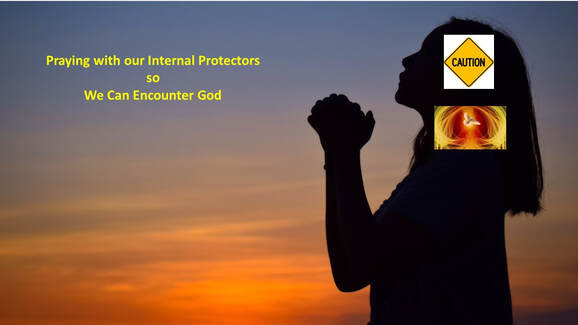 Before I explore the topic of prayer and Protectors, it is important that I briefly review some key aspects of IFS and the human soul. As I have described in previous blogs, Internal Family System perceives the soul having three aspects to it: Exiles, Protectors, and the Self. Exiles and Protectors Exiles are those parts within our soul that contain the pain and trauma of past experiences, often from our childhood, that are unresolved and need healing. These parts contain beliefs, emotions, and memories from these painful times. These parts are called Exiles because these parts are kept hidden away, sometimes so hidden that we are unconscious of these memories. It is important to realize that all of us have Exiles, parts within our soul that we don’t want to talk about or remember. Protectors are those parts within our soul that contain coping strategies that keep us from triggering or feeling the pain located within our Exile parts. Many of these Protectors are proactive in nature meaning that they seek to manage our thoughts, feelings, and behaviors such that the pain within our Exile parts is not triggered. Managing Protectors include staying in our thinking heads, emotional management strategies, numbing our bodies, relationship patterns, avoidance tendencies, distraction schemes, compulsions, etc. Other Protectors are reactive in nature, that is, as soon as significant pain arises, they take over and distract us from our pain. Examples of reactive protectors are fight, flight, and freeze responses, anger/rage, eating disorders, addictions, soothing through food, suicide ideation, sleepiness, impulsions, etc. Together, the Exile and Protector parts make up what Christians might call their fallen nature. I use the term fallen nature purposely because as IFS has discovered, these parts didn’t function like this in the beginning. No, each of these parts had a totally different role when we were born, one that was always life-giving to us and part of God’s design for our soul. However, due to the times of pain and stress we found ourselves experiencing, often in our younger years, these parts of our soul had to abandon these healthy roles and take on necessary, but fallen roles, for the stability of our soul system, either Exile roles or Protector roles. Thanks to IFS, I have come to see these fallen roles as the best life-giving option available at the time for our soul when the overwhelming incident occurred. Otherwise, another coping strategy would have been chosen. This coping pattern may be problematic now, like addiction or suicide ideation, but there was a time when this management tactic was truly a life-giving blessing to our psyche, an answer from God, one could say, to our prayer for help at the time so we could survive and somehow live. (Richard Schwartz's book "No Bad Parts" (2020) is a good place to explore this insight that all parts play an important role in our life. Richard Schwartz is the developer of IFS)  Dynamics of the Divine Self I think we can all relate to having Exile and Protector structures in our soul. But IFS has discovered another aspect of our human soul, what it calls the Self with a capital “s”. The Diamond Approach calls IFS’s notion of Self as the Essential Nature or True Nature of the soul. Within Christianity, we would call it our Divine nature that all humans are born with and is the ground or foundational fabric of our soul. The Diamond Approach teaches that the True Nature of the human soul, when it is free of any ego structures like Exile parts and Protector parts, is where all the qualities of Essence or Spirit arise within us like compassion, joy, strength, will, love, truth, power, etc. IFS has a similar understanding of Self where curiosity, compassion, courage, connectedness, confidence, presence, playfulness, patience, perspective and many other spiritual qualities all can arise depending on what we are experiencing. As a Christian, this understanding of Essence or Self could be seen as the incarnation of the Christ-Self within our human soul, what some Christian mystics call the Indwelling Christ. Many times, the dynamics of the Indwelling Christ are also called the fruits, gifts, or works of God’s Holy Spirit. The Chameleon Nature of our Witnessing “I” There is one final soul dynamic that is crucial to understand before we move to the topic of “prayer and Protectors," namely the witnessing “I”. The concept of the witnessing “I” appears in many spiritual and psychological frameworks. Our witnessing “I” provides that sense of what we experience as “me” or “I”, that is, “this is who I am, what I am thinking, seeing, feeling, experiencing, and sensing in the present moment.”  It is important to understand that our witnessing “I” is like a chameleon. It takes on the qualities that it is centred in. If our witnessing “I” becomes merged with aspects of our fallen nature, we become lost in all the thoughts, emotions, memories, and strong sensations like anxiety and pain associated with that part of our fallen nature. When this happens, our sense of “I” feels trapped and oppressed by the structured nature of this fallen part. However, when our witnessing “I” becomes centred in our Divine nature, our sense of “me” becomes very spacious and free and we discover the spiritual fruit of self-awareness. From this centre in Self, we are now able to notice all the dynamics happening in our souls, both the dynamics of our fallen nature, but also the dynamics of our Divine nature arising in response to what we are experiencing. Having this IFS background in place, let us now explore the theme, “Prayer and our Protectors.” 1. Prayerful interaction with God only happens when we are self-aware, that is, our witnessing “I” is centred in Self. One truth we soon realized with this IFS model is that we are rarely centred in God/Self, even Christians. Instead, we find themselves blending from one part to another part to another part to another part within our soul throughout our whole day. Moments of Being where self-awareness can begin to arise for any period is an uncommon experience for most people. In fact, even for religious people who try to practice prayer or meditation, the experience of self-awareness and Being/Presence may be there for a few moments but it is soon gone. Our sense of “I” soon blends with our thoughts or feelings or memories and we are no longer praying. When this happens, we are merged with one of our Protectors and thus become lost in our mind or experience, even during our times that we have set aside to pray. Why is this blending happening? The Christian response is that it is because of our fallen nature, a nature that no longer is aligned with the will and purposes of God There is truth in that description but it is not helpful for it does not recognize why this blending is happening. Remember an IFS truth I shared earlier: all aspects of our fallen nature were, in the beginning, a life-survival strategy, a blessing that kept us alive. So this begs the questions, how was this distraction pattern a helpful pattern at one time in our lives, maybe still is? 2. Our Protectors keeps us from entering into a prayerful state. To these Protectors, prayer is a dangerous activity.  Prayer, a dangerous activity, how can this be? Just think about what happens when prayer is truly experienced, from an IFS perspective: our sense of “me” unblends from our many Protector parts and now rests in a place of vulnerability in the presence of Self or God. This creates much fear and anxiety to many of our Protectors. To understand the significance of this fear of vulnerability, I want you to consider when this Protector part was formed. Most of our Protectors have their roots in our childhood where the ability for God/Self to manifest in our souls was very restricted due to the developmental limitations of our young physical bodies, hearts and minds. As children, we were totally dependent on how well the dynamics of Self/God were manifesting in parents, teachers, pastors, and other caregivers in our lives. When they fail to protect us during these vulnerable times and we experienced intense pain, we developed Protector structures in our soul whose goal was to protect the wounded little boy and girl parts within us from ever experiencing that type of pain again…through mental distraction, through fighting, fleeing, freezing, avoidance, numbing oneself, and many more coping styles. Now you know why Protectors don’t trust Self/God protecting us when we enter a place of vulnerability, which is what prayer is, a time of vulnerability with Self/God. Seeing this trust issue with our Protectors, how can we help our Protectors trust God/Self more so we can pray and enter a deeper place of vulnerability where we can have a more intimate relationship with God? 3: Unblending from our Protectors allows us to form a prayerful relationship with them where we are rooted in God/Self. As I explained earlier, prayer can only happen when our sense of “I” is not blended with any part of our soul, included our Protectors. When this happens, space opens up between our sense of “I” and our Protectors, and now we can develop a prayerful relationship with our Protector. To help you understand what it means to unblend from our Protectors, let me first help you see what blending with our Protectors might look like when we do centering prayer or meditation. There are many Protectors that arise that keep us from entering that place of being with our experience in the Present Moment where we can sense God’s Presence. 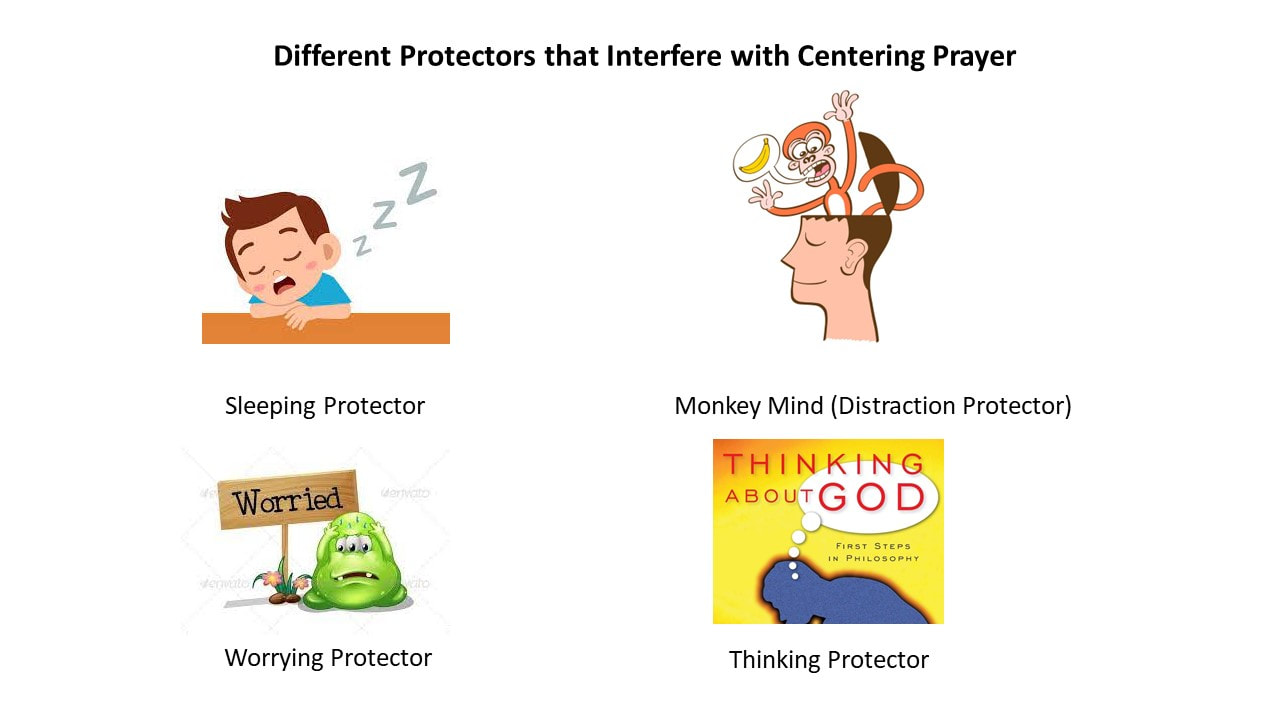 A common Protector is that of sleepiness, where we fall asleep during our time of prayer. Another Protector believes that centering prayer is boring and so looks for ways to stimulate or distract ourselves which often leads to the condition of what Buddhism calls “monkey mind.” As soon as you start thinking about anything, we often become lost in our thoughts and are no longer aware of our experience in the Present Moment. Many times during these times of prayer we find ourselves stewing or worrying about something that is happening in our lives or our children's lives or other people’s lives. When this happens, our sense of “I” has merged with this worrying Protector. Finally, for many people, centering prayer can be a time when we try to pray by thinking about God or talking to God during this silence. But if we never move into a place of receiving when we sit in silence waiting for God to respond to our words or thoughts, then we know that our Protector is the one doing the praying, not our sense of “me”. Prayer involves an intimate interaction between ourselves and God in the Present Moment, and anytime we disengage from this vulnerable place, we know our sense of “me” has merged with a Protector. Seeing how easy it is to blend, what does it means to unblend from our Protectors during centring prayer? Let me play with an example. Let say that we struggle with a lot of sleepiness during centring prayer. That tells us that our sense of “I” often blends with our Sleepy Protector. When this happens, we experience life, in this case, centring prayer through this sub-personality that contains all the beliefs, feelings, body sensations, and memories associated with this sleepiness. What does it mean to unblend from this Sleepy Protector so that we can pray with it? (please see Endnote to see other explanations for why sleep may happening during centring prayer and meditation) For most of us, if we have a problem that we are struggling with, like falling asleep in centring prayer, we ask God to take away our problem. When God does not answer our prayer, we often feel angry at our problem, a sign that our witnessing “I” has now blended with another Protector, an anger Protector that is angry at God for not answering our prayer or angry at ourselves for not being strong enough to rise above our problem, in this case sleepiness in prayer. The result of this prayer is that we become angry or disillusioned with God for not answering our prayer, and become even more stuck with our issue.. 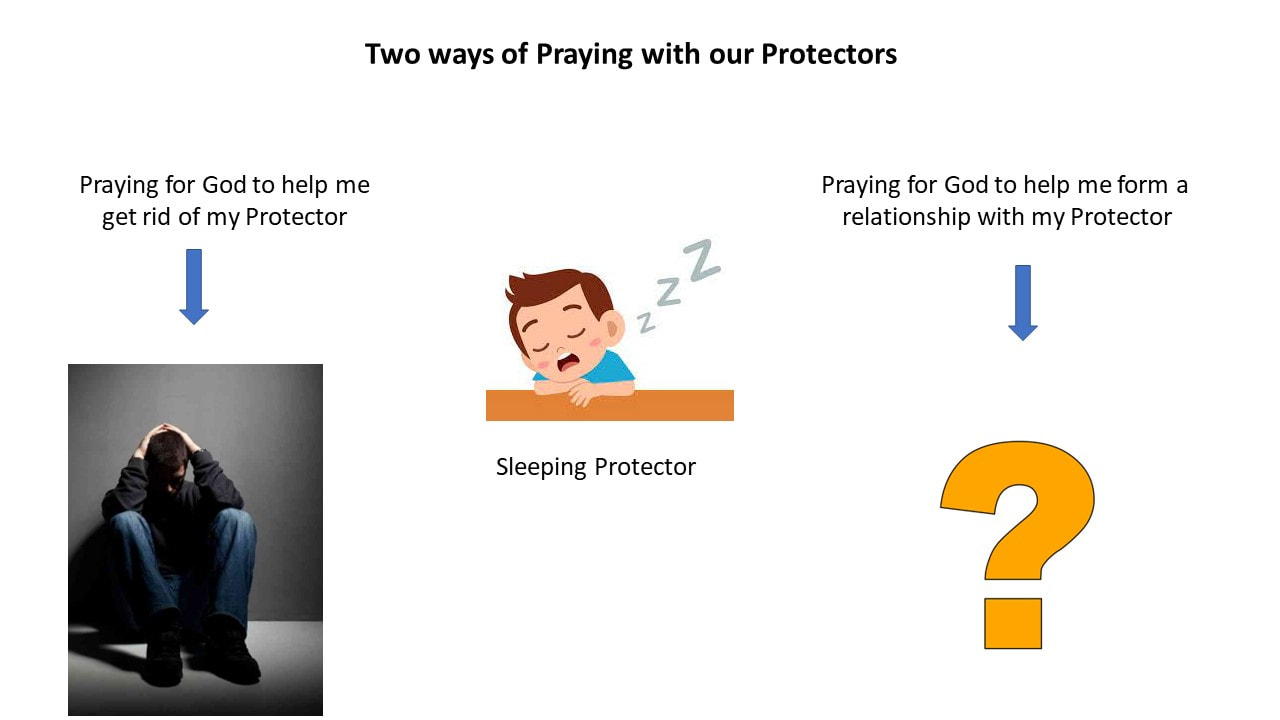 Let me propose another way to approach prayer with our Protector, in this case, a sleepy Protector. Instead of praying for God to take away our Sleepy Protector, we ask God first to help us unblend from this part so that we can form a prayerful relationship with it. When we are merged with our Sleepy part, we become our sleepiness and fall asleep; we have no relationship with it. For us to enter in this prayerful place, we need to find ways to unblend when we feel sleepiness coming on so that we can form a relationship with this Sleepy Protector from a place of self-awareness. To help us enter into this prayerful unblended state of self-awareness, we can ask our Sleepy Protector the following questions:
4. Deepening our relationship with our Protectors allows them to experience the Presence of God/Self through our sense of “me”. One of first signs of Self/Spirit arising in us is that we often begin to feel curiosity toward our Protector, in our example, our Sleepy Protector. This curiosity is the beginning of a relationship forming with this Protector. This curiosity causes us to wonder, how could this Sleepy part be a Protector? How is it protecting me by causing me to become sleepy? 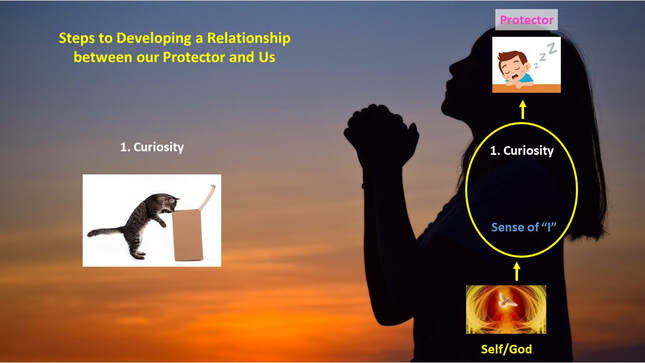 We might begin to wonder, are there other times this Sleepy Protector arises in our life, outside of times where we are trying to do centring prayer? Maybe we notice that we become sleepy every time we are in a place of quiet, where there is little activity or mental stimulation. A key IFS question to eventually ask this Protector is the following: What does it fear will happen if it does not make us sleepy? Don’t allow your mind to quickly answer that question but allow your Sleepy part within your body to answer that question instead. The responses that come provide hints into why this Sleepy part is protecting us. We may feel some anxiety arising, a sign of another part emerging, and if so, we want to be prayerfully curious why that anxiety part is there. IFS teaches us that below every Protector is an Exile part that is waiting to be seen, heard, validated, and cared for, but our Protector is keeping it from our awareness. Knowing this, it is important for us to understand what our Protector fears will happen if it allows us to be with our Exile part or parts now. It may fear that we will become overwhelmed, that that our emotions will be too painful, too much for us to handle, that God/Self will abandon us again. There is truth to this fear for when this painful childhood experience happened, it was too much for us, as a child, to handle and God/Self didn’t stop it from happening. As we prayerfully explore, with God’s help, the why behind our Sleepy part protecting us, we will often begin to feel appreciation toward this part, another sign of God’s spirit arising in our soul. This appreciation is also a sign that our relationship with our Sleepy Protector is deepening. 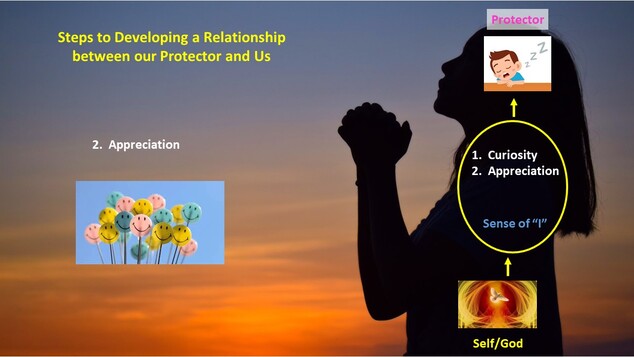 Just because we come to appreciate how our Protector has protected us in the past does not mean that we don't see how this coping pattern also has caused us lots of issues at time. For example, we see how our Sleepy Protector interferes with our ability to trust and deepen our relationship with God and possibly other people in our life. And yet this frustrating realization is tempered by grace as we see more clearly how this Sleepy Protectors has kept us from getting hurt again by becoming vulnerable. One key insight IFS has found is that our Protectors are working very hard to keep us safe and away from possible painful experiences of our Exiles. Some of our Protectors are hypervigilant, always watching to make sure we are safe. Seeing this, we can now understand why our Protectors are so active during prayer times, especially prayers like centring prayer where the whole purpose of this prayer is to become vulnerable to God in the Present Moment. But there is a downside to all this working, from the Protector’s point of view. They are often very tired for it takes a lot of energy to keep our body and soul in a protected, contracted state, and this is also true with the Sleepy Protector. Our Sleepy Protector has to contract our mind, heart, gut, and body so that all stimulation is blocked and we feel sleepy. This type of sleepiness is not restful like the sleep that happens at night as we allow ourselves to relax and fall asleep. (see end footnote around sleep in centering prayer) When we see how hard our Protector has been working to protect us, we often begin to feel compassion toward our Protector, another sign of God’s spirit appearing in us. When that happens, it is important that we express this compassion to our Protectors telling them how much we appreciate what they are trying to do and how hard and tiring it is to do their protective work. Upon hearing those compassionate and understanding words from us, our Protectors will often soften, become less suspicious of us, and trust us more. 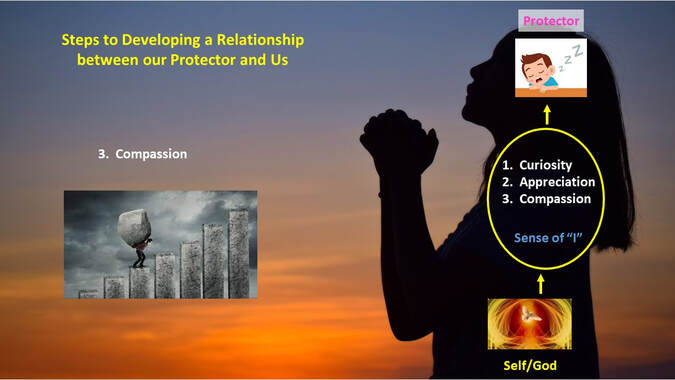 There is one more IFS question that is helpful to ask our Protector, one that is based on the fact that this Protector is a fallen part; it is not actually doing what it was designed to do in our life. In the case of our Sleepy Protector, we could ask, “If a miracle were to happened and you no longer had to do this protective role in my life, what would you rather do?” Again, don’t allow your mind to answer this question too quickly but instead allow your Sleepy Protector to respond. IFS has found the people are often surprised what comes. Sometimes the Protector just wants to rest and do nothing. Other times, it actually wants to have a role that is almost opposite to what it is currently doing. Upon hearing this answer, we can offer our Protector hope that someday soon, with the help of God/Self, we can learn from the Protector how to protect this Exile part, as it has done so for many years now, but also care for it with the possibility of healing our young Exile part. 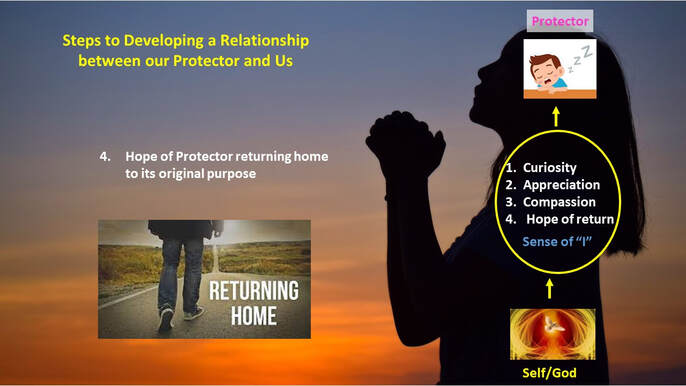 Through this time of prayerfully interacting with our Protector, our relationship with it has changed. Instead of judging our Protector as problematic and sinful, we instead now:
One final but shocking observation There is something else that is important for us to notice, and this is a little shocking for us to realize. Our Protectors see us, when our sense of “I” is centred in Self/God as Self/God, the very Self/God who they felt betrayed by in our younger years when our Protectors were formed. When we see our Protectors in a curious way, our Protectors experience Self/God seeing them with that same curiosity. When we sense appreciation and compassion flowing from us to our Protectors, they experience this appreciation and compassion as coming through us from Self/God. In other words, when we are centred in Self/God, our Protectors and our Exiles experience us as conduits of God’s Sprit or Self, what could be seen as incarnations of God in human form. As our Protectors have more positive experiences with us praying for them and with them, their relationship with God/Self begins to change. They start to trust God/Self more to protect our Exile parts, and thus allows us to spend more and longer times in this place of vulnerability in our prayer times with God. There is still the important topic how we prayerfully let God/Self care for our Exile parts so that our Protectors no longer need to be hypervigilant in protecting our younger Exile parts. But that is for future blogs to explore. Endnote: I should note that a restful form of sleep can also happen in centering prayer for it happens often for me. I used to think that this sleep was due to my Sleeping Protector but don't think this is true any more because of my work in palliative care. Within palliative care, we talk about two types of sleeping. One type of sleep happens when we feel ourselves getting tired, like what happens at night in bed, and then we fall asleep. In this case, when we wake up from this sleep in the morning, we feel tired and groggy, but we slowly wake up. The other type of sleep is very different. You don’t feel yourself falling asleep. You are instantly gone, and then when you wake up, you are not tired but instantly here, alert, very refresh, and ready to go. This second form of sleep is really a person going in and out unconsciousness, and this type of sleep is more refreshing than normal sleep. I see this type of sleep often in Hospice. Many times in centering prayer I experience something like this unconscious state. Some might not call this meditative state a sleep state but rather a state of no mental activity, and so your sense of self-awareness disappears. I no longer see this meditative state as a Sleepy Protector but rather a gift from God that happens for me in prayer. Gord Alton MDiv RP CASC Supervisor-Educator Over two years ago, when I began the Spiritual Care Provider (SCP) role with Lisaard and Innisfree Hospice, I knew this position, which involves primarily visiting Local Health Integrated Network (LHIN) palliative clients in the community, would include helping palliative client explore Medical Assistance in Dying, commonly known as MAID. I am aware that many SCPs struggle with how to respond to MAID and whether one should support MAID. Since MAID was now part of the Palliative Care world, I had two choices, either to express my right of conscious objection, and not be involved with MAID, or to find a way to bring the Sacred into the MAID process. I chose the latter and this blog is a summary of my learnings as I help palliative care clients explore the MAID option around death, and then walk with people as I seek to bring prayers of blessing and comfort into their MAID dying process.  I have been wanting to write this blog for a while but I have struggled with how to begin this reflection until now. This month I attended a memorial service for one of my clients in my private counselling practice who died of suicide. In processing my experience of that suicide, I realized that this is the place I need to begin when reflecting on MAID. Rethinking Suicide Many people equate MAID with suicide and since suicide has and often is viewed in a negative light by the Christian Church and other major religions, MAID is often seen in a similar way. But as was apparent by the memorial service I attended this past month, not all churches believe this, which I am glad. In the past, people who committed suicide were often buried outside the church cemetery for suicide was seen as sin, maybe the unforgiveable sin by some Christians for they believe there is no opportunity left in their life for the person who "committed" suicide to repent of their choice and thus experience God's forgiveness. When we label suicide as sin, we are essentially saying that the person who is struggling with mental illness and suicide ideation is responsible for their death. Thanks to the growing research and knowledge of mental illness, most mental health professionals no longer see suicide as a choice a person makes. How can it be a choice when the person who dies of suicide believes or feels deeply inside that there is no choice, no hope of any other way to relieve the pain they are going through. Suicide feels like, becomes the only option, they have to release themselves of the pain. As I sat in that memorial service for my client, I knew that this was why they died of suicide. The issues around serious mental illness that leads to suicide are not just rooted in the person who is mentally ill. As a psychotherapist who is trained in trauma, I am very aware that mental illness often has its roots in experiences of trauma, painful experiences in a client’s past that have traumatized their soul creating many forms of coping mechanisms that are often labeled as forms of mental illness. So when I was grieving the loss of my client at the memorial service, I was angry, not at my client, but at the traumas they experienced in life that led to their mental health challenges, traumas beyond their control to avoid. But my anger went beyond these traumas. I felt anger at the mental health system and its failure to help this young adult. There are many limitations found within the mental health system that interfere with its ability to help people who are wrestling with mental illness and suicide ideation. The limitations are many. Sometimes, the limitations involve the lack of knowledge and skills in knowing how to treat serious mental illness through medication and/or psychotherapy. I, myself, felt this limitation, and lamented at my inability to help my client more. Sometimes the constraints are due to the lack of financial and/or professional resources available to ensure people with serious mental illness get the help they need. And sometimes, the very sad reality is that some illnesses, when they become severe, are sometimes beyond treatment: death is the only healing option. When suicide is understood in this way, one can no longer see it as a sin in the sense that the person who died by suicide committed a sin. However, we still need to be honest in saying that suicide feels wrong. In the ideal world where we would have unlimited knowledge and resources and skills, suicide would not happened, and yet this is not the earthly world we live in. Suicide does happen, and when it does, we lament the fact that it has occurred. This is what I was experiencing at the memorial for my client who died of suicide.  When we turn to MAID, many people of faith see MAID as a form of suicide: people are choosing to die. However, as I, as a SCP, walk with people as they explore MAID and sometimes chose it, the reasons for MAID are very similar to issues people face around suicide: there is no hope of a better future and the pain they fear or are feeling is too great to bear. The Pain Involved in Dying People often see dying as a physically painful process, and it can be but palliatively trained doctors do everything possible to keep the patient's pain level well-managed, and in the vast majority of cases, it can be. However, some people don't respond well to opioids and so their pain levels are harder to control, and physical pain becomes a bigger issue. Furthermore, when patients start receiving higher dosages of pain medications, they begin to experience the side effects of these drugs: tiredness, dopiness, clouded judgement, hallucinations, etc. Doctors often work closely with patients and their family to find the right balance between pain-tolerance and clear alertness and awakeness. Sometimes this balance is not possible, and so often a pain-free state is chosen by the patient and family through sedation. It is important to realize that the pain behind a MAID request is less about physical pain and more about emotional and spiritual distress. There are a lot of fears and anxieties that arise for people during the dying process. For people who have breathing issues, it is the panic that arises around not being able to breathe, although doctors can often manage this breathlessness through medication. For people who have a need to be in control of their life, they experience intense anxiety as they begin to lose control of it. For some, they cannot imagine losing their ability of using a toilet, and thus experiencing all the potential shame that may arise around uncontrolled bladder and bowel functions, or the need to wear pull-ups. For others, they fear becoming a burden to others, especially to those who they have caregived all their life. For some, it is their fear of what happens upon death...whether it be a judgement that they associate with death and the afterlife due to religious beliefs or simply the unknown. For others, it is fear of potential physical pain toward the end of their life that could arise due to things like tube feeding being stopped. To help people process, manage, and potentially alleviate these many emotions, medication, psychotherapy through spiritual care providers, social workers, and other staff, and emotional/spiritual support provided by family, friends and volunteers are helpful.  As I walk with clients and began to understand the different fears and spiritual distress they encounter around dying, I have come to appreciate why people want to talk about MAID. Like the people who suffer from suicide ideation, they cannot imagine having to experience the reality of their dying process. MAID seems as an attractive legal option. Before MAID Before Medical Assistance in Dying became legal in June, 2016 in Canada, people died naturally using medication as necessary to manage physical and emotional pain as it arose. When physical and emotional pain was beyond what the client could endured, then the client could request palliative sedation. This involves using medication to place the client into a comfortable unconscious state free of pain and suffering. From here, no longer able to eat or drink, which is often what happens in natural death when people are naturally asleep or unconscious toward the end of their life, the person would slowly die over a few days, often surrounded by family and friends. In many ways, one could see palliative sedation as a milder form of MAID. The person is still choosing to die, medication is still used to put the client into an unconscious state, but instead of dying happening over a 10-15 minute period like it does with MAID, it happens over a period of days due to lack of fluids and nutrition. The Arising of MAID The push for the legalization of MAID in Canada first began with Sue Rodriguez in 1993 who had Amyotrophic lateral sclerosis (ALS). She argued that “if I cannot give consent to my own death, whose body is this? Who owns my life.” In 1993, the Supreme Court of Canada ruled 5-4 that prohibition on assisted suicide was not in violation of the Canadian Charter of Rights and Freedoms. Twenty-two years later, Kay Carter, who had severe spinal stenosis, and Gloria Taylor, who had ALS, brought their case to the Supreme Court of Canada based on intolerable suffering. On Feb 6, 2015, the Supreme Court ruled unanimously that “competent adults who are suffering intolerably as a result of a grievous and irremediable medical condition would no longer be restricted from accessing an assisted death.” A year later, in June 2016, Bill C-14 allowing for Medically Assistance Death was passed by the House of Commons. (quotes and facts taken from Powerpoint slides presented by Dr. Martha Taylor and NP Cindy Shobbrook to Lisaard and Innisfree Hospice staff in September, 2022). 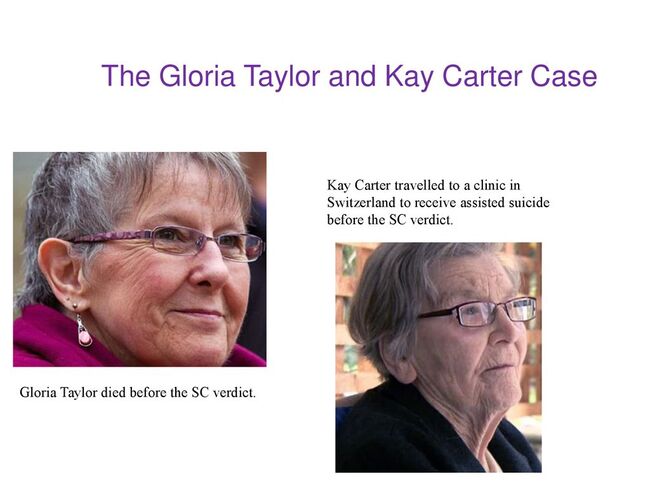 Who Can Receive MAID Based on the latest law involving MAID ( Bill C-7, March 17, 2021), there are currently two pathways to receiving MAID. Both tracks involve the person having a grievous and irremediable medical condition that meets the following conditions:
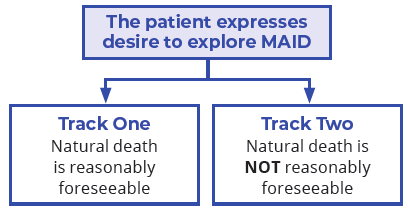 One of the changes that came with Bill C-7 was around capacity. In the original Bill C-14, the person receiving MAID had to have mental capacity at the time of the MAID procedure. Due to fears of losing capacity, this was causing people to have MAID sooner than they needed or wish to. With the new Bill C-7, a person requesting MAID now must only have capacity at the time of requesting and being assessed for MAID. They can then complete a waiver of consent which is “an agreement to proceed with MAID, even if the patient has lost capacity on or before the date of the Waiver Agreement.” This change has allowed clients to be assessed and approved for MAID, but then wait until their health fails more and then they can set the date for MAID to happen. (facts and quote taken from Powerpoint slides presented by Dr. Martha Taylor and NP Cindy Shobbrook to Lisaard and Innisfree Hospice staff in September, 2022). Safeguards around MAID It is important to realize that the decision to choose and do MAID is not taken lightly. There are many safeguards that have been legally put in place. They include the following:
As a SCP, I find that when clients bring up questions of MAID, it provides an opportunity to process their fears around dying, and what is behind these fears. Many are relieved that there is an option that they can legally access if the experience of suffering and pain becomes too great. However, just because people get assessed and approved for MAID does not mean that they will access MAID in the end. Many do not and end up dying naturally. The Stats around MAID Based on the 2021 annual report from the Government of Canada, 10,064 MAID deaths occurred in 2021, 2.2% of them being track 2 MAID deaths where natural death was not reasonably foreseeable (https://www.canada.ca/en/health-canada/services/medical-assistance-dying/annual-report-2021.html). The rest were track 1 MAID deaths. As of March 31, 2021, 2.2 percent of deaths in Waterloo Region happened by MAID, 2.7% in Ontario, and 3.3 percent in Canada. Provincially, the total percentage of MAID deaths in 2019 was 1.7, 2.7 in 2020, and 3.3 in 2021. (facts taken from Powerpoint slides presented by Dr. Martha Taylor and NP Cindy Shobbrook to Lisaard and Innisfree Hospice staff in September, 2022). 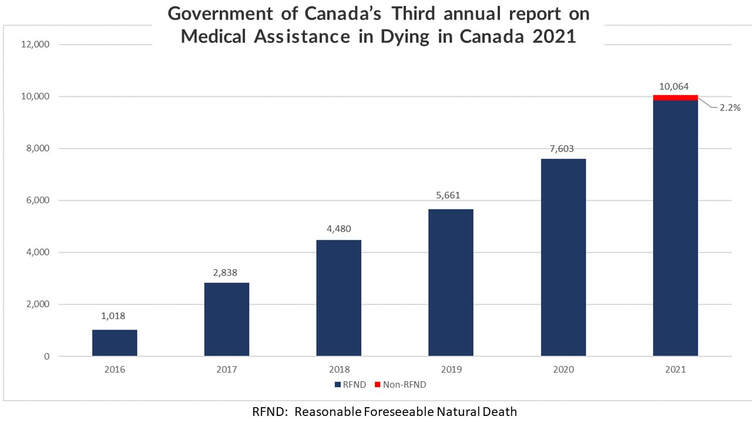 Theological questions around MAID As I help people explore MAID, one of the major theological questions is how MAID can be part of God’s will. This question is in the background of certain negative judgements people make about MAID. Some people have told me that MAID feels like humans are playing God around death, that God knows when we are going to die, and thus people should not interfere with the timing of our death. Some of these people point to the Bible as evidence of their belief. For example, Ecclesiastes 3 is sometimes quoted: “For everything there is a season, and a time for every matter under heaven: a time to be born, and a time to die; a time to plant, and a time to pluck up what is planted”. However, time in this text means that these opposing but connected experiences are a part of life, that life and death are a part of what makes up life. This text is not referring to the belief that God has set a time when we are going to die, and thus we should not tamper with the timing of our death. Another commonly quoted text is from Psalm 139. Here the psalmist writes, “Your eyes saw my unformed substance; in your book were written, every one of them, the days that were formed for me, when as yet there was none of them.” This text suggests that the author of this Psalm believed that every day of our life is recorded within God’s book of life. There is much mystery and debate within Christian theology about how the dialectic tension between human freedom and God’s preordained will plays out in human life. What we can say is that if God knows when tragic death happens to people whether it be death at war, a car accident, or suicide, then God also knows when someone will choose a MAID death. If God is all knowing, as much of Christian theology teaches, then it follows that God knows when we are going to die regardless of how it happens. The bigger question for many critics of MAID, especially for people of faith, is how humans are playing God when people choose MAID. This an interesting argument for many aspects of health care involves medical professionals intentionally intervening with illnesses with the goal of keeping people from dying. Without human intervention, death would occur. Within this context, we don’t consider medical interventions as humans playing God. Rather, medical professionals are following or aligning themselves with the will of God in keeping the person alive, healthy as possible, and able to live a meaningful life. However, within this life context, death is seen as the enemy, and healing involves removing the threat of dying so that the person can still live a fulfilling life. However, death is not always the enemy. There are times in life when death is a friend, even from God's perspective. Within palliative care and the process of dying, we see this truth very clearly. As the experience of suffering deepens and life becomes less and less meaningful, a transition happens within the sick person and their family from seeing death as their enemy to seeing death as their friend. No longer finding life in this earthly world fulfilling, dying people look forward to the cessation of suffering and healing of their soul that comes through physical death. 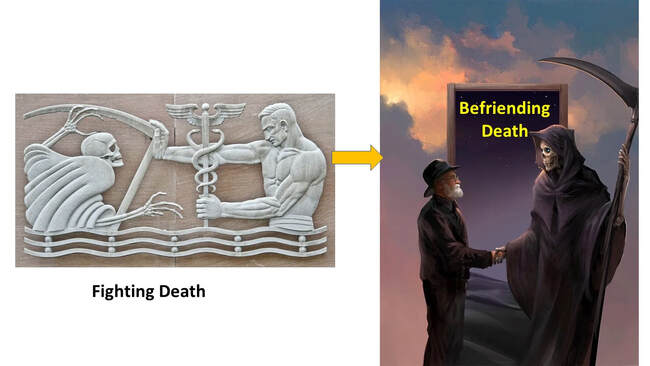 It is in this framework of death being a friend, even in God’s eyes, that Medical Assistance in Dying begins to make ethical sense, even within a faith framework. Just as the goal of medical care is to alleviate suffering within life, does it not make sense that the goal of medical care within context of death and dying is also to alleviate suffering? How can one still say that medical professionals are playing God when performing the procedure of MAID when they are aligning themselves with the will of God through embracing death, at the end of life, as our friend? How to Bring the Sacred into the MAID Process When I decided to be involved in helping people process the MAID question and support them going through the MAID process, if that was their wish, I began to invite clients and families to consider doing a blessing ritual before the MAID procedure happened. For those who took up this invitation, I helped them developed some form of good-bye service that could include music, readings, blessings from family members, and possibly a final blessing prayer, similar to the one I share with family members who are in vigil around a dying loved one waiting for them die. One of the gifts I have found with MAID is that it often causes clients and their families to be more intentional around saying good-bye to each other. Often times, in natural dying situations, family members avoid having these mutual good-bye conversations, and so when family members finally get to the place of having them, their loved one is often unconscious and no longer able to respond to them. I still encourage family members to talk to their dying loved ones during these good-bye times for we know hearing is the last sense that people lose before they die. However, in MAID situations, these good-bye times are often quite mutual and can be very meaningful. I remember a MAID service where a wife and four adult children said good-bye to their dying husband and father. After each family member spoke their final words to their treasured loved one, the dying man responded with his words of blessings to them personalizing them to the person who just shared their good-bye blessing. It was quite touching. And then the family began spontaneously staring story after story of treasured times they had together with him. I had to interrupt them to say a final prayer and then I encouraged them to continue their story telling until the MAID doctor came to do the procedure. In another MAID service, I was with my client, his adult children and his two sisters in his home in Kitchener. In this case, since it was during COVID, I connected them, by a video platform, to his brother and relatives out in Western Canada. As part of the final blessing time, the client asked me to play the song “It is a wonderful world” by Louis Armstrong. I was able to find a video on the Internet which included some introductory reflections by Armstrong that my client really liked. Following the song, I invited his sister to share some final words of blessings and then his brother spoke to us from Western Canada thanking his brother for their friendship and the many good times they shared. My Concerns Around MAID Up to now, I have shared how I see MAID as an important option within the field of Palliative Care, and an option that people should have access to. However, I also have concerns around how MAID will be used in the future. I am not alone in having these concerns. An Angus Reid poll done in January, 2020 revealed that while the majority of Canadians were supportive of people having the option of MAID, there were many concerns around the use of MAID. (https://www.cardus.ca/research/health/reports/broad-support-for-maid-in-canada-has-caveats-and-concerns/)  As I have noted, a lot of the reasons people chose MAID is less about the reality of physical pain and more about the existential distress that people experience as they go through the dying process. As I highlighted earlier about suicide, the reason that people die of suicide is primarily related to the limitations within the mental health field to address existential suffering, limitations due to lack of finances, lack of skilled professionals, lack of personal support from others, or lack of skills and knowledge around how to heal certain forms of mental illness. When people find themselves in this place of despair and hopelessness, suicide appears as the only option to them.
This experience of hopelessness is now expanding as our health and social safety net begins to break down. Due to the breakdown happening within our health care system caused by the lack of public financial funding and lack of professional staffing, people who used to find life meaningful, despite their health issues, are no longer finding this to be true. This is illustrated by a CTV news article (Sept 29, 2022) where a quadriplegic man is seeking MAID due poor home care condition ( https://montreal.ctvnews.ca/i-can-t-live-that-way-montreal-man-seeking-medically-assisted-death-due-to-home-care-conditions-1.6090165). Long Term Care residents are struggling with existential suffering issues due to insufficient staff to handle all the physical and emotional needs of residents in their LTC homes. To deal with this staff shortfall and the behaviors it creates in their residents, this CBC News article (Sept 14, 2022) suggest that many LTC residents are being medicated (https://www.cbc.ca/news/canada/kitchener-waterloo/antipsychotic-drugs-ltc-long-term-quality-of-care-seniors-residents-1.6581068). But the reason people may want to chose MAID in the future may not be entirely related to poor physical health. As one MAID applicant indicated in a CBC New article (July 11, 2022), who has been diagnosed with Long Term COVID, it is totally financial. Right now, Ontario Disability Support Program (ODSP), does not recognize long-term COVID as a disability, but even if it did, this MAID applicant would only get $1,169 which is impossible to live on (https://toronto.ctvnews.ca/ontario-woman-enduring-effects-of-long-covid-begins-process-for-medically-assisted-death-1.5976944). I hope by now you are beginning to see the issue I am highlighting. As people experience more and more intolerable existential suffering due to our health and social network failing to provide adequate care and support, more and more people will apply for MAID. Right now, most of these people will be ineligible for MAID because their sole underlying medical condition (SUMC) is tied to their mental health. However next spring, our government has promised to legalized another path for MAID for those who have mental illness as their sole underlying medical condition. Currently, the majority of persons who have mental illness as their SUMC are not eligible for MAID. This exclusion will be automatically repealed on March 17, 2023. Currently, the Ministers of Health and Justice are working with a team of experts to develop protocols, guidance and safeguards to apply to requests made for MAID by persons who have a mental illness (https://www.canada.ca/en/health-canada/corporate/about-health-canada/public-engagement/external-advisory-bodies/expert-panel-maid-mental-illness/final-report-expert-panel-maid-mental-illness.html#a11). It is important to realize that the issue, as I see it, is not the legalization of MAID. The use of MAID is really a barometer of how well our culture and society care for those who are experiencing existential suffering due to physical and mental conditions. If our health system and social support systems within our governments, non-profits, businesses, faith communities, family and friendship circles are functioning well, then MAID will only be requested in limited situations. However, if our society and culture fails to support well people struggling with health and existential issues, people will naturally seek out MAID as a legal option to escape this world that they experience as having too much suffering. Conclusion In this blog, I have shared my reflections and learnings as I care for people who choose MAID as their spiritual care provider. While I appreciate the reasons that people opt for MAID and understand how MAID can be seen as a valid choice, even within a faith framework, the existence of MAID demands that we, as a society and culture, including our faith communities, families and friendship circles, rise to the challenge of supporting those who are suffering. If we don't, MAID may become the option of choice, and if it does, I think that says more about the failure of our culture and society and its various support networks than it does about the person choosing MAID. Gord Alton MDiv RP CASC Supervisor-Educator In 1967, Elizabeth Kubler-Ross developed a well-known grief framework based on her studies of people going through anticipatory grief. She discovered that people experienced different stages of grief: denial, anger, bargaining, depression, and acceptance. I, like most counsellors, no longer see these aspects of grief as stages that we pass through. For myself who find it helpful to use an Internal Family System (IFS) lens, I see these aspects of grief as parts of our personality within our soul. The purpose of this blog is to highlight the ways I use the IFS framework in providing spiritual care, from a Christian perspective, to people on the dying journey.  As a Spiritual Care Provider and Psychotherapist, the therapeutic relationship with the client and their family is key. Through my counselling training I have been taught to hold my client’s experience with unconditional love, with no judgement, similar to how we, as Christians, imagine Jesus holding the experience of all the people he met in his healing ministry. But as a Christian, I try to take this therapeutic relationship one step further: to not only treat my clients as Jesus would treat them but to be with my clients in the same way Jesus was with the people in his ministry. When we hold people in this way, clients become more open to noticing the dynamics of God's spirit in their experience. Holding my Client’s Experience from an “Abiding in Christ” Place To understand this place of Being, I have been captured by the words that the gospel writer John records Jesus teaching his disciples. Jesus stressed the importance of being connected to the spiritual vine of Christ. We experience this connection to the vine when we “abide in Christ as Christ abides in us” (John 15: 4) I have spent a great deal of time seeking to understand what these words means. I have come to realize that “abiding in Christ as Christ abides in me” refers to a state of prayerfulness, a state where I am centred and fully aware of my experience of life. When I am in this place of Being, my mind is open, my heart is sensitive, and my will is free. Here, in this place of Being, as I listen to my client’s experience, I notice different fruits of God’s spirit arising in my soul in response to what I am hearing, seeing, and sensing. These spiritual fruits include a sense of curiosity where I want to understand more what my client is feeling, a sense of compassion in response to the pain or difficulty my client is undergoing, a sense of grace that allows me to experience no judgement to what my client may share, a sense of truth or insight that helps me find words that resonate to what my client is sharing and experiencing, etc. Within Internal Family System, one of the primary healing modalities I work with, this experience of “abiding in Christ” is called the experience of Self, with a capital “S”. This Self is the centre of the human soul found within every person whether it be the counsellor or client. Each person has a Self, or Divine Self as I prefer to call it, the centre within a human soul that allows everyone to experience what Christian would call the indwelling Christ or God’s Holy Spirit. However, as we all know, it is easy to lose touch with this prayerful centre when we are abiding in Christ, and Christ is abiding in us. This is also true for Spiritual Care Providers like myself when we lose touch with our curious open mind or gracious compassion heart. When this happens, I can easily find myself judging my clients for having negative thoughts, feelings, and behaviors, or find myself trying to fix my clients through giving advice I expect them to follow, or become very frustrated by my client's lack of positive change and healing. All of these experiences are signs that I am not centred in my experience of Christ but rather following the ways of my fallen self. When I work with a palliative client, I seek to hold my client’s experience from this place of Being, where I am abiding in Christ and Christ is abiding in me, where I am centred in my Divine Self. When I visit a client and their family in their home, which is where most of my ministry happens, I find that people have often lost this place of centreness in their Divine Self. Instead, they are lost in their experience of grief and pain around, their illness if they are the dying person, or the illness of their loved one if they are the person caring for their loved one. My goal as a Spiritual Care Provider is to help them regain this spiritual centre in their DIvine Self and the sense that God is holding and ministering to them in their grief. Working with Kubler-Ross Grief Framework but from an Internal Family System’s Lens To understand better this grief journey that dying people and their family travel, I have learned the grief framework that Elizabeth Kubler Ross developed based on her research of anticipatory grief. Anticipatory grief is grief that dying people and their family suffer before death happens. Her research indicated that people tend to pass through five stages of grief beginning with denial, then anger, then bargaining, then depression, and finally acceptance. 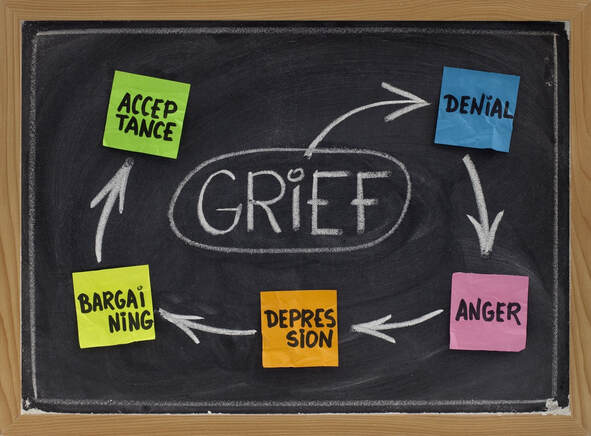 I, like many counsellors, no longer see these aspects of grief as stages that we pass through. For myself who finds it helpful to use an Internal Family System lens, I see these aspects of grief as parts of our personality in our soul. In this blog, I plan to focus on three common parts within our soul that arise as we grieve…namely the Denial part, the Angry part, and the Depression part. My goal is to hold each part as it expresses itself from a place of prayerfulness where I am abiding in Christ and Christ is abiding in me. When we hold our client’s grieving parts in this way, spiritual care begins to happen for my client. Let me explain how I do this “abiding in Christ” holding with each grieving part. Holding the Denial Protector When people first learn that they have a palliative prognosis, they are often in shock. Frequently, people have been living with their disease like cancer or Multiple Sclerosis or other health issue for many months or years before this palliative decision is made, a sign that the current chemotherapy, radiation, or immunotherapy is no longer working, or not anticipated to bring about healing. For other people, there is little warning. They go to their doctor with a health issue expecting it to be easily treated but after tests and scans discover they have a late stage of cancer that is beyond treatment. This experience of shock, and the coping pattern of denial that goes with it, is a Protector part designed to keep clients from feeling overwhelmed by their emotions. 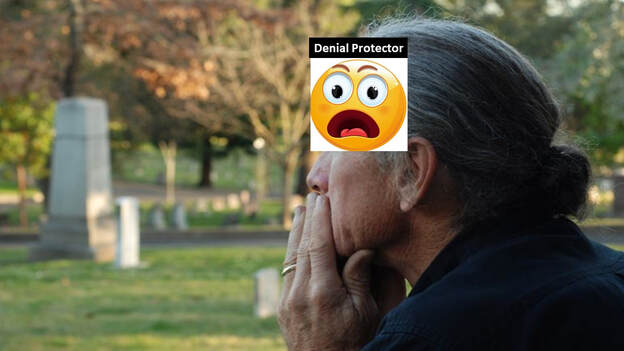 I remember clearly my first visit with a couple who had been married for over 65 years. They had been very blessed financially and lived a life of privilege all of their life building many homes and having travelled all over the world. When the wife learned that she had cancer that was too advanced to be treated and was deemed palliative, her husband and her were in totally shock. This couldn't believe this was possible. As a Spiritual Care Provider, my goal is not to take away my client’s experience of shock and denial. Rather, my task is to hold their shock experience in such a way that I am able to feel their shock with them, to join with their Denial Protector and its shock. This is how Jesus abided with all the people he met. He allowed himself to feel their experience of suffering in life. For this to happen, I allow myself to nurture a spirit of curiosity toward my clients' Denial Protector, and asked them open ended questions that allowed them to begin to share with me what was so shocking to them. As I become curious about their sense of shock, it allows my client's sense of Divine Self to develop their own divine curiosity toward their own shockness…“why am I so shock?” For this couple, it meant realizing that they had always been in control of their life: everything they wanted, they could always get or make happen. To hear their doctor say that nothing could be done was unfathomable for this had rarely happened before in their life. They had seldom been in a place of powerlessness and thus didn’t know how to live with this reality when life was outside their control. Furthermore, this senior couple believed that death happened quickly, often within a few days or instantly. The idea that most people lived through the dying process for weeks or even months right up to the death was beyond their comprehension. They could not, would not, let themselves imagine going through the dying process, and yet this was the place they found themselves. What further complicated things was that this woman with cancer was an introvert and very private person. The thought of sharing her emotional experiences with anyone, even her husband, was totally outside her comfort zone, and so this Denial Protector performed many levels of protecting her. As I explored their story of shockness with them, I began to really appreciate why their Denial Protector within their personality was so active. It was protecting them from experiencing the painful vulnerability and powerlessness that went with their dying process. As my appreciation of their shockness deepened, I began to feel much compassion for my clients and to their individual Denial Protectors who were working so hard to protect them from their pain. As I validated and expressed compassion to the wife and her husband, it helped them also to feel some of this Divine Compassion flow from their deeper sense of Divine Self to their Denial Protectors. This story of shock reminds me of the shock the Bible tells us that the rich young ruler experienced when he heard Jesus’ response to his question about how he could inherit eternal or fullness of life. Jesus told him to sell everything he owned and give it to the poor. We also read that Jesus looked upon with man with loving compassion and sadness just before he told him this response for he knew how shocking it would be for him to hear this. This is how spiritual care can happen when the Denial protector is very active for people due to the shock that arises from learning that they are palliative. Let us turn now to the Anger Protector around grief. Holding the Anger Protector Shock arises from the client’s belief that this suffering cannot be happening. In contrast, anger emerges when clients believe this suffering should not be happening. In many ways, the Anger Protector within people fights with the reality of dying with the goal of trying to keep death from happening. For some people, this Anger Protector means fighting death at every turn, trying every possible treatment option even if the possibility of cure is low and the side affects are severe. 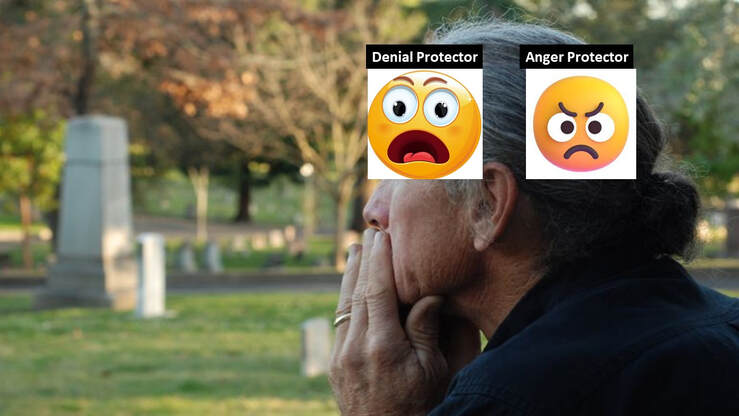 As a Spiritual Care Provider, my goal is to help people become curious about their Anger Protector with the hope that we learn why this Protector is working so hard. This means that I need to nurture a curious spirit within me toward this Anger part so that it keeps me in an open, nonjudgemental place of being with my clients. As you hold a client’s Anger Protector with a graceful stance, you, along with your client, soon begin to appreciate why this Anger part is so dominant. One thing you learn quickly is how Anger is a Protector feeling. When we feel anger, we often feel strong inside, instead of weakness. However, in feeling this anger, we lose touch with our vulnerability. When we explore what our Anger Protector fears will happen if it stops being angry at life, or at God, or at the reality of death, or at the medical professionals, we soon discover that their Anger Protector fears vulnerability. It does not want us to experience helplessness or guilt or shame or weakness or being out of control. And yet, without allowing us to enter this place of vulnerability, it is not possible for us to sense the experience of Being and all the different movements and qualities of God’s spirit. I remember one client I visited where his Anger Protector caused us to spend many visits processing the Why question. He had experienced many health issues throughout his life but with a serious cancer hitting him in his 60’s, he knew he couldn’t beat this illness. And so he wanted me to help him answer the why question. He believed that he had already suffered enough in life. Why was it necessary, from God’s perspective, for him and his family to suffer more due to an early death? Why? Through processing the two brothers’ death from HIV/AIDS in the 1990’s, I have sought answers to the why question many times. Intellectually, I have come to appreciate the gift of suffering and pain, and even death within life. If we lacked the ability to feel pain and suffering, we would not be compassionate and sensitive to the pain and suffering of others. If physical death was not possible, that we could physically live forever, we would discover life would have no meaning, no purpose…there would be no reason to love or care or protect anyone. All the things that make humans special, the way we think and feel and love, would disappear from the face of the earth. The experience of suffering and death is what causes our soul to grow and mature. From the head’s perspective, I understand fully what 2 Cor 4 is teaching when it says, “do not lose heart. Even though our outer nature is wasting away, our inner nature is being renewed day by day. For our slight, momentary affliction is producing for us an eternal weight of glory beyond all measure, because we look not at what can be seen but at what cannot be seen, for what can be seen is temporary, but what cannot be seen is eternal.” But my heart rebels against such thinking for it still believes that it was not right for my brothers to die…it was unjust, not fair. And I have come realize that God experiences pain, suffering, and death in the same way we do...this ability of feel pain and suffering is part of our Divine Nature. This is why our hearts will always feel the wrongness of suffering and death. While pain and suffering and death is a necessary part of life, they are not the purpose or goal of life. So my heart has lots of room to feel and hold the Anger Protectors of my client who are asking God why: "Why is this happening to me or my loved one?"; "This is painful, this is not right”. In holding this anger in this way, I help my client’s Divine Self to hold their Anger Protector within them in a similar compassionate and nonjudgemental way. I have a lot of compassion toward those who have strong Anger Protectors and why these Anger Protectors are working so hard. There is a rightness in these Anger Protectors within our clients and ourselves as spiritual caregivers that we need to validate and honour, and God wants us to honor too. One could see these Anger Protectors like the prophets in the Old Testament who were often anger at God and at the injustices within life and the world. I have found that once my client’s Anger Protectors feel validated by both myself and by their Divine Self, they soften and allow my client to move into more vulnerable territories with their experience. Holding the Despair Exile Part I have indicated that our Denial and Anger parts of our personality are Protectors. The reason Internal Family Systems calls them protectors is because they are protecting us from feeling another part within us, a part these Protectors don’t want us to feel. This is why this rejected part within us and our clients is called an Exile part. Our Denial and Anger Protectors are trying to keep this part in exile, hidden away from our awareness. 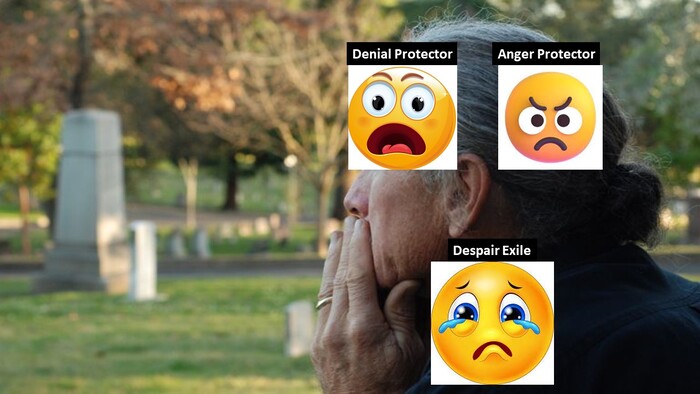 When our client’s Denial Protector and Anger Protector have been held well by a Spiritual Care Provider, that is, they have experienced curiosity, compassion, and validation from me, these protectors soften for they begin to trust the Divine Self that they are experiencing from within me and possibly also from within my client. Through befriending these Protectors, I learn a lot about the Exile part they are protecting within each of my clients. I have learned that these Exile parts are often quite young. This means that these Despair Exiles are carrying not only the pain from their current grieving process but also from all the traumas this person has experienced throughout their lives. These Protectors didn’t just appear when my client discovered they were palliative and dying. No, these Protectors formed early in my clients' lives due to past painful experiences and now they are active again due to the experience of dying and grief. One of the big revelations in my palliative care work is that dying is a traumatic experience. Trauma, by definition, arises from any experience that threatens our survival. Often, we associate trauma with different forms of abuse, physical, emotional, and sexual, or post-traumatic stress disorder that happens through witnessing war, violent deaths or acts, or other scary events. But the process of dying, especially to our Egoic Self, is also experienced as trauma. Furthermore, because dying is often experienced as traumatic, it touches into a person’s previous times of trauma for within the human soul, these traumas are all emotionally connected. Now, you can appreciate even more why the Denial and Angry Protectors are so active when death enters the picture. These young Despair Exiles, being triggered again by the trauma of dying, are often overflowing with many negative emotions, and so the Denial and Anger Protectors work overtime to keep everything under wrap so our soul does not become overwhelmed and traumatized again. This explains why our clients’ protectors of Denial and Angry Protectors are so busy. But there is something else that is really important to notice. The Despair Exiles these parts protect are very lonely for they are constantly being denied, dismissed, shunned, criticized, sometimes even emotionally abused by their Protectors, and hidden away in exile in their unconscious. When I, as a Spiritual Care Provider, have earned the trust of our client’s Denial and Anger Protectors, and they allow me to access the young Despair Exiles, I hear many stories of despair, disillusionment, depression, guilt, shame, fear, and pain. Since these stories have been rarely told, there is often a lot of pent-up energy and emotion that needs to be shared. When these types of visits happen, they are often emotionally intense, and often long for there is much that this Despair Exile of my client wants to share. Again, my role as a Spiritual Care provider is to hold them as Christ would hold them and to allow the spirit of curiosity, compassion, graciousness, insight, etc. to arise in me as I listen, support, and interact with them. It is not uncommon to hear this Despair Exile express words that echo of Psalm 22, words that Bible scholars believe Jesus uttered when he died on the cross, “My God, my God, why have you forsaken me? Why are you so far from helping me, from the words of my groaning? I cry by day, but you do not answer; and by night but find no rest “(Ps 22:1-2). The client’s Exile part has felt abandoned by others, life, and God. And this is very true. This is why I always validate this experience and share words of compassion and grace. Because the client’s protectors of Denial and Anger have been so active, the client has rarely entered the vulnerable space of Being where the spirit of God could interact with his/her Despair Exile and all the pain it carries. It was not possible. This Exile part has felt truly abandoned by God.  Realizing this, you can appreciate why there is such relief when this Despair Exile finally gets a chance to share its pain, and why it is often in such a rush to share it. The Despair Exile fears being abandoned again by God, others, and the Protectors who are trying to keep these negative energy and emotions contained. Accepting The Reality of Dying and Death Throughout this blog, I have highlighted the importance of the Spiritual Care Provider holding and validating the different personality parts of the dying client or their family, to hold and be with the Denial Protector, the Anger Protector, and Despair Exile parts of grieving people in the same way Christ would hold and be with them. In doing so, something mysteriously happens. As the client's Denial Protector feels held, validated and understood by the Divine Self located within the Spiritual Care Provider and the client, it softens and begins to trust that maybe it does not need to protect the young Despair Exile so much, that possibly the Divine Self within the SCP, client, others, even life itself, can provide the healing, support, and guidance necessary to transform and calm the Despair Exile. The same is true around client's Anger Protector. As it feels held, validated, and understood by the Divine Self with the SCP and client, it too softens and begins to realize that it possibly does not need to protect the Despair Exile so much...that possibly the Divine Self within the SCP, client, others, even life itself, can provide the healing, support, and guidance necessary to transform and calm the Despair Exile. As the Denial and Anger Protectors risk trusting the Divine Self of SCP and their client by stepping back from their protective roles, the Despair Exile within the client finally is able to share its painful experiences and story including its fears, concerns, and hopes around their dying and death. When this sharing happens and the Despair Exile part of the clients feels heard, validated, and cared for by the Divine Self within the SCP and the client and others, much pain is released, understanding emerges, and healing happens. As this healing gradually occurs, dying clients and their families slowly move into what Kubler-Ross called the acceptance stage of grief.  Questions to Ponder:
1. Reflect on your times of loss and grief in your life. How did you experience the dynamic of shockness and denial in your life around this loss or these losses? What were the different ways you practice denial in your life...numbing, avoiding, distracting, being busy, medicating, etc. What did your Denial Protector fear would happen if it didn't deny the reality of the loss? 2. How did you experience anger around your loss or losses? What or who were you angry at? How did this anger express itself? What why questions did you process? What did your Anger Protector fear would happen if it stop being angry and allowed yourself to be more vulnerable? 3. Explore you Despair Exile, that part of you that the Denial and Anger Protectors shield you from encountering. What difficult feelings and experiences of trauma are hidden within this Exile part? 4. When you have felt heard, held, and validated by another person? When have you experienced the gentle curiosity, compassion, validation and guidance from someone listening to you? What was it like to be held by the Divine Self of another? How did that experience help you become centred in your own experience of Divine Self and thus able to unblend from your Denial Protector, Anger Protector, and Despair Exile parts? Last month I explored why so many people who long to experience a deep sense of love toward self struggle for this to happen. To sense this gracious loving sacred presence, people need to move into a place of vulnerability, a place where their hearts and minds are sensitive and open. However, as I noted last month, entering into this vulnerable being state is very difficult for we have structures like the Inner Critic in our soul/personality that resist vulnerability. Furthermore, our Inner Critic often criticizes and expresses words of anger and self hatred at us as part of its strategy to keep us from becoming vulnerable. No wonder we struggle to experience God’s love and self love. How do we get out of this spiritual knot around love? The secret to untying this spiritual knot involves love, but love in a surprising way, namely loving our Inner Critic. The purpose of this blog is to explore what it means to love our Inner Critic part for in doing so, it opens the way for us to experience more often and deeply the love of God and our love of self.  For us to experience a deep internal love for self, we need to somehow help our Inner Critic step back from its role of protecting us. When our Inner Critic, and its partner Inner Manager, are active, they form a protective internal wall around our fragile younger vulnerable parts that carry the pain and memories of our past and childhood. Until these Protectors settle down and step back from this protective stance, there is little opportunity for us to enter into a more vulnerable open state where we can possibly sense compassion, love or grace flowing toward us from others and God. This is what happens when we learn to bring love to our Inner Critic. How the Inner Critic Formed In my last blog, I share how our Inner Critic formed. It is a Protector structure that formed in our soul during times in our past when we encountered overwhelming negative energies like anxiety, fear, and powerlessness. To survive such difficult incidents, our soul created two structures, a young Exile part that contains the distressing memories filled with emotions, beliefs, and images, and Protector parts, like the Inner Critic, whose goal is to protect us from entering future situations that may trigger these Exile memories. Now you know why Protectors, like our Inner Critic, are so active in protecting us from entering states of vulnerability. It sees vulnerability as dangerous for it was during one or more such vulnerable times when overwhelming distress flooded our soul and almost destroyed us. Based on those few painful past moments, our Inner Critic often sees every time of vulnerability as potentially dangerous.  Inner Critic Distrusts the Sacred But there is one other insight that I want you to see beyond the Inner Critic’s fear of vulnerability. I have noticed that Protectors like the Inner Critic are very distrusting of God’s spirit. Think about that for a moment. Moments of trauma arose when God’s incarnational spirit failed to manifest within our childhood environment to protect us. So, from our Inner Critic’s viewpoint, trauma happens because God failed in protecting us as children. As a result, our Inner Critic, and Protectors like it, were formed to make up for God’s failure to protect us. No wonder our Inner Critic is often suspicious of God, even anti-God at time through their internal negative chatter and the feelings they create within us around God. (Personally, I actually see the formation of Protector structures in our soul, like the Inner Critic, as God’s backup plan when trauma happens to us due to lack of support from others in our life.) This is the seemingly hopeless internal situation that every person finds themselves in to some or greater extent...where our Inner Critic and Exiles are locked in their emotional positions. Our Inner Critic keeps us from vulnerability and often does this through harsh criticism and words of self-anger and self-hatred. No wonder it is hard for us to experience love from God and love toward self. In contrast, our Exile parts seek vulnerability for that is where caring, comfort, and compassion and all the fruits of God’s spirit arise from. How can we move from this hopeless situation? Learning to Love our Inner Critic This is where I have found again the Internal Family System (IFS) framework so helpful. Instead of seeing our Protectors, like our Inner Critic, as the problem and often rejecting them by seeing them as the enemy, IFS invites us to love our Protectors and see them in a totally different light. In many ways, IFS invites us to practice the teaching of Jesus to love our enemies (Matt 5:44), in this case, our internal enemies.  What does it mean to love our Inner Critic, especially when our Inner Critic often says or thinks such cruel things about ourselves? It involves developing a love relationship with our Inner Critic, one step at a time. Lets look at each step briefly to understand how this love develops. Step 1: Separating from our Inner Critic For us to begin to love our Inner Critic part, we need to see and experience the Inner Critic as separate from us, separate from our sense of “I”. Without this separation, it is not possible to form a love relationship with our Inner Critic. This is why I often ask clients where they experience the Inner Critic. Most people say in their heads or outside their heads. Some people connect their Inner Critic to a critical voice that is speaking negatively at them. Others connect it to intruding negative thoughts about themselves. The key purpose of these questions is to help people notice that their Inner Critic is not them...but a structured part separated from their sense of “I”. Step 2: Becoming Curious of our Inner Critic Once, we notice that the Inner Critic is a part in us, and not us, we can then move to forming a relationship with it. This happens by exploring how our Inner Critic works. When is this part active? What triggers it? When does it arise? What circumstances? What tone of voice/thought does it use? How are you affected when your Inner Critic is active? Within IFS, Inner Critic parts are seen as Protectors. That should cause us to pause for we often don’t experience them as our protectors. If anything, we often see our Inner Critic as demanding, critical of us, angry at us, even hateful of us. They often cause us much shame, fear, and emotional harm through their angry critical words. How can they be protecting us when they feel like they are harming us? This is a very good question... especially when IFS sees them as Protectors within our soul. How could such internal harmful behavior be actually protecting us? Jay Earley, co-author to “Freedom from your Inner Critic”, and a major promoter of IFS therapy, says it this way, “one of the startling discoveries about our Inner Critic is that they are actually trying to help us…In its own distorted, confused way, your Inner Critic is actually trying to help you. At first this may seem surprising, but once you get to know your Critic in a deep way, you’ll come to understand why it is attacking you. It may be negative and harsh, but it is doing so in a distorted attempt to protect you from pain. (p 8). When counsellors have clients investigate these types of questions and ideas about the Inner Critic, they are trying to encourage the client to become curious of their Inner Critic part. Eventually, IFS encourages them to ask, “How do you feel toward your Inner Critic?” The purpose of this IFS question is to invoke the client’s essential Self and notice how their Self is relating to the Inner Critic part. If our client responds with words like “I hate this inner critic” or “It makes me nervous”, that tells us, as counsellors, that there is another client part blending with the client’s sense of “I”. In these cases, we invite this angry/hateful part or fear part to step back, to unblend from the client’s sense of “I” so that the client can experience a fuller sense of their Self. And then we, as counsellors, ask the question again, “how do you feel toward your Inner Critic now?” Eventually, after doing this unblending process a few times, the client will respond with words like “I am curious about my Inner Critic” or “I wonder how it protects me” or “I am curious where it came from” and so on. (to learn more about unblending from your Inner Critic, see chapter 4 in Earley’s book “Freedom From Your Inner Critic”)  That curiosity, a quality of God’s spirit, is a sign of God’s nonjudgmental love arising toward our Inner Critic. Instead of judging it as bad or the enemy, we feel a curiosity toward it and wonder how our Inner Critic functions in our life, and how it might actually be a Protector in disguise. This curiosity opens our mind causing us to ask deeper questions around how our Inner Critic actually works. Step 3: Beginning to Appreciate our Inner Critic This curiosity opens up more space between you and your Inner Critic. However, “it is also important to develop a relationship <with it> in which it trusts that you appreciate its efforts and roughly share its goals” (Earley, p. 37). To form a relationship with your Inner Critic, you begin by asking questions like, “when did you first become aware of your Inner Critic? Who does the Inner Critic remind you of when you were young: a teacher, a parent, a family member, etc. Is its tone similar to someone in your childhood?” When a non-judgmental relationship begins to form between the client’s “I” or Self and his/her Inner Critic, you can then ask the client another key IFS question, “what does your Inner Critic fear will happen if it does not criticize you, if it does not shame you when you make a mistake, etc.” Often, in response, the client’s Inner Critic will reveal its core fear. This fear provides a huge clue to how our Inner Critic is a Protector, and what young Exile part it is trying to shield. Our Inner Critic might reveal thoughts like, “If I didn’t berate him, he would be lazy and never finish his task and get hurt, like what happened with his Dad when he was young”; “If I didn’t yell at her and keep her scared and small, she might do something bold that will cause her to get severely hurt like she did as a little girl in her family”; “If I didn’t scold him when he does something imperfect, he will continue to make mistakes and get really hurt by someone.” You can see in all these statements that the Inner Critic is trying to protect its host through its critical thoughts and voice, a negative behavior that it sees as not near as dangerous and abusive as the original traumatic incident that our Inner Critic fears will happen again. As we understand how our Inner Critic protects us, we also notice the younger exile parts that it is trying to protect. In the first example, the Inner Critic is trying to protect a little boy exile part from re-experiencing the pain caused from being accused of being lazy by his Dad. In the second case, the Inner Critic is shielding a young girl exile from speaking her mind so she won’t get abused again. In the third instance, the Inner Critic is trying to make the man act perfectly so his little boy exile won’t be distressed again for failing to live up to his parents’ ideals around perfection. Once we understand how our Inner Critic is a Protector, we can begin to perceive how its negative and painful behavior actually protects us in a strange way, despite how it makes us feel. Rather than hating our Inner Critic, we now may begin to appreciate the role it has played in our life, another aspect of love. It is often helpful to express mentally words of appreciation to our Inner Critic when this feeling of appreciation emerges.  Step 4: Experiencing Compassion toward our Inner Critic However, feeling this appreciation toward our Inner Critic does not dismiss the harm our Inner Critic creates in our life through its critical and shaming dynamics. This begs the question of whether our Inner Critic could do its protective role in a different way, one that is not near as painful to us. Before we can help our Inner Critic explore doing its protective role in a different way, we need to understand why it is doing its protective role currently. This means we need uncover the origins of our Criticized Exile Child and begin to form a relationship with it, without blending or getting lost its pain. (Check out Chapter 6 “Uncovering the Origins of Your Criticized Child” in Earley’s book Freedom from your Inner Critic to learn how to do this). As we, counsellors, invite our client to explore why their Inner Critic protects their Child Exile that way it does, we often discover a few common things. First, we learned that it is not easy for our Inner Critic to change. Our Inner Critic feels trapped in its role and can’t imagine protecting in any other way for that is what it has done all its life. It is important to remember that our Inner Critic took on this Protector role reluctantly for the sake of keeping our internal system stable following the trauma. Furthermore, our Inner Critic feels very much alone for every one judges it as bad, sometimes evil, even though it is trying to protect our Exile parts from experiencing trauma again in our lives. Finally, we discovered that our Inner Critic is quite tired of its protective role, especially when it has been triggered. Due to its hypervigilant nature, it is always on guard against vulnerability and other activities that may lead us to getting hurt. As we understand how hard, trapped, and lonely our Inner Critic feels in trying to protect our traumatized Child Exile, the experience of compassion begins to emerge in our soul toward our Inner Critic. When this happens, it is helpful to mentally express words of this compassionate understanding to our Inner Critic. This is another expression of Divine love arising in our soul toward our Inner Critic. Step 5: Offering Hope to our Inner Critic When our Inner Critic experiences curiosity, then appreciation, and finally compassion from our sense of Self, it begins to soften considerably. This positive attention from our Self is a totally new experience for our Inner Critic for our Self was not strongly present when the original distress happened that formed our Inner Critic often due to developmental reasons (we were a young child when it happened). Now with our Self directly relating to our Inner Critic, our Inner Critic begins to trust our Self.  However, our Inner Critic cannot imagine giving up its protective role until our Exile is released of the traumatic pain and beliefs it is carrying. The presence of this traumatic pain is why our Inner Critic took on its protective role in the first place. It is here that Richard Schwartz, developer of IFS, says that we become hope merchants to our Protectors, like the Inner Critic (Schwartz, p. 199). We help our Inner Critic realize that its future can be different. We, as counsellors, ask if our client’s Inner Critic will allow us and our client’s sense of Self to care for the young Exile part that it has been protecting all these years with the promise that we can healed this Exile of its traumatic part. Most Inner Critics, after experiencing the curiosity, appreciation, and compassion of our Client’s Self, are open to this invitation, and so step back and allow the counsellor and their client’s Self to minister to this unhealed Exile part. Part of this healing involves the client’s Self and counsellor becoming a compassionate witness to the trauma the young Exile went through. Another part of the healing involves inviting the Exile part, when it feels heard and trusts the Client’s Self, to leave its painful place in traumatic memory and move to the Present Moment where the client’s Self resides. In this present moment, the trauma is no longer playing out and the young Exile part can finally rest and do what it wants. Much more could be said about this healing process but I refer you to one of many IFS books that explain in great detail how this healing process works. (See chapter 7 “Healing Your Inner Children” from Earley’ book Freedom from your Inner Critic to learn more.) Step 6: Encouraging our Inner Critic to Pursue Its Preferred Role With our Exile part now experiencing life in the present moment, it is no longer living in constant fear of pain. This means that our Inner Critic no longer needs to play its protective role of scaring or shaming our young Exile for it is now safe. The polarization between the Inner Critic and traumatized Exile is gone for they are both free of their past pain.  With this shift, our Self can encourage our Inner Critic, another aspect of Divine Love, to pursue a different role, one that it may actually enjoy doing and be closer to its original purpose within our life. Sometimes this role may be one of discerning, helping us discern what is true and not true, but now it does this discernment in a gracious way, no longer criticizing or shaming us. Other times, its role, at least for the moment, is simply to rest and enjoy life for it is tired from all the stress and hypervigilance it has practiced all our life.
Conclusion What I have described in this blog is the journey of what happens when we learn to love the enemy within us, our Inner Critic. Depending upon how much trauma we have experienced in our past determines how harsh and powerful our Inner Critic is, and thus how long our healing love journey is. In severe cases, the Inner Critic can have a demonic feel to it, a strong hatred toward us that feels evil. However, even in those cases, the pathway to healing is one of love, although it takes longer for us to unblend from our parts so we can access our Divine Self. It also takes longer for our Inner Critic to respond and trust the various forms of love that arises from our Self, namely curiosity, appreciation, compassion, hope, and in the end transformation. Questions to Ponder: 1. How do you experience your Inner Critic? Critical voices at you? Negative thoughts about yourself? When does your Inner Critic get triggered: When others critique you? When you feel you have let others or yourself down and failed to meet theirs/your expectations? 2. For those of you who are aware of your Inner Critic, explore how your Inner Critic could be trying to protect you through its behavior, keeping you small, insecure, weak or powerless so you don't say or do something that will bring negative attention to yourselves. Consider what your Inner Critic might fear would happen if it stopped its critiquing or demeaning behavior? 3. This blog explores how our experience of Divine Love can grow toward our Inner Critic allowing our Inner Critic to transform. First, this love shows up as curiosity toward our Inner Critic and how it works, then appreciation for the role it plays in protecting us, then compassion for how hard it works (always watching) to keep us safe, and finally in offering it hope through being transformed by healing the young exile it is protecting. What are the different ways you have expressed love, or would like to express love to your Inner Critic? Bibliography Early, Jay and Weiss, Bonnie. Freedom from your Inner Critic. Boulder: Sound True, 2013. Schwartz, Richard and Sweeney, Martha. Internal Family Systems Therapy. New York: Guilford Press, 2020. Gord Alton MDiv RP CASC Supervisor-Educator |
 RSS Feed
